
Key takeaways
- Five cedar bird houses compared for bluebirds and wrens, with notes on predator guards, clean-out doors, ventilation, mounting and materials.
- Top Pick: Woodlink NABB Audubon Cedar Bluebird House
- Runner-up: Wild Wings WWCH3 Cedar Blue Bird Box House
- Also consider: Cedar Alpha Bluebird House, 2-Pack
Cedar has been the default material for backyard nest boxes for generations, and for good reason: it tolerates rain and sun without paint or treatment, it insulates the nesting cavity against temperature swings, and it is light enough to mount on a pole or post. For bluebirds, though, the box itself is only part of the decision. Entrance sizing, predator protection, ventilation and a way to clean the box out between seasons all shape whether a house gets used and whether the birds that move in stay safe. Wrens ask for something different again: a smaller house suited to a smaller bird.
The five houses below are all cedar and all sold for the backyard, but they split into clear camps: a full-featured bluebird box, simpler traditional designs, a two-pack for yards with room for more than one territory, and one wren-specific house. Where a listing does not state a specification, that is noted plainly rather than filled in with a guess.
As an Amazon Associate, we earn from qualifying purchases.
Quick answer
For most backyards, the Wild Wings WWCH3 is the most complete cedar bluebird box here, with ventilation, a clean-out door, fledgling kerfs and a predator guard. The Woodlink NABB and Coppertop models suit buyers who want a simpler cedar box, the Cedar Alpha 2-pack covers two mounting spots, and the Audubon wren house fits smaller wrens.
Woodlink NABB Audubon Cedar Bluebird House

The Woodlink NABB is the traditional entry in this group: a cedar bluebird house from the Woodlink Audubon line, built around the classic nest-box format. For buyers who want a straightforward cedar box without added hardware or feature lists, it is the simplest option here.
The honest caveat is how little the captured listing evidence states beyond the essentials. The material is cedar, the model is NABB, and the house is made for bluebirds; entrance-hole diameter, internal dimensions, ventilation arrangement and clean-out access are not stated in the evidence gathered for this guide. That does not make it a poor box, since the classic format exists because it works, but buyers who need a specific entrance size confirmed before ordering should check the full product details carefully, because nothing beyond the name, material and model is confirmed here.
Within this group, the NABB suits buyers who already know the standard bluebird box pattern and want it in cedar from an established bird-products line.
Specs:
- Material: Cedar
- Model: NABB
- Target species: Bluebirds
- Additional specifications: Not stated in the listing evidence
Wild Wings WWCH3 Cedar Blue Bird Box House

The Wild Wings WWCH3 is the most fully specified bluebird box in this group. Sold under the Nature’s Way Bird Products brand and manufactured by Wild Wings, it is a cedar box that adds the features experienced nest-box keepers look for: wall and floor ventilation to move hot air out of the cavity, a clean-out door so old nesting material can be removed between seasons, and fledgling kerfs, the grooves inside the front panel that give young birds a foothold when it is time to leave the box.
It also includes a predator guard at the entrance, which helps discourage reaching predators from disturbing the nest inside. The listing gives clear mounting guidance as well: place the box 4 to 6 feet high, facing south or southeast. That orientation keeps the entrance away from prevailing weather in many regions while giving the box morning sun.
For a single-box purchase, this is the easiest recommendation in the group, because the important working details are stated rather than left to guesswork.
Specs:
- Brand: Nature’s Way Bird Products (manufacturer: Wild Wings)
- Model: WWCH3
- Material: Cedar wood
- Ventilation: Wall and floor ventilation
- Clean-out: Clean-out door
- Interior: Fledgling kerfs
- Predator protection: Predator guard included
- Mounting guidance: 4 to 6 feet high, facing south or southeast (per listing)
Woodlink Audubon Coppertop Cedar Bluebird House
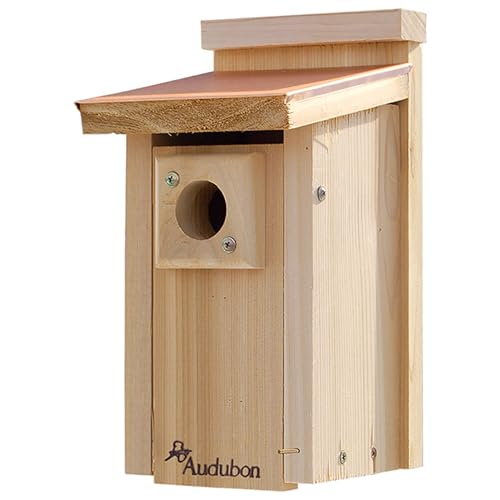
The Woodlink Audubon Coppertop, model NACOPBB, takes the same classic cedar bluebird format as the NABB and changes the roof: the top is copper, per the listing name and model. A copper top gives the box a different look in the garden and a roof surface that weathers to a patina over time rather than staying bright.
As with the NABB, the captured listing evidence is brief. Cedar construction and the copper top are confirmed; entrance size, ventilation, clean-out access and dimensions are not stated. Buyers comparing it directly with the WWCH3 should note that the WWCH3 states those working details openly, while the Coppertop’s appeal is the classic format plus the roof material.
It suits buyers who want a traditional cedar bluebird house with a more finished appearance on a fence line or garden post, and who are comfortable with the standard box pattern rather than a long feature list.
Specs:
- Material: Cedar, with copper top
- Model: NACOPBB
- Target species: Bluebirds
- Additional specifications: Not stated in the listing evidence
Cedar Alpha Bluebird House, 2-Pack
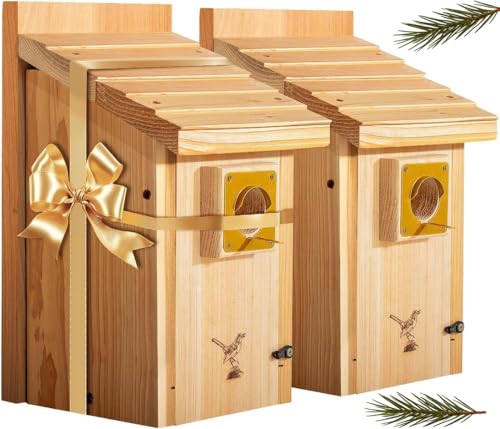
Bluebirds defend the territory around their nest box, which is why committed bluebird yards often run several boxes spaced well apart rather than a single box in the middle of the lawn. The Cedar Alpha package speaks directly to that approach: it is a 2-pack of bluebird houses made from western red cedar, so two mounting spots can be covered with matching boxes.
Each house includes a metal predator guard at the entrance, a meaningful addition for boxes mounted where raccoons or cats could reach in. Assembly is required, so the boxes arrive as a small project rather than ready to hang; for most buyers that is a short job, but it is worth knowing before ordering.
For a larger yard, a line of boxes along a fence, or a shared purchase between neighbours, the 2-pack format is the practical difference here. Buyers with one small garden will likely use only one box and should compare the single houses above instead.
Specs:
- Material: Western red cedar
- Pack size: 2-pack
- Predator protection: Metal predator guard
- Assembly: Assembly required
- Target species: Bluebirds
Audubon Wren House, Red Cedar

The Audubon Wren House shifts the target species. It is built from red cedar and sized for wrens, which are smaller birds than bluebirds and use smaller houses. Wrens are energetic backyard singers that readily use nest boxes placed near shrubs and garden edges, and a house made for them is a different purchase from a bluebird box rather than simply a smaller version of the same thing.
Beyond the red cedar material and the wren sizing, the listing evidence is minimal: entrance dimensions, mounting hardware and clean-out arrangement are not stated. As with the simpler bluebird boxes above, the confirmed facts are the material and the intended bird, and buyers who need more detail should read the full product listing before ordering.
It is the pick in this group for gardeners whose yards already host wrens, or who want to encourage them, and it pairs naturally with a bluebird box elsewhere in the garden since the two species use different houses.
Specs:
- Material: Red cedar
- Target species: Wrens
- Additional specifications: Not stated in the listing evidence
How to choose
Start with the bird. Bluebirds and wrens need different houses, and a box bought for the wrong species usually sits empty. If bluebirds are the goal, choose from the bluebird boxes; if wrens already sing in your shrubs, the wren house is the relevant pick.
Next, look at protection. A predator guard at the entrance, as fitted to the WWCH3 and the Cedar Alpha houses, discourages reaching predators, and it matters most on boxes mounted where climbing animals can get to them. Clean-out access matters once a season ends: old nesting material should be removed so the box is ready for the next brood, and a clean-out door like the one on the WWCH3 turns that into a quick job. Ventilation in the walls and floor helps the cavity shed heat on hot afternoons, which is worth weighing in warm climates.
Mounting completes the picture. The WWCH3 listing’s guidance, 4 to 6 feet high and facing south or southeast, is a sound pattern for bluebird boxes generally: high enough to deter ground predators, low enough to clean and check, and turned away from the worst of the weather. Finally, treat unstated specifications honestly. Where a listing does not confirm an entrance size or a dimension, check the full product details before ordering rather than assuming the standard figure.
Who should skip
Skip this group if you want a purely decorative house to hang as garden ornament, since these are working nest boxes and their value is in the details that serve the birds. Skip them if you are unwilling to clean a box out once a year, because a nest box that is never emptied quickly stops being useful. If your yard is a small enclosed patio with no open ground or perch points nearby, bluebirds are unlikely to use any box, and a feeder would be money better spent. And if the birds in your garden are wrens only, the four bluebird boxes are the wrong size; go straight to the wren house.
FAQ
How high should a bluebird house be mounted?
The WWCH3 listing gives 4 to 6 feet high, facing south or southeast, and that is a sensible pattern to follow for the other bluebird boxes here too. It keeps the entrance clear of ground predators while leaving the box low enough to open and clean without a ladder.
Do these houses need to be cleaned out?
Yes. Old nesting material should be removed after the breeding season so the box is ready for the next one and does not harbour parasites. A clean-out door, like the one on the WWCH3, makes the job simple; where a listing does not state how the box opens, check the product details before buying.
Can bluebirds and wrens share one house?
Not at the same time, and the houses are sized differently for a reason. Bluebirds need the larger bluebird boxes; wrens use smaller houses like the Audubon wren house. Many gardens run one of each in different spots, since the two species are not competing for the same box.
Why choose cedar over other materials?
Cedar resists rot and insect damage without paint or chemical treatment, it insulates the nesting cavity against heat and cold better than thin plastic or metal, and it stays light enough to mount on a post. That combination is why every house in this group is built from it.
Final verdict
For a single bluebird box with nothing left to guesswork, the Wild Wings WWCH3 is the strongest choice here: ventilation, clean-out door, fledgling kerfs, a predator guard and clear mounting guidance are all stated in its listing. The Cedar Alpha 2-pack is the pick for bigger yards that need two guarded boxes. The Woodlink NABB and Coppertop cover the traditional end of the market, with the Coppertop adding its copper roof, though both leave most specifications unstated. And for wrens, the red cedar Audubon wren house is the only correctly sized option in the group.
FAQ
How high should a bluebird house be mounted?
Do these houses need to be cleaned out?
Can bluebirds and wrens share one house?
Why choose cedar over other materials?
More from Amazon
Programs that pair well with the guide above. Offers and eligibility are set by Amazon and may change.
Free shipping on eligible items, Prime Video and more. Eligible new members can start with a free trial.
Start a Prime free trialAudiobooks and podcasts to listen to on the go. Eligible new members can start with a free trial.
Try Audible freeAd-free music streaming. Eligible new subscribers can start with a free trial.
Try Music Unlimited freeA free business account with business pricing and bulk-buying tools for work, shop or home office.
Create a business accountAs an Amazon Associate we earn from qualifying purchases.





Write Your Review
No reviews yet. Be the first to share your experience!