
Key takeaways
- Compare five wide snow pushers and combo shovels built for long driveways, from a 42-inch pusher to a wheeled steel blade, with specs and tips.
A long driveway changes what a snow shovel needs to do. Narrow scoop shovels force you into dozens of extra passes, and every pass is another chance to stall out in deep or heavy snow. For most long, paved driveways, the smarter tool is a wide pusher: a broad, mostly flat blade you walk behind, rolling snow off to the side in continuous passes instead of lifting and throwing it load by load.
This guide compares five manual pushers and combo tools sized for long driveways, from a 42-inch extra-wide pusher down to a 24-inch combo shovel that earns its place at the end of the driveway, where the plow ridge piles up. Each pick is covered with the specs its product page actually states, so you can match blade width, blade material, and weight to the driveway you clear.
As an Amazon Associate, we earn from qualifying purchases.
Quick answer
For a long paved driveway, start with a wide pusher: the 42-inch MANPLOW PRO covers the most ground per pass, and the 40-inch MANPLOW RevolutionX adds a tall, reversible blade. The 30-inch Snowplow is the lighter classic option, the wheeled GarveeTech suits anyone who wants the tool to carry the load, and the 24-inch Suncast combo handles the plow ridge.
How to choose
Blade width drives pass count. On a long driveway, width is the spec that matters most. A 40- to 42-inch pusher can clear a typical two-car driveway in a handful of walking passes, while a 24-inch tool roughly doubles that. Wider is not always better, though: the wider the blade, the more snow it gathers, and wet snow gets heavy fast. If your storms are usually wet and dense, a 30-inch pusher is often the practical ceiling.
Pushers move snow; they do not lift it. A pusher works by sliding snow along the surface and off the edge, which is why it shines on long, flat, paved runs. It is the wrong tool for deep drifts, steps, or gravel, where the blade catches. Many households pair a wide pusher for the main run with a smaller combo shovel for the apron, the walkway, and the ridge the street plow leaves behind.
Blade material shapes durability and glide. High-density polyethylene and UHMW polyethylene blades are light, resist sticking, and slide well on pavement. Steel blades are heavier but scrape packed snow and thin ice layers more aggressively. A galvanized wear strip on a lighter blade is a middle path: it protects the edge that does the scraping.
Weight matters over distance. On a short driveway, a few extra pounds barely register. Over a long driveway, you push the tool the full length dozens of times, so a pusher in the 5- to 9-pound range feels very different from one near 30 pounds. Wheeled designs shift that weight onto the wheels, which helps on flat pavement but adds bulk in storage.
Match the tool to your typical snowfall. Light, dry snow a few inches deep is pusher weather. Deep or wet snow may need to be cleared in stages, mid-storm, before it gets too heavy to push. Keep each pick’s stated limits in mind rather than assuming one tool covers every storm.
MANPLOW PRO Snow Pushers (PRO with Power U Handle Upgrade, 42″)

The widest pick in this guide, the MANPLOW PRO pairs a 42-inch blade with the brand’s Power U Handle Upgrade, a U-shaped aluminum handle with an ergonomic grip that lets you push with both hands spread wide. That stance suits long, straight runs: you lean in, walk, and let the blade carry a broad ribbon of snow to the edge.
The blade is high-density polyethylene, which keeps the whole tool at 9 pounds despite its size. Polyethylene also tends to shed wet snow better than bare metal, and it will not rust in a damp garage corner. At 42 inches, this is a pusher for genuinely wide, open driveways; on a narrow drive or one broken up by parked cars and tight turns, the width becomes a liability rather than an advantage.
Specs
- Blade width: 42 inches
- Blade material: High-density polyethylene
- Handle: Aluminum, Power U Handle Upgrade, ergonomic grip
- Weight: 9 pounds
The Snowplow The Original Snow Pusher (30 Inches)

The Snowplow is the long-running name in this category, built around a 30-inch blade of virgin UHMW polyethylene. UHMW is the slick, abrasion-resistant plastic used where low friction matters, and here it helps the blade glide and shrug off the scraping that chews up softer blades. The listing describes it as a tool to push, chop, and scrape, which covers the packed layer that forms at the bottom of a snowfall.
At 5.09 pounds with a D-grip, it is the lightest full-size pusher in this guide and easy to hang on a garage wall between storms. The 30-inch width is a sensible middle ground: wide enough to keep pass counts reasonable on a long driveway, narrow enough to stay manageable when the snow turns wet. The listing notes it is made in the USA.
Check the Amazon product page for current availability.
Specs
- Blade width: 30 inches
- Blade material: UHMW polyethylene
- Grip: D-grip
- Weight: 5.09 pounds
MANPLOW RevolutionX Snow Pusher with U Handle (40 Inch)
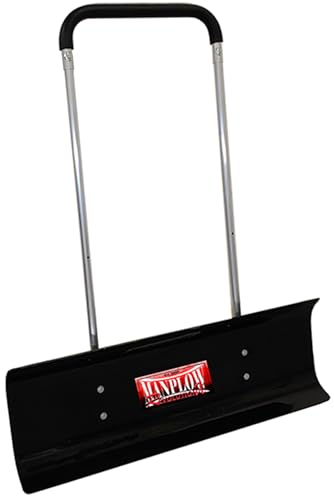
The RevolutionX takes a different approach to blade wear. Its blade stands 15.5 inches tall and is made of high-density polyethylene nearly a quarter inch thick, and it can be rotated top to bottom and replaced when an edge wears down. A tall blade matters on a long driveway because it holds a deeper roll of snow in front of you instead of spilling it back over the top on every pass.
The aluminum U-handle gives the same two-handed pushing stance as the PRO model, and at 8.23 pounds the tool stays light for its size. The brand positions it for redistributing more snow and clearing faster, which is exactly the job on a long run after a moderate storm. As with any wide pusher, deep and heavy snow is best taken in partial-width passes so the load in front of the blade stays pushable.
Check the Amazon product page for current availability.
Specs
- Blade width: 40 inches
- Blade height: 15.5 inches
- Blade material: High-density polyethylene, rotatable and replaceable
- Handle: Aluminum, U-handle
- Weight: 8.23 pounds
GarveeTech 30 Inch Wheeled Snow Shovel

The GarveeTech is the outlier here: a 30-inch heavy-duty carbon steel blade mounted on 10-inch textured wheels, with a handle that adjusts to five positions and a blade that sets to five angles. The wheels carry the tool’s considerable weight, so instead of dragging a loaded blade you roll it, angling the blade to windrow snow off to one side as you walk.
That design makes sense for long, flat driveways and for anyone who finds a loaded pusher hard on the back and shoulders. The trade-offs are real: at 29.8 pounds it is by far the heaviest pick in this guide, and the wheels that help on smooth pavement are of little use on gravel, grass edges, or deep unbroken snow. The aluminum handle’s height adjustment does help dial in a comfortable pushing posture for the length of the run.
Specs
- Blade width: 30 inches
- Blade material: Carbon steel
- Handle: Aluminum, adjustable to 5 positions
- Blade angles: 5 adjustable positions
- Wheels: 10-inch textured
- Weight: 29.8 pounds
Suncast 24 Inch Combo Snow Shovel Pusher with Galvanized Wear Strip

The narrowest pick earns its place by doing two jobs. The Suncast combo has a flat edge for pushing and a curved back for collecting and lifting, so it handles the spots a wide pusher cannot: the plow ridge at the apron, the strip along the garage door, and the walkway. Its galvanized steel wear strip protects the working edge and helps it scrape down to pavement.
Suncast states this tool is best for dry snow 3 to 4 inches deep on smooth paved surfaces, and that limit should be taken seriously. It is not a deep-snow tool and not a gravel tool. Within its lane, though, it is light at about 5.1 pounds, has a simple D-grip handle, and pairs naturally with any of the wider pushers above as the second tool in a two-tool setup.
Specs
- Blade width: 24 inches
- Type: Combo pusher and shovel
- Wear strip: Galvanized steel
- Grip: D-grip
- Best for: Dry snow 3 to 4 inches deep on smooth paved surfaces
- Weight: 5.1 pounds
Who should skip
Skip wide pushers entirely if your driveway is gravel, deeply rutted, or mostly steps and tight landings; a pusher blade catches on uneven surfaces and cannot lift snow up a step. Skip the 42-inch MANPLOW PRO if your driveway is narrow or usually holds parked cars, since the blade needs open room to be worth its width. Skip the GarveeTech if your surface is anything but flat pavement, or if you need to carry the tool up stairs to storage. And skip the Suncast combo as your only tool if you regularly get snow deeper than a few inches at a time.
FAQ
Is a snow pusher better than a regular shovel for a long driveway?
For paved driveways and light to moderate snow, usually yes. A pusher clears by walking and sliding snow aside, so it covers a long run with far less lifting than a scoop shovel. A regular shovel is still better for deep snow, drifts, and spots where snow has to be lifted and thrown.
How wide should a snow pusher be?
Match width to your driveway and your snow. Blades from 30 to 42 inches suit long driveways, with the widest blades best reserved for light, dry snow on wide, open pavement. If your snow is often wet and heavy, a 30-inch pusher is easier to keep moving.
Can a pusher handle the ridge left by the street plow?
A wide pusher can move a fresh, loose ridge, but a compacted plow ridge usually needs chopping and lifting. That is the job the combo shovel in this guide is for: break the ridge up, then push or lift it clear in sections.
Do polyethylene blades hold up on concrete?
High-density and UHMW polyethylene blades are made for paved surfaces and resist the abrasion of concrete and asphalt well. They wear gradually at the edge rather than bending, and on the RevolutionX the blade can be flipped or replaced when the edge wears down.
Final verdict
For most long, paved driveways, the MANPLOW PRO 42-inch is the headline pick: the widest blade here, a two-handed U-handle, and only 9 pounds to push. The RevolutionX is the better choice if blade wear is your concern, thanks to its tall, reversible, replaceable blade. The Snowplow remains the light, proven 30-inch option, the GarveeTech serves anyone who wants wheels to carry the load on flat pavement, and the Suncast combo is the right second tool for ridges and edges, within its stated 3- to 4-inch dry-snow limit. Pick the width your driveway and your typical storm can actually handle, and the clearing goes faster either way.
Product and ASIN Reference
| Product | ASIN |
|---|---|
| MANPLOW PRO Snow Pushers (PRO with Power U Handle Upgrade, 42″) | B0B9DPSKRR |
| The Snowplow The Original Snow Pusher (30 Inches) | B00BVC8058 |
| MANPLOW RevolutionX Snow Pusher with U Handle (40 Inch) | B08V8658XW |
| GarveeTech 30 Inch Wheeled Snow Shovel | B0G4MTQ2QC |
| Suncast 24″ Combo Snow Shovel Pusher with Galvanized Wear Strip, D-Grip Handle | B0DN23DTZ4 |
FAQ
Is a snow pusher better than a regular shovel for a long driveway?
How wide should a snow pusher be?
Can a pusher handle the ridge left by the street plow?
Do polyethylene blades hold up on concrete?
More from Amazon
Programs that pair well with the guide above. Offers and eligibility are set by Amazon and may change.
Free shipping on eligible items, Prime Video and more. Eligible new members can start with a free trial.
Start a Prime free trialAudiobooks and podcasts to listen to on the go. Eligible new members can start with a free trial.
Try Audible freeAd-free music streaming. Eligible new subscribers can start with a free trial.
Try Music Unlimited freeA free business account with business pricing and bulk-buying tools for work, shop or home office.
Create a business accountAs an Amazon Associate we earn from qualifying purchases.




Write Your Review
No reviews yet. Be the first to share your experience!