
Key takeaways
- Pin vs pinless firewood moisture meters compared: how each type reads, when to test a split log, and five meters with ranges, modes and depth limits.
A firewood moisture meter answers one practical question: is this log dry enough to burn well, or is it still holding too much water? The two designs answer it differently. A pin meter drives two small probes into the wood and measures electrical resistance between them, giving a percentage reading at the depth the pins reach. A pinless meter rests a flat sensor pad on the surface and reads moisture below it without leaving holes. If you split a log and test the fresh face, a pin meter gives a direct number for that spot; if you want to scan many pieces quickly without marking them, a pinless meter is faster. This guide compares the two approaches, then walks through five meters: three pin models and two pinless models.
As an Amazon Associate, we earn from qualifying purchases.
Quick answer
Choose a pin meter if you want a direct percentage from the freshly split face of a log, and a pinless meter if you want fast, mark-free scans of stacked wood. The General Tools MMD4E and TESMEN TWM-186 are straightforward pin picks, the Mecurate adds eight wood scales, and the pinless Klein ET140 and General Tools MMD7NP read below the surface without pins.
How to choose
Start with how you will actually test. Firewood dries from the outside in, so the surface of a log almost always reads drier than the centre. The reliable routine is to split a piece, then test the freshly exposed face right away, ideally in a couple of spots. Pin meters are built for exactly that: the pins reach into the wood and report moisture at that depth. Pinless meters read a volume of wood beneath the sensor, convenient for scanning a whole stack, but the reading blends surface and deeper moisture together.
Next, look at the measurement range and the wood scales. Firewood is generally considered ready to burn at around 20 percent moisture or below, so any meter here covers the range that matters. What differs is how the meter handles species. Dense hardwoods and lighter softwoods conduct differently, so better pin meters offer calibration scales for different wood groups, and better pinless meters offer separate softwood and hardwood modes to keep readings comparable across a mixed pile.
Finally, be honest about what each reading type means. A pin meter and the General Tools pinless model below report percentages for wood. The Klein ET140 is different: it reports relative readings only, a comparison scale rather than a true percentage. Relative readings still help you judge one log against another, but they never tell you a log sits at a specific percentage.
General Tools MMD4E Digital Moisture Meter
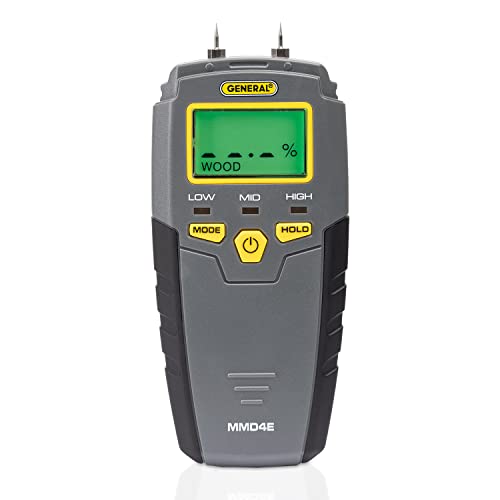
The MMD4E is a long-running pin design aimed at exactly the split-and-test routine. You push the stainless steel pins into the wood and read the result on a backlit LCD. Its wood range runs from 5 to 50 percent, comfortably bracketing the zone firewood passes through as it seasons, and it also covers building materials from 1.5 to 33 percent, so the same tool can check a damp wall. Low, medium and high moisture levels are flagged with audible tones and on-screen icons, making quick sorting of a pile easier. A HOLD button freezes the display, handy when the pins sit in an awkward spot.
Specs
- Type: Pin meter with stainless steel pins
- Wood range: 5 to 50 percent
- Building materials range: 1.5 to 33 percent
- Display: Backlit LCD with 0.3 inch digits
- Alerts: Audible and visual high, medium and low moisture alerts
- Extras: Spare 8 mm pins included; protective cap doubles as a calibration checker
- Battery: 9V battery included
- Warranty: 1 year
Check the Amazon product page for current availability.
TESMEN TWM-186 Portable Pen Moisture Meter

The TWM-186 shrinks the pin design into a pen shape with a clip, so it rides in a shirt pocket or a glove box. Despite the small body it carries 2 modes and 7 calibration scales, with an overall range of 0.0 to 58.0 percent and a stated accuracy of plus or minus 2.0 percent. Its first wood scale covers species such as beech, spruce, larch, birch, cherry and walnut across 8.5 to 58.0 percent, while the second covers oak, pine, maple, ash, Douglas fir and eucalyptus across 6.8 to 53.4 percent. The remaining scales handle building materials such as cement mortar, gypsum mortar, lime mortar and brick. A three-colour backlight shifts from green for low readings through orange to red for high ones, and the meter holds data and shuts itself off after 10 minutes.
Specs
- Type: Pin meter, portable pen design with clip
- Modes and scales: 2 modes, 7 calibration scales
- Overall range: 0.0 to 58.0 percent
- Accuracy: Plus or minus 2.0 percent
- Wood scale 1: 8.5 to 58.0 percent (beech, spruce, larch, birch, cherry, walnut and similar)
- Wood scale 2: 6.8 to 53.4 percent (oak, pine, maple, ash, Douglas fir, eucalyptus and similar)
- Display: Three-colour backlight, green low, orange moderate, red high
- Battery: 2 AAA batteries included
- Extras: Data hold; auto shut-off after 10 minutes
Mecurate Digital Pin Type Wood Moisture Meter

The Mecurate is another pin meter, finished in orange, built around a large backlit display and three coloured indicators that summarise the reading at a glance. It offers 2 modes, and its wood mode carries 8 calibrated scales for different wood types, the full list of which is set out in the manual. The stated wood range is 6 to 60 percent, and the building material range is 1.5 to 33 percent. Those figures appear on the product page inside a field labelled operating humidity, an odd label for a measurement range, but they are the numbers the maker publishes. Two replacement pins come in the box, a practical touch since pins are the part most likely to bend or snap in seasoned hardwood.
Specs
- Type: Pin meter
- Modes and scales: 2 modes; wood mode with 8 calibrated scales
- Wood range: 6 to 60 percent
- Building material range: 1.5 to 33 percent
- Display: Large backlit display with 3 coloured indicators
- Included: Moisture meter and 2 replacement pins
- Battery: Not stated
Check the Amazon product page for current availability.
Klein Tools ET140 Pinless Moisture Meter

The ET140 is the first pinless model, and it needs an honest explanation before its specs. Klein describes it as a meter that non-invasively detects hidden relative moisture content, and that word relative is the whole story: it does not report a percentage range or a percentage accuracy for wood. Instead it gives relative readings, which let you compare a suspect log against a known dry one, or watch a stack trend drier over the season. Its electromagnetic sensor detects moisture up to 3/4 inch, or 19 mm, below the surface, and a mode button selects between drywall, masonry, hardwood and softwood. Results show on a reverse-contrast display backed by an LED bar graph.
Specs
- Type: Pinless meter, electromagnetic sensor
- Reading type: Relative readings only; no percentage range stated
- Detection depth: Up to 3/4 inch (19 mm) below the surface
- Modes: Drywall, masonry, hardwood and softwood
- Display: Reverse-contrast display with LED bar graph
- Operating humidity: 30 to 70 percent RH
- Upper temperature rating: 40 degrees C
- Battery: 1 x 9V battery required, included
Check the Amazon product page for current availability.
General Tools MMD7NP Pinless Moisture Meter

The MMD7NP is the pinless option for readers who still want percentages. Its sensor reads up to 3/4 inch, or 19 mm, into the material, and it reports 0 to 53 percent for softwood and 0 to 35 percent for hardwood, with relative readings for wallboard, drywall and masonry. Because there are no pins, it will not mar, scratch or damage the surface, which matters if you also check finished lumber or walls. The meter is auto-calibrating, shows readings on a 2 inch diagonal backlit LCD, and adds a three-colour LED bar graph. A hold button freezes the display, an audible alarm sounds on out-of-range readings, and a low battery alert warns you before the 9V battery runs down.
Specs
- Type: Pinless meter, non-invasive sensor
- Detection depth: Up to 3/4 inch (19 mm)
- Softwood range: 0 to 53 percent
- Hardwood range: 0 to 35 percent
- Other materials: Relative readings for wallboard, drywall and masonry
- Display: 2 inch diagonal backlit LCD with 3-colour LED bar graph
- Extras: Auto-calibrating; hold button; audible out-of-range alarm; low battery alert
- Battery: 9V battery included
Check the Amazon product page for current availability.
Who should skip
Skip pin meters if you refuse to split a test piece, because a pin reading on the weathered outside of a log tells you about the dry shell, not the wet core. Skip pinless meters if you need one defensible percentage before loading the stove, since a pinless reading averages a volume of wood rather than testing one exact depth. Skip the Klein ET140 in particular if a true percentage is the whole point of buying a meter, because its readings are relative by design. And skip all five if your real problem is a soil bed or a houseplant, since every meter here is made for wood and building materials, not soil.
FAQ
How should I test a log with a pin meter?
Split the log first, then push the pins into the freshly split face as soon as you can, before the exposed surface starts drying. Test near the centre of the face, and check a second spot if the first reading looks unusual. Testing the bark side or an old end gives a misleadingly dry result, because those surfaces dry first.
Is 20 percent the right target for firewood?
Around 20 percent or below is the commonly used threshold for wood that burns cleanly and gives off its heat instead of boiling off water. Freshly cut wood starts far above that, so a meter mainly confirms a stack has seasoned long enough, rather than leaving you to guess by weight or sound.
Can a pinless meter replace a pin meter for firewood?
It can for screening. A pinless meter is excellent for scanning a whole stack quickly and finding the wettest pieces. For a final check on the exact percentage of a specific log, a pin meter reading the split face is the more direct measurement. The General Tools MMD7NP is the pinless pick here that still reports wood percentages.
Why does the Klein ET140 not show a percentage?
Because it is designed as a relative meter. It compares the moisture signal in the material against its internal reference and displays that comparison on its bar graph and screen. That is useful for finding damp patches and comparing logs, but it is not a calibrated percentage, and the maker does not state one for it.
Final verdict
For most firewood burners, a pin meter is the safer first buy: the General Tools MMD4E keeps things simple with clear alerts and a calibration-checking cap, the TESMEN TWM-186 adds species scales in a pocketable pen body, and the Mecurate offers eight wood scales with spare pins in the box. Choose pinless if you value speed and a mark-free surface: the General Tools MMD7NP still reports softwood and hardwood percentages, while the Klein ET140 suits relative comparisons across a stack rather than exact figures.
Product and ASIN Reference
| Product | ASIN |
|---|---|
| General Tools MMD4E Digital Moisture Meter, Pin Type | B00275F5O2 |
| TESMEN TWM-186 Portable Pen Moisture Meter, Pin-Type | B0CLDB5B16 |
| Mecurate Digital Pin Type Wood Moisture Meter | B08VDZP7N5 |
| Klein Tools ET140 Pinless Moisture Meter | B07SZX8QXH |
| General Tools MMD7NP Pinless Moisture Meter | B00HARYVUQ |
FAQ
How should I test a log with a pin meter?
Is 20 percent the right target for firewood?
Can a pinless meter replace a pin meter for firewood?
Why does the Klein ET140 not show a percentage?
More from Amazon
Programs that pair well with the guide above. Offers and eligibility are set by Amazon and may change.
Free shipping on eligible items, Prime Video and more. Eligible new members can start with a free trial.
Start a Prime free trialAudiobooks and podcasts to listen to on the go. Eligible new members can start with a free trial.
Try Audible freeAd-free music streaming. Eligible new subscribers can start with a free trial.
Try Music Unlimited freeA free business account with business pricing and bulk-buying tools for work, shop or home office.
Create a business accountAs an Amazon Associate we earn from qualifying purchases.

Write Your Review
No reviews yet. Be the first to share your experience!