
Key takeaways
- Compare five garden shovels for digging, from serrated root-cutting spades to narrow drain spades, with blade gauges, handles and lengths covered.
Digging decides whether a garden project feels manageable or miserable. Beds not turned in years, soil packed by foot traffic, and roots running under a planting row all punish a flimsy tool. A full-size digging shovel earns its place when its blade is thick enough to pry without bending, its handle lets you work standing up, and its shape matches the holes you dig.
This guide compares five full-size digging shovels and spades: long-handle designs for general excavation, a serrated root-cutting model, a flat garden spade for planting and transplanting, and a narrow drain spade for trenches. Each pick is covered with the blade material, gauge, handle type and dimensions stated on its product page.
As an Amazon Associate, we earn from qualifying purchases.
Quick answer
For most digging in tough soil, a 14-gauge round-point shovel like the Bully Tools 82515 handles general work, while the Root Slayer 22511 XL adds serrated teeth for roots. Gardeners planting in rows may prefer the Fiskars spade for its D-handle control, and the narrow KOLEIYA drain spade suits trenches and transplant holes.
How to choose
Start with blade shape. A round-point blade is the general-purpose choice: its curved, pointed tip concentrates force so the edge enters compacted soil and slices through small roots. A garden spade has a flatter, straighter edge and a lower-profile head, better for cutting clean planting holes and lifting transplants with a tidy root ball. A drain spade, or sharp shooter, has a long, narrow blade for trenches and deep holes where a wide blade will not fit.
Next, blade gauge. Gauge numbers run backwards: a lower number means thicker steel. The shovels here sit at 13- and 14-gauge where stated, the heavy-duty end of the range, and thicker blades resist bending when you pry against rocks. Where a listing states no gauge, treat it as unknown.
Handle length and grip come next. Long straight handles, on tools roughly 57 to 60 inches overall, let you dig standing upright and give more leverage for prying. A D-handle shortens the tool and puts your hand in a closed grip, preferred for controlled work like transplanting. Fiberglass handles absorb shock and resist weather; all-steel designs trade that flex for rigidity.
Finally, check the step, the ledge at the top of the blade where your boot pushes. A wide foot platform matters in hard soil because most digging force comes from your leg. Only one pick here has a foot platform explicitly stated on its page; for the others it is not stated, so do not assume a generous ledge.
Root Slayer 22511 XL Garden Shovel

The Root Slayer 22511 XL is built for ground that defeats ordinary shovels: soil laced with roots. Its powder-coated carbon steel blade carries serrated, rip-saw style teeth along the edge, so instead of bouncing off a root or forcing you to reach for a separate saw, the blade cuts through roots as part of the digging stroke. At 13-gauge, its blade is the thickest stated in this guide.
At 57.5 inches overall it is also one of the longest tools here, with an extended shaft aimed at taller gardeners. The shaft is described on the page as reinforced resin-encased fiberglass with a straight, non-latex handle, although the listing’s own fields do not describe the handle material consistently, so treat the exact construction as unsettled and the extended length as the reliable takeaway. At 5.25 pounds it matches the other picks on weight. Choose it if your digging runs into tree roots or overgrown beds; in clean, loose soil the serrations add little.
Specs
- Blade material: Carbon steel, powder-coated
- Blade gauge: 13
- Blade style: Serrated edge with rip-saw teeth
- Overall dimensions: 57.5 x 3.75 x 10.5 inches
- Item weight: 5.25 lb
- Handle material: Not stated (listing fields differ)
- Foot platform: Not stated
Bully Tools 82515 14-Gauge Round Point Shovel
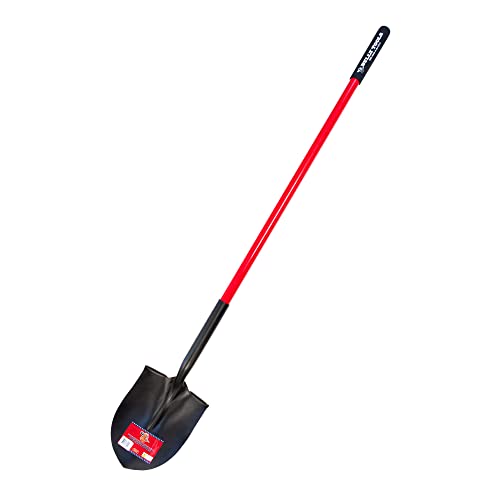
The Bully Tools 82515 is the workhorse of the group: a true 14-gauge steel round-point blade measuring 9.25 by 11 inches, in a closed-back design. The closed back matters because open-back blades collect soil in the socket area, weakening the joint over time; a closed back keeps the blade face clean and the connection solid.
The handle is reinforced fiberglass with a triple-wall construction and a reinforced wood core, finished with an extended steel ferrule where handle meets blade, the point that takes the most stress when prying. Its 48.5-inch handle makes a 60-inch tool overall, the longest here, suiting taller users and anyone wanting maximum leverage in compacted ground. It is a straight handle rather than a D-grip, and the listing presents the tool as made in the USA. At 5.4 pounds it is mid-pack.
Specs
- Blade material: Steel
- Blade gauge: 14
- Blade size: 9.25 x 11 inches, round point, closed-back design
- Handle: Reinforced fiberglass, triple-wall with reinforced wood core
- Handle length: 48.5 inches
- Overall dimensions: 60 x 9 x 5 inches
- Item weight: 5.4 lb
- Foot platform: Not stated
Fiskars 46-Inch Steel Garden Spade

The Fiskars garden spade takes the opposite approach to the long-handle shovels: an all-steel tool in the 46-inch class, with an ergonomic D-handle and a low-profile spade head. The flat head is shaped for digging planting holes and transplanting, where you want a clean cut and a controlled lift rather than maximum soil per stroke. The D-handle gives a secure closed grip for that precise work and makes the shorter tool easier to manage in borders and raised beds.
Construction is alloy steel throughout, blade and handle, at a stated 14-gauge, the same thickness class as the Bully Tools round point despite its different role. Dimensions are listed as 46.88 x 8.5 x 2.88 inches, and the page states a full lifetime warranty. One listing field, the item weight, is plainly mis-entered, so no weight is given here rather than repeating a figure that cannot be right. Pick it if most of your digging is planting.
Specs
- Blade material: Alloy steel
- Blade gauge: 14
- Construction: All-steel blade and handle
- Grip: D-handle, ergonomic
- Overall dimensions: 46.88 x 8.5 x 2.88 inches
- Item weight: Not stated
- Warranty: Full lifetime warranty stated on the page
- Foot platform: Not stated
KOLEIYA Drain Spade

The KOLEIYA is the specialist of the set: a 45-inch drain spade, also called a sharp shooter, with a narrow pointed blade for work where width is the problem. Drainage trenches, irrigation lines, planting in tight rows and transplanting between established plants all call for a blade that goes deep without disturbing soil on either side. The listed dimensions, 45 x 5.3 x 1.2 inches, show how much narrower it is than the heads above.
The blade is high carbon steel and the handle fiberglass, with a D-grip per the product name. The listing’s retrieved details are thinner than for the other picks: no blade gauge, weight or foot platform is stated, so this recommendation rests on blade shape and materials rather than a deep spec sheet. Choose it if trenching and transplanting are regular jobs; as an only shovel it is too narrow for moving soil in volume.
Specs
- Blade material: High carbon steel
- Blade gauge: Not stated
- Blade style: Narrow pointed drain spade blade
- Handle material: Fiberglass
- Grip: D-grip
- Overall dimensions: 45 x 5.3 x 1.2 inches
- Item weight: Not stated
- Foot platform: Not stated
- Colour: Orange
Fiskars Garden Shovel with Straight Handle

The second Fiskars entry is a different tool from the spade above: a full-size digging shovel with a straight handle and an all-steel build, blade and shaft both alloy steel with a hardened steel blade. Its headline feature is the extra-large foot platform stated in the page’s feature list. It is the only pick here where a foot platform is explicitly stated, and in hard, compacted soil that ledge is where most of your power comes from, letting you drive the blade with your full body weight through the boot.
The grip type is listed as contoured on a straight, long handle rather than a D-handle. Overall length is listed at 57.25 inches and the stated weight is 5.97 pounds, the heaviest here. One dimension field on the listing is clearly a packaging figure rather than a blade measurement, so blade width is recorded as not stated instead.
Specs
- Blade material: Alloy steel, hardened steel blade
- Construction: All-steel blade and shaft
- Grip: Contoured, straight handle
- Foot platform: Extra-large, stated on the page
- Overall length: 57.25 inches
- Blade width: Not stated
- Item weight: 5.97 lb
Who should skip
Skip this whole category if your digging is limited to containers, grow bags and small raised beds. A hand trowel or short transplant spade will be faster and easier on your wrists in confined soil, and a 57- to 60-inch tool is awkward between bed walls. Gardeners with limited grip strength or shoulder problems should think twice about the all-steel picks: the rigidity that helps prying sends more shock back into your hands.
Skip the drain spade if you need one shovel that does everything, because its narrow blade moves soil slowly. Skip the Root Slayer if your ground is clean loam with no roots. And if your main job is moving loose material such as compost or mulch, none of these is the right shape: a square-point transfer shovel moves volume far better.
FAQ
What gauge shovel blade is best for digging in hard soil?
Lower gauge numbers mean thicker steel. The 13- and 14-gauge blades in this guide are at the heavy-duty end for garden shovels and resist bending when you pry in compacted or rocky soil. For tough ground, the thicker stated gauges are the safer choice.
What is the difference between a round-point shovel and a garden spade?
A round-point shovel has a curved, pointed blade that enters hard soil easily and is the general-purpose digging shape. A garden spade has a flatter, straighter edge and a lower-profile head, which cuts cleaner planting holes and lifts transplants more neatly.
When would I use a drain spade instead of a regular shovel?
A drain spade has a long, narrow blade made for trenches, drainage lines and deep narrow holes. It also helps when transplanting between established plants, disturbing less soil on either side. It moves soil slowly, so it complements a wider shovel rather than replacing one.
Does a longer handle really make digging easier?
A longer handle lets you dig standing more upright and gives extra leverage when prying, helping taller gardeners and anyone breaking rough ground. The trade-off is control in tight spaces: a D-handle tool around 46 inches is easier to manage in borders and raised beds.
Final verdict
For one shovel to cover most digging, the Bully Tools 82515 is the balanced choice: a true 14-gauge closed-back blade, a reinforced handle joint and the longest reach here. If roots are your main obstacle, the Root Slayer 22511 XL and its serrated 13-gauge blade solve a problem the others cannot. Planting-focused gardeners should look at the Fiskars D-handle spade, add the KOLEIYA drain spade for trenches and tight rows, and consider the straight-handle Fiskars when hard ground makes foot pressure the deciding factor. Treat any unstated gauge or weight as unknown.
Product and ASIN Reference
| Product | ASIN |
|---|---|
| Root Slayer 22511 XL Garden Shovel | B073X8HVB7 |
| Bully Tools 82515 14-Gauge Round Point Shovel | B002YOTA7E |
| Fiskars 46-Inch Steel Garden Spade with D-Handle | B000F95D0I |
| KOLEIYA Drain Spade | B0DZH94XY7 |
| Fiskars Garden Shovel for Digging with Straight Handle | B000B6Q6BA |
FAQ
What gauge shovel blade is best for digging in hard soil?
What is the difference between a round-point shovel and a garden spade?
When would I use a drain spade instead of a regular shovel?
Does a longer handle really make digging easier?
More from Amazon
Programs that pair well with the guide above. Offers and eligibility are set by Amazon and may change.
Free shipping on eligible items, Prime Video and more. Eligible new members can start with a free trial.
Start a Prime free trialAudiobooks and podcasts to listen to on the go. Eligible new members can start with a free trial.
Try Audible freeAd-free music streaming. Eligible new subscribers can start with a free trial.
Try Music Unlimited freeA free business account with business pricing and bulk-buying tools for work, shop or home office.
Create a business accountAs an Amazon Associate we earn from qualifying purchases.

Write Your Review
No reviews yet. Be the first to share your experience!