
Key takeaways
- Electric garage heaters for insulated garages compared on thermostat control, wattage, mounting and circuit needs, using specs from Amazon listings.
Insulation changes the buying decision completely. A drafty garage rewards raw wattage, because heat escapes as fast as the heater makes it. A sealed, insulated garage keeps the heat in, so the real question becomes control: a thermostat that cycles the unit on and off accurately will hold a steady working temperature, while an oversized heater with a crude dial short-cycles, overshoots, and turns the space stuffy. Right-sizing and thermostat quality matter more here than maximum output.
This guide is for owners of insulated one- and two-car garages, people keeping pipes, paint, or a project car above freezing, and anyone who works at a bench in the garage through winter. Every pick below was chosen from the product titles and specification details published on its Amazon listing, with priority given to thermostat control, adjustable output, and mounting that spreads heat evenly.
Quick Picks
As an Amazon Associate we earn from qualifying purchases
| Product | Best for | Key spec from title |
|---|---|---|
| Fahrenheat FUH54 | Insulated two-car garages needing output you can dial down at install | 5,000W with field-adjustable wattage settings |
| Comfort Zone CZ220 | A simple hard-wired ceiling heater for a one-car insulated garage | 5,000W fan-forced ceiling mount, 240V |
| Comfort Zone CZ225ER | Set-and-forget heating controlled from the bench | 6,000W with digital thermostat and remote |
| Dr. Infrared Heater DR-988 | Garages that already have a 240V receptacle | 5,600W portable with thermostat control |
| NewAir G73 | Compact insulated garages up to its listed coverage | 5,000W hardwired, heats up to 500 sq ft |
How to Choose
Match wattage to a space that holds its heat
In an uninsulated garage, buyers chase the biggest wattage they can wire. In an insulated one, that logic backfires: the space reaches temperature quickly and then has nowhere for extra heat to go, so an oversized unit runs in short, hot bursts. Start from the coverage figure printed in the listing and treat it as a ceiling, not a target. A 5,000-watt unit listed for roughly 400 to 500 square feet suits most insulated two-car garages; going bigger only makes sense for high ceilings or a door that opens constantly.
Prioritise thermostat quality over headline output
The thermostat is the component you will interact with all winter, and in a sealed garage it does most of the work. A digital thermostat with a remote, like the one on the Comfort Zone CZ225ER, lets you set a number and adjust it from the bench. A dial thermostat, like the Fahrenheat FUH54’s 45 to 135 degree range, is simpler and perfectly workable, but expect to calibrate it by feel over the first few sessions. Either way, a built-in thermostat that actually cycles the heater is non-negotiable for an insulated space.
Look for adjustable output, not just adjustable temperature
A thermostat decides when the heater runs; adjustable wattage decides how hard it runs. The Fahrenheat FUH54 can be set at installation to lower output settings between 2,500 and 5,000 watts, which is exactly the flexibility an insulated garage rewards: the element works longer and gentler instead of blasting and shutting off. Multi-setting plug-in and hard-wired models with two or three power levels offer a simpler version of the same idea. Single-output heaters give you no such lever, so their wattage has to be right on day one.
Plan the mount and the circuit together
Ceiling mounting keeps the heater clear of cars and benches and lets fan-forced air wash down across the whole floor, which suits even distribution. Wall mounting with a tilt head, as on the NewAir G73, aims heat at a work zone instead. Then check the electrical side before ordering: most 240V garage heaters are hard-wired and need a dedicated circuit sized to the listing, while the Dr. Infrared DR-988 plugs into a NEMA 6-30R receptacle that many garages do not already have.
Heater Safety Checks
- Keep the clearances the listing and manual state: garage heater listings commonly require at least 3 feet between the unit and combustible materials such as furniture, curtains, fuel, and stored cardboard.
- Give the heater its own dedicated circuit sized to the amperage in the listing; never share the circuit with other large loads, and never run a 240V heater from an ordinary household outlet or an extension cord.
- Have hard-wired models installed by a licensed electrician, with the unit grounded and connected to a properly sized breaker that meets national and local electrical codes, as the listings themselves direct.
- Treat built-in overheat protection and thermal cut-out switches as a last line of defence, not a reason to relax clearances; keep the discharge path unobstructed and do not drape or store anything over the unit.
- Do not leave a garage heater running unattended for long stretches, and keep flammable liquids and spray cans stored away from the heated zone.
The 5 Best Options
Fahrenheat FUH54
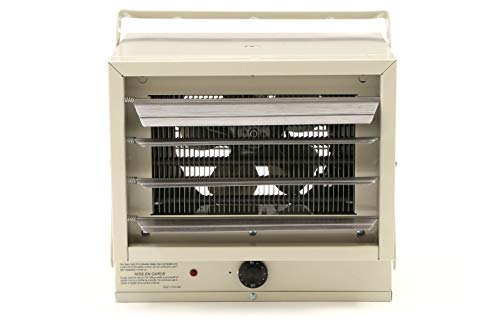
For an insulated garage, the FUH54’s party trick matters more than its headline wattage: its output can be field-adjusted at installation, stepping down from 5,000 watts through lower settings to 2,500 watts. That lets an installer match the heater to a space that holds heat well, so it runs in longer, gentler cycles instead of overshooting. The built-in dial thermostat spans 45 to 135 degrees Fahrenheit, the steel cabinet mounts on the ceiling, and adjustable louvers aim the fan-forced air where you work.
Specs
- Wattage: 5,000 watts at 240V, adjustable down to 2,500 watts; 3,750 watts at 208V
- Heat output: 17,065 BTU
- Thermostat: built-in, adjustable from 45°F to 135°F
- Heating coverage: 400 sq ft
- Amperage: 20.83 amps
- Mounting: ceiling mount, steel cabinet
- Safety feature listed: overheat protection with high-limit cutout
Best for: Insulated two-car garages where the installer can set a reduced output for steady, even heat.
Watch out for: It is hard-wired with no plug or cord, so budget for a dedicated circuit and professional installation.
ASIN: B0000AXEZV
Comfort Zone CZ220

The CZ220 is the straightforward hard-wired option: a 5,000-watt, 240-volt fan-forced unit that bolts to the ceiling and stays out of the way permanently. Its dual-knob manual thermostat gives you separate control of temperature and fan, which is all an insulated one-car garage really needs once the space is holding heat. The listing highlights overheat protection with a thermal cut-out switch, and the ceiling position spreads warm air across the floor rather than concentrating it in one corner near a portable unit.
Specs
- Wattage: 5,000 watts
- Voltage: 240 volt, hard-wired installation
- Heat output: 17,065 BTU
- Heating method: fan-forced, ceiling mount
- Thermostat: manual, dual knob control
- Safety features listed: overheat protection, thermal cut-out switch, ETL compliant
Best for: A one-car insulated garage that needs a permanent, no-fuss ceiling heater.
Watch out for: Hard-wired installation only, and the manual dial thermostat needs a few sessions of trial and error to find your setting.
ASIN: B009F1SWH8
Comfort Zone CZ225ER

Where the CZ220 is manual, the CZ225ER is the control-focused pick in the Comfort Zone line: a 6,000-watt ceiling heater with a digital thermostat, a remote control, and a 12-hour timer. In an insulated garage that combination is genuinely useful, because the heater’s job is mostly fine adjustments — nudging the temperature up before a work session or letting the timer shut it down afterwards. The listing rates coverage up to 1,000 square feet, which is generous headroom for an insulated two-car space, and the fully enclosed motor suits dusty garage air.
Specs
- Wattage: 6,000 watts
- Voltage: 208/240 volt, hard-wired single-phase connection
- Heat output: 20,477 BTU
- Heating coverage: up to 1,000 sq ft
- Controls: digital thermostat, remote control, 12-hour timer
- Safety features listed: overheat protection, ETL compliant
Best for: Insulated garages where you want precise, remote-controlled temperature holding rather than raw power.
Watch out for: At 6,000 watts it is the strongest unit here, so confirm your panel and circuit can support it before ordering.
ASIN: B093QC4ZV1
Dr. Infrared Heater DR-988

The DR-988 takes the opposite approach to installation: it is a portable floor unit with a plug, so there is nothing to hard-wire — provided your garage has the right receptacle. It delivers 5,600 watts at 240 volts, and its thermostat range of 37 to 113 degrees Fahrenheit is unusually well suited to an insulated garage, because the low end lets you hold the space just above freezing for stored paint, plants, or pipes. Automatic overheat cut-off protection is built in, and the six-foot cord gives modest placement flexibility.
Specs
- Wattage: 5,600 watts at 240V; 4,200 watts at 208V
- Heat output: 19,110 BTU
- Heating coverage: up to 600 sq ft
- Thermostat range: 37°F to 113°F
- Plug: NEMA 6-30P with 6 ft heavy-duty cord; requires a NEMA 6-30R 250V 30 amp receptacle
- Safety features listed: auto overheat cut-off protection; UL and C-UL listed
Best for: Insulated garages that already have, or can easily add, a 240V 30 amp receptacle, including freeze-protection duty.
Watch out for: It will not plug into a standard outlet, and as a floor unit it needs its stated clearances kept clear on a busy garage floor.
ASIN: B003XOZN7A
NewAir G73

The G73 is a compact hard-wired heater rated by its listing at 5,000 watts and up to 500 square feet, a pairing that lines up neatly with an insulated one- or small two-car garage. It mounts on the ceiling or wall, and the tilt head lets you angle the fan-forced output toward a bench or the centre of the floor instead of straight down. Because it is hard-wired to a 30 amp breaker, it becomes part of the garage rather than another appliance competing for floor space and outlets.
Specs
- Wattage: 5,000 watts
- Heat output: 17,060 BTU
- Heating coverage: up to 500 sq ft
- Electrical: 240V, hard-wired to a 30 amp breaker
- Mounting: ceiling or wall mount with tilt head
- Heating method: fan-forced
Best for: Smaller insulated garages where a compact permanent heater should disappear above the work area.
Watch out for: The listed coverage tops out at 500 square feet, so larger or high-ceiling insulated garages should step up to a higher-coverage pick.
ASIN: B000TK2SWO
Which One Fits Your Situation
You keep the garage just above freezing all winter
Choose the Dr. Infrared Heater DR-988. Its thermostat range starts at 37 degrees Fahrenheit, lower than typical dial heaters, so it can hold an insulated garage barely above freezing for stored paint, pipes, and plants without wasting energy on comfort temperatures. You will need the NEMA 6-30R receptacle it requires, but in exchange there is no hard-wiring and the unit can move if the garage layout changes.
You work at a bench several evenings a week
Choose the Comfort Zone CZ225ER. The digital thermostat and remote mean you can raise the temperature from the bench when a session runs long, and the 12-hour timer handles shutdown when you forget. Its 6,000-watt output is more than an insulated garage strictly needs, but the precise control keeps that headroom from turning into overheating, and warm-up from cold is noticeably quicker.
Your insulated two-car garage overshoots with your current heater
Choose the Fahrenheat FUH54, and have the installer set one of its lower output settings. Stepping the unit down toward 2,500 or 3,300 watts stretches each heating cycle, so the temperature climbs gently and holds instead of spiking past the thermostat setting and leaving the space stuffy. No other pick in this list offers that install-time adjustment, which is exactly the fix for a well-sealed garage.
You want the simplest permanent install in a one-car garage
Choose the Comfort Zone CZ220 or the NewAir G73. Both are 5,000-watt hard-wired ceiling units sized honestly for smaller insulated spaces. Pick the CZ220 for its dual-knob control and listed thermal cut-out, or the G73 if its tilt head helps aim heat at your usual work spot. Either way, an electrician visit is part of the plan, and then the heater simply lives on the ceiling.
Common Mistakes
- Sizing for an uninsulated garage out of habit, then fighting short-cycling and overshoot all winter in a space that actually holds heat well.
- Ignoring the electrical requirement until the box arrives — most 240V garage heaters are hard-wired or need a specific receptacle, not a standard outlet.
- Mounting a ceiling heater where a raised garage door or storage rack blocks its airflow, creating one hot corner and a cold floor.
- Setting a dial thermostat once in autumn and never recalibrating, even though an insulated garage’s needs change between mild and deep-winter weeks.
- Storing paint cans, fuel, or cardboard within the clearance zone the listing specifies around the heater.
Frequently Asked Questions
How many watts does an insulated two-car garage actually need?
Less than an uninsulated one, because the heat stays in the space. The listings here cluster around 5,000 watts for roughly 400 to 500 square feet, which covers most insulated two-car garages. High ceilings, frequent door opening, or very cold climates push the requirement up; a tight, well-sealed garage can often run a 5,000-watt unit at a reduced setting, like the FUH54 allows.
Is a digital thermostat worth it in a garage?
It depends on how you use the space. If the garage is mainly freeze protection, a simple dial thermostat is enough. If you work there regularly, a digital thermostat with a remote and timer, like the CZ225ER’s, makes holding a steady comfort temperature much easier, and in an insulated garage good control prevents the stuffiness that comes from overshooting your set temperature.
Can I plug a 240V garage heater into a normal outlet?
No. The plug-in model here, the Dr. Infrared DR-988, uses a NEMA 6-30P plug that requires a dedicated 240V 30 amp NEMA 6-30R receptacle, and the other picks are hard-wired to a dedicated circuit. None of them runs from a standard household outlet, and none should ever be used with an extension cord. Have an electrician confirm your panel before buying.
Should an insulated garage heater run all the time?
It does not need to. Because insulation slows heat loss, the thermostat will cycle the heater in shorter, less frequent runs than in a drafty garage, and many owners only power the heater before and during work sessions. For freeze protection, a low thermostat setting — the DR-988 goes down to 37 degrees Fahrenheit — keeps pipes and stored liquids safe without heating the space to comfort levels.
FAQ
How many watts does an insulated two-car garage actually need?
Is a digital thermostat worth it in a garage?
Can I plug a 240V garage heater into a normal outlet?
Should an insulated garage heater run all the time?
More from Amazon
Programs that pair well with the guide above. Offers and eligibility are set by Amazon and may change.
Free shipping on eligible items, Prime Video and more. Eligible new members can start with a free trial.
Start a Prime free trialAudiobooks and podcasts to listen to on the go. Eligible new members can start with a free trial.
Try Audible freeAd-free music streaming. Eligible new subscribers can start with a free trial.
Try Music Unlimited freeA free business account with business pricing and bulk-buying tools for work, shop or home office.
Create a business accountAs an Amazon Associate we earn from qualifying purchases.





Write Your Review
No reviews yet. Be the first to share your experience!