
Key takeaways
- Compare five reciprocating saws, corded and cordless, using maker-rated amps, stroke lengths and speeds for demolition, pruning and remodeling work.
A reciprocating saw is the tool most remodelers reach for when a cut has to be fast rather than pretty. The blade moves back and forth in a straight line, chewing through nailed lumber, pipe, conduit, tree roots and old framing that would stall a circular saw or ruin a finer blade. Because the work is rough by nature, the buying decision comes down to a short list of maker-published numbers: motor power, stroke length, strokes per minute, weight and how the blade clamp works.
This guide compares five reciprocating saws that cover the main ways people buy them. Two are full-size cordless models on major battery platforms, one is a compact one-handed cordless saw for tight spaces, and two are corded models for buyers who would rather plug in than manage batteries. Every specification below is attributed to the maker, and every model was matched against two independent sources before it was included.
As an Amazon Associate, we earn from qualifying purchases.
Quick answer
For most cordless buyers, the DEWALT DCS367B and the Milwaukee 2621-20 are the two to compare first: both are full-size saws with a 1-1/8 inch stroke, and the choice usually follows the battery platform already on your shelf. The Milwaukee 2625-20 HACKZALL suits one-handed work in tight spaces. For corded power, the DEWALT DWE304 adds a four-position blade clamp, while the SKIL 9206-02 covers basic demolition for less money.
How to choose a reciprocating saw
Start with the power source. Cordless saws trade runtime limits for freedom from cords, and a bare tool only makes sense if you already own compatible batteries and a charger. Corded saws run as long as the job lasts and weigh less for the same output, but the cord limits reach and needs care around ladders and debris.
Stroke length is the single best predictor of cutting speed. DEWALT and Milwaukee both rate their full-size saws here at a 1-1/8 inch stroke, while the compact HACKZALL uses a shorter 3/4 inch stroke that trades speed for control. Speed is quoted in strokes per minute, and every saw in this guide has a variable-speed trigger, so the published maximum matters less than how easily you can feather the trigger at the start of a cut.
Blade changes should be tool-free. All five saws use a lever or twist clamp that the makers describe as tool-less or keyless, which matters because blades are consumables that you will swap often between wood, metal and demolition types. Weight matters more than the numbers suggest: a saw near 7 pounds is fine at waist height and tiring overhead, which is why the compact models exist.
Finally, plan the safety basics before the first cut. Wear eye protection, since reciprocating blades throw chips and can snap. Unplug a corded saw or remove the battery before changing blades. Clamp or brace the workpiece so it cannot shift mid-cut, match the blade to the material following the blade maker’s guidance, and check for hidden wires, pipes and fasteners before cutting into walls, floors or ceilings.
1. DEWALT DCS367B 20V MAX XR Compact Reciprocating Saw

DEWALT builds the DCS367B around a brushless motor in a body that DEWALT lists at 14.5 inches long, noticeably shorter than a traditional full-size saw. That compact frame, paired with a pivoting shoe, is aimed at cutting between studs, under sinks and in other spots where a longer saw body will not fit. DEWALT rates the saw at up to 2,900 strokes per minute with a 1-1/8 inch stroke length, so on paper it gives up nothing in stroke to larger models.
The blade clamp is a keyless lever design that accepts blades in four positions, which helps with flush cuts and overhead work where the saw body would otherwise block the approach. An LED light at the nose lights the cut line in dark cavities. The saw is sold as a bare tool, so the total purchase only makes sense alongside existing DEWALT 20V MAX batteries. DEWALT lists the tool weight at 5 pounds, the lightest full-stroke saw in this guide, which suits long overhead sessions.
Specs
- Power source: DEWALT 20V MAX battery, bare tool
- Motor: Brushless, per DEWALT
- Stroke length: 1-1/8 inch, per DEWALT
- Speed: 0 to 2,900 strokes per minute, per DEWALT
- Length: 14.5 inches, per DEWALT
- Weight: 5 pounds, per DEWALT
- Blade clamp: Keyless lever, four-position
2. Milwaukee 2621-20 M18 SAWZALL Reciprocating Saw
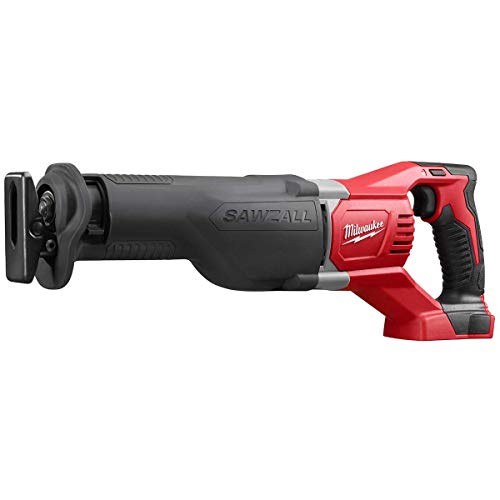
The 2621-20 is Milwaukee’s standard M18 SAWZALL, the full-size two-handed pattern that most people picture for demolition. Milwaukee rates it at 0 to 3,000 strokes per minute with a 1-1/8 inch stroke, and fits a QUIK-LOK blade clamp that Milwaukee describes as tool-free. A counterbalance mechanism is built in to reduce vibration at the handle, and the gearing uses an all-metal gearbox housing for durability in rough service.
At 18 inches long and 7.4 pounds per Milwaukee’s specification sheet, this is the biggest saw in the guide, and the size buys a long, stable shoe and a full-size grip that suits two-handed demolition of framing, pipe and pallet wood. It runs on any Milwaukee M18 battery and is sold as a bare tool. Milwaukee also includes its REDLINK electronics, which the maker describes as protection against overload during heavy cuts. Buyers already invested in the M18 platform will find this the default full-size option.
Specs
- Power source: Milwaukee M18 battery, bare tool
- Stroke length: 1-1/8 inch, per Milwaukee
- Speed: 0 to 3,000 strokes per minute, per Milwaukee
- Length: 18 inches, per Milwaukee
- Weight: 7.4 pounds, per Milwaukee
- Blade clamp: QUIK-LOK tool-free clamp, per Milwaukee
- Extras: Counterbalance mechanism, all-metal gearbox
3. DEWALT DWE304 10 Amp Corded Reciprocating Saw

The DWE304 is DEWALT’s straightforward corded option: a 10 amp motor, a 1-1/8 inch stroke and a variable-speed trigger rated by DEWALT at up to 2,800 strokes per minute. There is no battery to charge and no runtime ceiling, which makes it a sensible pick for a long demolition day in one building, a workshop, or any job that stays within reach of an outlet and a suitable extension cord.
Its distinguishing feature is the keyless, lever-action blade clamp with four blade positions, the same system DEWALT fits to its compact cordless saw. Turning the blade sideways or upside down lets you start cuts closer to a floor or ceiling surface and keep the saw body clear of obstructions. DEWALT’s datasheet lists the weight at 7.87 pounds, typical for a corded saw of this output. The variable-speed trigger and pivoting shoe are standard fare, and the fixed cord means one less consumable system to maintain over the tool’s life.
Specs
- Power source: Corded, 120 volt
- Motor: 10 amp, per DEWALT
- Stroke length: 1-1/8 inch, per DEWALT
- Speed: 0 to 2,800 strokes per minute, per DEWALT
- Weight: 7.87 pounds, per DEWALT datasheet
- Blade clamp: Keyless lever-action, four-position, per DEWALT
4. Milwaukee 2625-20 M18 HACKZALL Reciprocating Saw

The HACKZALL is built around one-handed use. Milwaukee gives the 2625-20 a compact in-line body, 13 inches long, that can be controlled with a single hand for overhead cuts, pruning and work inside cabinets or between joists where a two-handed saw cannot swing. Milwaukee rates it at 0 to 3,000 strokes per minute, matching the bigger SAWZALL on speed, but the stroke is a shorter 3/4 inch, so it cuts more slowly through thick material in exchange for noticeably better control at the start of a cut.
The QUIK-LOK clamp is the same tool-free system used on the full-size model, and it accepts standard reciprocating blades as well as the shorter HACKZALL blades Milwaukee sells for tight work. A built-in LED lights the work area. Like the other cordless saws here, it is a bare tool for the M18 platform. Choose it as a second saw for detail and access work, or as a main saw if your cutting is mostly pipe, conduit, branches and light framing rather than heavy demolition.
Specs
- Power source: Milwaukee M18 battery, bare tool
- Stroke length: 3/4 inch, per Milwaukee
- Speed: 0 to 3,000 strokes per minute, per Milwaukee
- Length: 13 inches, per Milwaukee
- Design: One-handed in-line body, per Milwaukee
- Blade clamp: QUIK-LOK tool-free clamp, per Milwaukee
- Extras: Built-in LED work light
5. SKIL 9206-02 7.5 Amp Variable Speed Reciprocating Saw
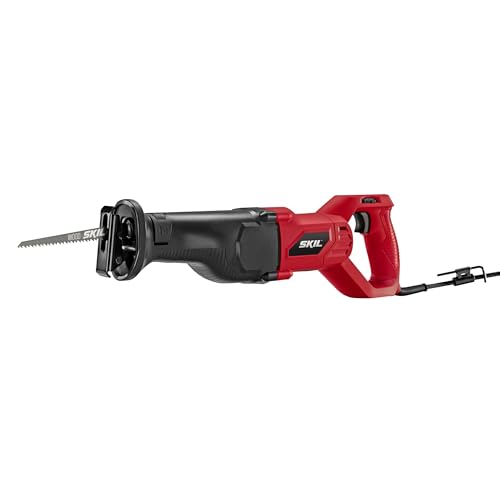
The SKIL 9206-02 is the budget corded entry in this guide. Its 7.5 amp motor is a step down from the 10 amp DEWALT, and SKIL positions it for household demolition, yard pruning and occasional remodeling rather than daily trade use. SKIL fits a counterbalance system to take some buzz out of the handle and a metal gear housing at the front end, both unusual at this level.
Blade changes are tool-less, the shoe pivots to follow uneven surfaces, and the variable-speed trigger lets you start cuts gently in metal or plastic pipe. Expect it to work harder and cut more slowly than the bigger saws in thick, nail-embedded lumber; in exchange it costs less than a single cordless battery in many cases, and there is nothing else to buy to keep it running. For a homeowner who needs a reciprocating saw a few weekends a year, that trade is often the right one.
Specs
- Power source: Corded, 120 volt
- Motor: 7.5 amp, per SKIL
- Speed: Variable speed trigger, per SKIL
- Blade clamp: Tool-less blade change, per SKIL
- Extras: Counterbalance vibration control, metal gear housing, pivoting foot, per SKIL
How the five compare
The two full-size cordless saws are closer than their spec sheets suggest: identical 1-1/8 inch strokes, similar maximum speeds, and tool-free clamps, so the battery platform you own should decide between them. The DCS367B is shorter and lighter, which helps in cavities; the 2621-20 is longer and heavier, which helps stability in open demolition. The HACKZALL gives up stroke length for one-handed control and should be judged as an access tool, not a demolition saw.
Between the corded pair, the DWE304 offers more motor, a four-position clamp and a longer track record in trade use, while the SKIL 9206-02 covers lighter work for less. Neither corded saw needs batteries, chargers or platform loyalty, which keeps them attractive as shared or occasional-use tools. Across all five, blades are standard-shank consumables, so a good assortment of wood, metal and demolition blades matters more than small specification differences.
Frequently asked questions
Which is better for demolition, corded or cordless?
Both formats do demolition well. Cordless saws such as the DCS367B and 2621-20 move freely around a site but depend on charged batteries, while corded saws such as the DWE304 run indefinitely near an outlet. Match the choice to how far you work from power and which batteries you already own.
What blade should I use for nail-embedded wood?
Use a demolition blade rated by its maker for nail-embedded wood, typically a thicker, lower-tooth-count bi-metal blade. Fit it with the saw unplugged or the battery removed, keep the shoe pressed to the work, and let the blade clear the cut before withdrawing it.
Can a compact saw like the HACKZALL replace a full-size saw?
For pipe, conduit, pruning and light framing, yes. Its 3/4 inch stroke cuts more slowly through thick beams and dense demolition material, so for sustained heavy work a full-size saw with a 1-1/8 inch stroke is the better main tool.
What safety steps matter most with a reciprocating saw?
Wear eye protection, unplug the saw or remove its battery before blade changes, clamp or brace the workpiece, choose a blade the blade maker rates for the material, and check for hidden wires, pipes and fasteners before cutting into walls, floors or ceilings.
Final verdict
Pick the DEWALT DCS367B if you own 20V MAX batteries and want full-size cutting in a compact, light body. Pick the Milwaukee 2621-20 if you are on the M18 platform and want a traditional full-size SAWZALL. Add the Milwaukee 2625-20 HACKZALL for one-handed access work. For corded reliability, the DEWALT DWE304 is the stronger all-round choice, and the SKIL 9206-02 is the sensible budget pick for occasional household demolition and pruning.
Product and ASIN Reference
| Product | ASIN |
|---|---|
| DEWALT DCS367B 20V MAX XR Compact Reciprocating Saw | B01M69K91R |
| Milwaukee 2621-20 M18 SAWZALL Reciprocating Saw | B00VV0EF4A |
| DEWALT DWE304 10 Amp Corded Reciprocating Saw | B00ODN1CP2 |
| Milwaukee 2625-20 M18 HACKZALL Reciprocating Saw | B003EZWK42 |
| SKIL 9206-02 7.5 Amp Variable Speed Reciprocating Saw | B008J1GNEO |
FAQ
Which is better for demolition, corded or cordless?
What blade should I use for nail-embedded wood?
Can a compact saw like the HACKZALL replace a full-size saw?
What safety steps matter most with a reciprocating saw?
More from Amazon
Programs that pair well with the guide above. Offers and eligibility are set by Amazon and may change.
Free shipping on eligible items, Prime Video and more. Eligible new members can start with a free trial.
Start a Prime free trialAudiobooks and podcasts to listen to on the go. Eligible new members can start with a free trial.
Try Audible freeAd-free music streaming. Eligible new subscribers can start with a free trial.
Try Music Unlimited freeA free business account with business pricing and bulk-buying tools for work, shop or home office.
Create a business accountAs an Amazon Associate we earn from qualifying purchases.




Write Your Review
No reviews yet. Be the first to share your experience!