
Key takeaways
- Compare five auto-darkening welding helmets on viewing area, shade range, optical rating and sensors, with plain guidance on fit, power and safe setup.
An auto-darkening helmet does two jobs at once: it keeps your face covered while you line up a joint, then darkens the lens the instant an arc strikes. The five helmets in this guide cover the main buying paths, from a large-view professional hood to a simple analog model for a home shop. Every figure below is the maker’s own published figure for that helmet, and each product was checked against two independent sources before it earned a place here. If you mostly run one process in one position, a mid-range helmet is usually enough; if you weld out of position or switch processes all day, sensor count and shade range start to matter more.
The differences that decide a purchase are easy to miss in a listing. Viewing area is quoted in square inches or as a window size, optical ratings use a four-part scale, and shade ranges split differently between weld, cut and grind modes. This guide lines those figures up side by side so you can match a helmet to your process and your amperage without guessing. It also covers the basic safety checks that apply to every auto-darkening helmet, whichever model you choose.
As an Amazon Associate, we earn from qualifying purchases.
Quick answer
Pick the helmet whose maker-rated shade range covers your process and amperage, with the largest viewing area in your budget tier and enough arc sensors for the positions you weld in. The Lincoln VIKING 3350 leads this list on window size and optical rating, the ESAB Sentinel A50 suits frequent TIG work, and the Antra AH6-260-0000 is the simplest low-cost route.
How to choose a welding helmet
Shade range and modes. Match the dark shade to the process and amperage you actually run, using the shade guide in the helmet maker’s manual. Weld shades on the helmets here run from 5-13 at the widest to 9-13 on simpler models. A separate cut range and a grind mode with a light shade are worth having if you swap tasks often, because they save you lifting the hood between operations.
Optical rating. Auto-darkening lenses carry a four-part optical rating covering optical class, light diffusion, luminous transmittance variation and angular dependence. A 1/1/1/1 rating is the top mark in all four parts. Lower numbers in the third or fourth position are common on mid-range helmets and mainly show up as slight shade variation when you view the arc at an angle.
Viewing area and sensors. Window sizes here run from about 6.7 square inches to 12.5 square inches. A larger window helps when you weld in tight spots or move your head instead of the work. Four arc sensors keep the lens triggered when one sensor is blocked by the workpiece or your own position; two-sensor helmets ask for a clearer line of sight to the arc.
Power and headgear. Most of these helmets pair a solar cell with a replaceable battery, and a low-battery indicator or test button is worth checking for. Headgear with several adjustment points and a padded sweatband matters more than small weight differences on a long day.
Safety basics. Choose a helmet whose shade range the maker rates for your welding process and amperage. Test the auto-darkening function before each session, and replace a scratched or pitted cover lens, since a damaged cover lens can affect how the filter performs. Never weld with a helmet whose lens fails to darken. A welding helmet is not rated for laser work, and it is not rated for overhead cutting splash unless the maker says so.
1. Lincoln Electric VIKING 3350 (K3034-4)
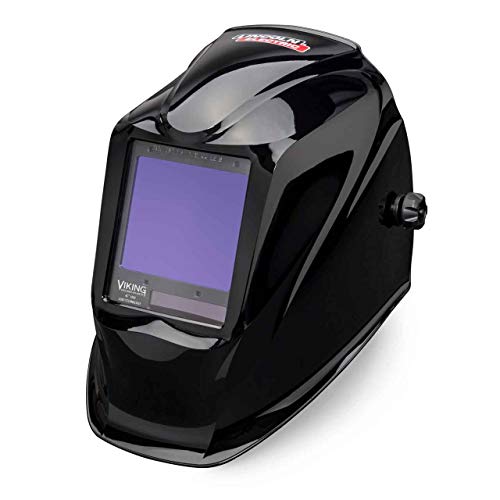
The VIKING 3350 is Lincoln Electric’s flagship auto-darkening helmet, built around the maker’s 4C lens technology. Lincoln rates the lens at 1/1/1/1 for optical clarity, the top score in all four parts of the rating, and pairs it with the largest viewing area in this guide at 12.5 square inches. The variable shade runs from 5 to 13, which covers low-amp TIG through heavier stick work in one helmet, and Lincoln rates the sensors for TIG arcs above 2 amps on both AC and DC. An external grind button switches to the light grind shade without lifting the hood. The X6 headgear uses several adjustment points to spread the load, and the lens runs on a replaceable CR2450 battery. This is the pick for welders who run long sessions across several processes and want the widest, clearest view on the list.
Specs (Lincoln Electric figures)
– Lens: 4C lens technology, optical rating 1/1/1/1
– Viewing area: 12.5 sq in (3.74 x 3.34 in)
– Shade range: variable 5-13, grind mode light shade 3.5
– Switching speed: 1/25,000 second
– Arc sensors: 4
– TIG rating: above 2 amps, AC and DC
– Power: replaceable CR2450 battery
– Headgear: X6 with multiple adjustment points
2. Miller Digital Performance with ClearLight 4x (296756)

Miller’s Digital Performance sits a step below the maker’s Elite line and uses the same ClearLight 4x lens family. Miller quotes a 7.2 square inch viewing area and a notably bright 2.5 light state, which keeps the workpiece easier to see between welds with the hood down. The weld shade range is 8-13 and the cut range is 5-8, with Weld, Cut and Grind modes selected on digital controls that also allow half-shade steps. AutoSense is Miller’s name for automatic sensitivity adjustment: the helmet reads the environment and sets sensitivity itself, which helps when you move between bench work and brighter shop areas. The listed optical class is 1/1/1/2. This listing is the Burn & Blossom graphic edition of the 296756; the lens, controls and shell are the Digital Performance specification. Choose it if you want digital controls and automatic sensitivity without stepping up to the Elite tier.
Specs (Miller figures)
– Lens: ClearLight 4x, optical class 1/1/1/2
– Viewing area: 7.2 sq in
– Shade range: weld 8-13, cut 5-8, light state 2.5
– Modes: Weld, Cut, Grind with digital controls
– Sensitivity: AutoSense automatic adjustment
– Arc sensors: 3
– Switching speed: 1/20,000 second
– Weight: 17 oz
3. ESAB Sentinel A50 (0700000800)

The Sentinel A50 is ESAB’s low-profile auto-darkening helmet, shaped with a rounded shell that clears nearby obstructions better than a flat-front hood. ESAB quotes a 3.93 x 2.36 inch viewing area and a two-part shade range of DIN 5-8 and 9-13 over a shade 4 light state, which gives it a dedicated low range for plasma cutting and low-amp TIG alongside the main welding range. Controls are handled through a color touch screen panel inside the helmet, including grind mode selection and memory settings. The filter runs on two CR2450 lithium batteries listed in ESAB’s parts documentation for the model. The listed optical class is 1/1/1/2. The A50 suits welders who work in confined assemblies or do frequent low-amp TIG and cutting, and who prefer a compact shell over the largest possible window.
Specs (ESAB figures)
– Viewing area: 3.93 x 2.36 in (100 x 60 mm)
– Shade range: DIN 5-8 and 9-13, light state shade 4
– Cartridge size: 5.2 x 4.5 x 0.35 in (133 x 114 x 9 mm)
– Controls: color touch screen with grind mode
– Optical class: 1/1/1/2
– Power: 2 x CR2450 lithium batteries
– Shell: low-profile rounded nylon shell
– Model number: 0700000800
4. Hobart Inventor (770890)
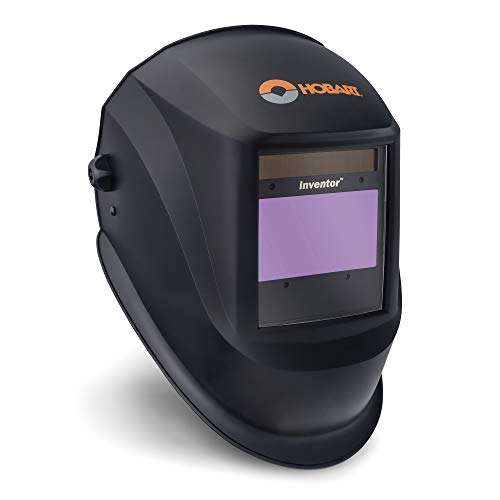
The Inventor is Hobart’s straightforward large-view helmet, with analog knobs instead of digital menus. Hobart fits its PureColor lens in a 3.94 x 2.36 inch viewing field, which works out to the 9.3 square inch figure the maker uses for this series, so the window is wider than most mid-range hoods. The darkened shade range is 9-13 with a shade 3 light state, and the two operating modes are weld and grind. Four arc sensors watch for the arc, and Hobart quotes a switching speed of 1/25,000 second. The maker’s specification sheet lists a weight of 19.7 ounces, compliance with ANSI Z87.1-2015, CSA and CE EN379 standards, and a two-year warranty. There is no cut shade range, so plasma work belongs on one of the wider-range helmets above. Pick the Inventor if you want a big window, simple controls and a mainstream maker behind the product.
Specs (Hobart figures)
– Lens: PureColor lens technology
– Viewing field: 3.94 x 2.36 in (100 x 60 mm), 9.3 sq in
– Shade range: darkened 9-13, light state 3
– Switching speed: 1/25,000 second
– Arc sensors: 4
– Modes: weld and grind, analog controls
– Weight: 19.7 oz (560 g)
– Standards: ANSI Z87.1-2015, CSA, CE EN379; two-year warranty
5. Antra AH6-260-0000

The AH6-260-0000 is Antra’s long-running budget auto-darkening helmet. Its shade control splits into two ranges, 5-9 and 9-13, over a shade 4 light state, so it covers plasma cutting shades and general welding shades in one inexpensive hood. Antra quotes a 3.86 x 1.73 inch viewing area, four arc sensors and a switching time of 1/25,000 second, with an optical rating of 1/1/1/2. Power comes from a solar cell backed by replaceable CR2032 batteries, and the maker lists compliance with ANSI Z87.1, EN379 CE and CSA Z94.3 standards. Sensitivity and delay are adjusted with external knobs, and the light polyamide nylon shell keeps the helmet easy to wear for short jobs. The window is the smallest here and the controls are basic, but every core figure is in line with what occasional MIG, TIG and stick work requires. It is the sensible first helmet or spare hood on this list.
Specs (Antra figures)
– Viewing area: 3.86 x 1.73 in
– Shade range: 4/5-9/9-13 (light state 4, ranges 5-9 and 9-13)
– Switching time: 1/25,000 second
– Arc sensors: 4
– Optical rating: 1/1/1/2
– Power: solar cell with replaceable CR2032 batteries
– Standards: ANSI Z87.1, EN379 CE, CSA Z94.3
– Shell: polyamide nylon
How the five compare
The Lincoln VIKING 3350 is the clear step-up pick: the biggest window, the only 1/1/1/1 optical rating here and the widest single shade range. The Miller Digital Performance and ESAB Sentinel A50 trade window size for control features, AutoSense sensitivity on the Miller and a touch screen plus a low cut range on the ESAB. The Hobart Inventor offers a wide window and simple analog controls in the middle of the range, while the Antra AH6-260-0000 covers the same core shade territory as the premium helmets at the cost of a smaller window and fewer refinements. All five are full auto-darkening helmets for arc welding processes; none of them is a passive-only hood, and none should be used for laser work. If you weld out of position often, favor the four-sensor models. If you cut as much as you weld, favor a helmet with a dedicated cut shade range.
FAQ
What shade should I set for MIG, TIG or stick welding?
Use the shade guide in your helmet maker’s manual for your process and amperage, since the correct dark shade depends on arc current. As a general pattern, lower-amp TIG sits at the lighter end of a helmet’s range and higher-amp stick and flux-core work at the darker end. If the lens does not darken as expected, stop and sort the helmet out before continuing.
Is a 1/1/1/1 optical rating worth paying for?
It is the top score in all four parts of the lens rating system, and it mainly buys a more even shade when you view the arc at an angle. Welders who work out of position notice it most. For flat bench work, a 1/1/1/2 lens like the ones on several helmets here is a reasonable place to save money.
How many arc sensors do I need?
Two sensors are workable when the arc is always in clear view. Four sensors, fitted to most helmets in this guide, keep the lens triggered when the workpiece, a clamp or your own body blocks one sensor’s view of the arc. If you weld inside assemblies or around corners, four sensors are the safer specification to buy.
Can I grind and plasma cut with the same helmet?
Yes, if the helmet has the right modes. Use grind mode, which holds the lens at its light shade, for grinding, and a cut shade range for plasma cutting; the Miller and ESAB above list dedicated cut ranges. Keep the cover lens clean and replace it when it gets scratched or pitted, and remember a standard welding helmet is not rated for laser work or for overhead cutting splash unless the maker states otherwise.
Final verdict
Buy the Lincoln VIKING 3350 if you weld often and want the largest, clearest view; buy the Miller Digital Performance or ESAB Sentinel A50 if digital controls, automatic sensitivity or a low cut range fit your work better. The Hobart Inventor is the balanced middle choice with analog controls, and the Antra AH6-260-0000 is the budget pick that still covers the core shade ranges. Whichever you choose, match the maker’s shade range to your process and amperage, and test the lens before every session.
Product and ASIN Reference
| Product | ASIN |
|---|---|
| Lincoln Electric VIKING 3350 (K3034-4) | B019G6T4RS |
| Miller Digital Performance with ClearLight 4x (296756) | B0DC21TKT8 |
| ESAB Sentinel A50 (0700000800) | B06XRYV3N3 |
| Hobart Inventor (770890) | B07MKRYWMD |
| Antra AH6-260-0000 | B00BWAEYV8 |
More from Amazon
Programs that pair well with the guide above. Offers and eligibility are set by Amazon and may change.
Free shipping on eligible items, Prime Video and more. Eligible new members can start with a free trial.
Start a Prime free trialAudiobooks and podcasts to listen to on the go. Eligible new members can start with a free trial.
Try Audible freeAd-free music streaming. Eligible new subscribers can start with a free trial.
Try Music Unlimited freeA free business account with business pricing and bulk-buying tools for work, shop or home office.
Create a business accountAs an Amazon Associate we earn from qualifying purchases.


Write Your Review
No reviews yet. Be the first to share your experience!