
Key takeaways
- The best straight edges for layout and machine setup compared, from a 12 inch beveled steel edge to a 50 inch aluminum bar, with maker-stated tolerances.
A straight edge is a reference tool, not a ruler. Its job is to give you one edge you can trust, so you can compare a surface against it, scribe a line along it, or bridge a machine table and read the gap underneath with feeler gauges. That is the work behind jointer and planer setup, table saw alignment, checking a board for wind, and confirming that a cylinder head or engine block face is flat enough to seal. A measuring rule answers how long something is. A straight edge answers whether it is straight, and that answer is only useful when the maker states a tolerance for the edge itself.
The five picks below cover the main ways these tools are built. Two are precision-ground steel references from Starrett, the pattern machinists have used for generations. One is a heavy steel edge ground for automotive surface checks. Two are anodized aluminum bars aimed at woodworking machinery and long spans, where steel would be heavy and awkward to handle. Lengths run from 12 inches to 50 inches, and every tolerance figure is the maker’s own published number, quoted the way the maker states it, because a figure given per foot and a figure given over a full length are not the same claim.
As an Amazon Associate, we earn from qualifying purchases.
Quick answer
For a machinist reference, the Starrett 380-24 is the pick: precision-ground steel with a per-foot tolerance. Woodworkers setting up jointers and planers should look at the Taytools SE24, a light aluminum bar guaranteed over its full length. For long beds and wide surfaces, the POWERTEC 71503 spans 50 inches. Engine builders get a thicker ground steel edge in the OEMTOOLS 25355, and the beveled Starrett 385-12 suits short work.
1. Starrett 380-24 Steel Straight Edge

The 380 series is Starrett’s plain reference pattern: a solid steel bar, precision ground, with no bevel and no graduations, so nothing distracts from the single working edge. Starrett states the accuracy of the 380-24 as plus or minus .0002 inch per foot, and describes the bar’s thickness and design as permitting it to retain shape and accuracy while staying portable and easy to handle. At 24 inches, it bridges most jointer tables, planer beds, and saw tops in one placement, which matters, because a reference shorter than the surface can hide a long, gentle bow.
Because the face is ungraduated, this is a comparison tool only. You will still want a rule nearby for measurements, and Starrett itself positions the 380 for drawing or scribing straight lines and checking surfaces for straightness rather than measuring them.
Specs (per Starrett)
- Length: 24 inches
- Width: 1-13/32 inches
- Thickness: 11/64 inch
- Material: steel, regular finish
- Edge style: not beveled, not graduated
- Accuracy: plus or minus .0002 inch per foot, per Starrett
Who it’s for: machinists, toolroom workers, and serious woodworkers who want a steel reference with a per-foot tolerance statement for machine setup and surface inspection.
Who should skip: anyone who wants graduations on the tool itself, or who needs to span surfaces longer than 24 inches in a single placement.
2. Taytools SE24 24 Inch Anodized Aluminum Straight Edge

Taylor Toolworks sells the SE24 under its Taytools brand as a woodworking setup reference, and its guarantee is stated the way woodworkers usually want it: straight to within .001 inch over the full 24 inch length, per Taylor Toolworks. The bar is an anodized aluminum extrusion, 7/16 inch thick and 1-3/4 inches wide, with a contoured cross section that gives your fingers a grip and lets the bar stand on its edge on a machine table. The reference edge is machined flat and smooth, and there is a hanging hole in one end for storage.
Aluminum makes this bar noticeably lighter than a comparable steel edge, at 1.52 pounds per Taylor Toolworks, so it is easy to place and lift repeatedly while you work around a jointer or planer. The trade-off is that aluminum is softer than steel, so the edge deserves more protection from knocks and from being stored loose among steel tools.
Specs (per Taylor Toolworks)
- Length: 24 inches
- Width: 1-3/4 inches
- Thickness: 7/16 inch
- Material: anodized aluminum
- Straightness: within .001 inch over the full 24 inch length, per Taylor Toolworks
- Weight: 1.52 pounds
Who it’s for: woodworkers aligning jointers, planers, and saw tops who want a light bar with a full-length straightness guarantee and an edge that stands up on the table.
Who should skip: machinists who need a per-foot tolerance statement or a hardened steel edge for daily inspection work against metal surfaces.
3. POWERTEC 71503 50 Inch Anodized Aluminum Straight Edge
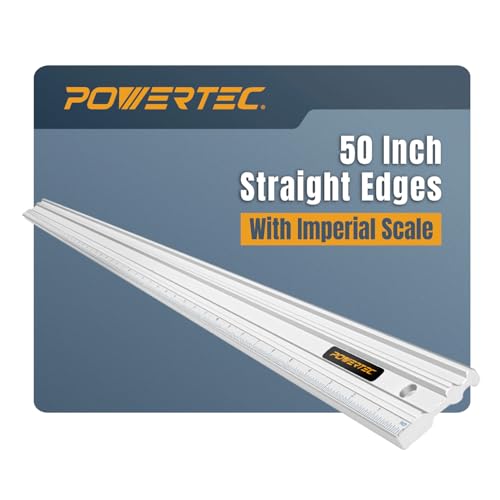
Most straight edges stop at 24 or 36 inches. The POWERTEC 71503 runs a full 50 inches, which lets it span a long jointer bed, a wide planer, or a full sheet-goods layout in one placement. POWERTEC states that the reference edge is machined flat to within 0.003 inch over the full 50 inches. That figure is looser than the short steel edges above, which is the normal trade at this length, and POWERTEC publishes it plainly so you can judge whether it suits your work.
The bar is anodized aluminum, 2 inches wide, with a ribbed, reinforced profile that POWERTEC describes as an ergonomic grip section, and a 5/16 inch measuring surface width. Etched scales in inches and millimeters run along the bar, so it can double for layout marking, and a pre-drilled hanging hole at the broad end gives it a proper storage spot. POWERTEC positions it for checking surface warp, machine alignment, and cylinder head checks with feeler gauges.
Specs (per POWERTEC)
- Length: 50 inches
- Width: 2 inches
- Measuring surface width: 5/16 inch
- Material: anodized aluminum
- Flatness: machined flat to within 0.003 inch over the full 50 inches, per POWERTEC
- Scales: etched inch and millimeter scales
Who it’s for: anyone setting up long machine beds, checking wide panels, or doing layout across sheet goods, who needs the span more than the tightest tolerance.
Who should skip: buyers doing fine inspection work where a 0.003 inch full-length figure is too loose, or anyone without a flat or hanging storage spot for a 50 inch bar.
4. OEMTOOLS 25355 24 Inch Straight Edge

The OEMTOOLS 25355 is built for one job family: checking engine surfaces. It is made from 1/4 inch thick cold rolled steel, with a precision ground edge that OEMTOOLS rates to plus or minus 0.001 inch, and a durable powder coat finish over the rest of the bar. Used with feeler gauges, it is the standard way to check cylinder heads and engine blocks for the warp that causes gasket leaks, and OEMTOOLS sells it for exactly those inspections. It is made in the USA, per OEMTOOLS.
That thick steel section is the point. An engine shop edge gets laid across cast iron and aluminum castings all day, and the 25355 is heavy and stiff enough to sit where you place it without flexing while you probe underneath with a gauge. It has no graduations and no bevel; it is a single-purpose inspection reference, and it does that job with a ground edge rather than a machined extrusion.
Specs (per OEMTOOLS)
- Length: 24 inches
- Thickness: 1/4 inch
- Material: cold rolled steel, powder coat finish
- Edge: precision ground to plus or minus 0.001 inch, per OEMTOOLS
- Use: cylinder head and engine block checks with feeler gauges
- Origin: made in the USA, per OEMTOOLS
Who it’s for: mechanics and engine builders who check heads and blocks as part of gasket and rebuild work and want a stiff, ground steel edge.
Who should skip: woodworkers, who will find it heavy for machine setup, and anyone who needs a span longer than 24 inches.
5. Starrett 385-12 Steel Straight Edge with Bevel Edge

The 385-12 is the compact member of Starrett’s steel straight edge family. It is 12 inches long, and one edge is beveled while the bar remains ungraduated. Starrett describes the 385 pattern as beveled on one edge but not graduated, and the bevel brings the working edge down close to the work, which makes it easier to see a light gap under the edge and to scribe a line that lands where you intend. Starrett states the same accuracy for the 385 series as for the 380: plus or minus .0002 inch per foot.
Twelve inches is short for machine tables, but it is the right size for checking plane soles, small castings, saw blades, sharpening stones, and the local flatness of a larger surface one section at a time. It also fits in a toolbox drawer or an apron pocket in a way no 24 inch bar does, so it tends to be the edge that is actually at hand when a quick check comes up.
Specs (per Starrett)
- Length: 12 inches
- Width: 1-13/32 inches
- Thickness: 11/64 inch
- Material: steel
- Edge style: beveled on one edge, not graduated
- Accuracy: plus or minus .0002 inch per foot, per Starrett
Who it’s for: machinists, luthiers, and hand-tool woodworkers who check small parts and tool soles and want a precision beveled edge that stores in a drawer.
Who should skip: anyone checking machine tables or engine surfaces, where a 12 inch reference is too short to give a trustworthy reading in one placement.
How to choose
Start with span. The edge has to bridge the whole surface you are judging in one placement, because stepping a short edge along a long table can miss a shallow bow. Then read the tolerance statement carefully: a figure stated per foot, like Starrett’s, describes local accuracy along the edge, while a figure stated over the full length, like the Taytools and POWERTEC guarantees, describes the whole bar. Neither is automatically better; they answer slightly different questions, and the right one is the one that matches your inspection.
Material comes next. Steel edges are harder, hold up against metal workpieces, and are the traditional machinist choice, but a long steel bar is heavy. Aluminum bars are lighter and easier to place on big woodworking machines, but the edge is softer and needs protection. Decide about graduations last: etched scales are handy for layout, while a plain, ungraduated face keeps the focus on comparison work.
However you use it, verify a straight edge against a known reference before trusting it for setup work: check it against a surface you already trust, or against a second reference, when it arrives and after any drop. The edges of metal straight edges can be sharp, so handle and store them with care. A straight edge is a reference tool, not a pry bar or a cutting guide, unless the maker rates it for that use; prying and saw-guide duty will nick and bend the very edge you are relying on. Finally, store it flat or hanging, in its own spot, so it does not warp, bend, or get nicked by neighboring tools.
FAQ
Can I use a straight edge as a cutting guide for a knife or saw?
Only if the maker rates that model for guide duty. Most precision straight edges are reference tools, and running a blade along the reference edge risks nicking it. Use a dedicated cutting guide for that work and keep the reference edge clean.
How do I check a surface with a straight edge?
Lay the edge across the surface in several directions, look for light showing under it, and measure any gap with feeler gauges. Clean both the edge and the surface first, and do not press the bar down to close a gap; the reading only means something if the edge sits on the surface under its own placement.
Is a longer straight edge always more accurate?
No. Length and accuracy are separate specifications. Longer bars usually carry looser full-length tolerances than short steel references, so choose the shortest edge that spans your work, with a tolerance statement that fits the job.
How should I store a straight edge?
Flat on a clean surface or hanging from its storage hole, away from loose steel tools that can nick the edge. Keep the edge dry, wipe it down after use, and re-check it against a known reference if it is ever dropped.
Final verdict
Buy the Starrett 380-24 if you want one traditional steel reference for machine setup and inspection, and add the Starrett 385-12 when you need the same pedigree in a drawer-sized, beveled format. The Taytools SE24 is the woodworking pick, light and guaranteed over its full length. The POWERTEC 71503 is the answer when the surface is simply too long for a 24 inch bar. The OEMTOOLS 25355 stays the specialist: a thick, ground steel edge made for cylinder head and engine block checks. Match the span and the tolerance statement to the job, store the tool properly, and any of the five will give you readings you can build on.
Product and ASIN Reference
| Product | ASIN |
|---|---|
| Starrett 380-24 Steel Straight Edge | B0006J4GKK |
| Taytools SE24 24 Inch Anodized Aluminum Straight Edge | B017CFWP58 |
| POWERTEC 71503 50 Inch Anodized Aluminum Straight Edge | B084TL5T83 |
| OEMTOOLS 25355 24 Inch Straight Edge | B076ZYJPGR |
| Starrett 385-12 Steel Straight Edge with Bevel Edge | B0006J4HTK |
More from Amazon
Programs that pair well with the guide above. Offers and eligibility are set by Amazon and may change.
Free shipping on eligible items, Prime Video and more. Eligible new members can start with a free trial.
Start a Prime free trialAudiobooks and podcasts to listen to on the go. Eligible new members can start with a free trial.
Try Audible freeAd-free music streaming. Eligible new subscribers can start with a free trial.
Try Music Unlimited freeA free business account with business pricing and bulk-buying tools for work, shop or home office.
Create a business accountAs an Amazon Associate we earn from qualifying purchases.



Write Your Review
No reviews yet. Be the first to share your experience!