
Key takeaways
- Find the best tree pruner for high branches, thick limbs, and tidy garden work. Compare reach, cutting capacity, blade type, and power before you choose.
A good tree pruner turns a job that once needed a ladder into steady work from the ground. The right tool reaches high limbs, holds its line while you cut, and leaves a clean edge that helps the tree heal. The wrong tool flexes at full extension, binds in the cut, or forces you to stretch into an unsafe position.
This guide compares five tree pruners that cover the main ways people prune: manual pole pruners with a rope pull, manual pruner-and-saw combinations, a modular system with interchangeable poles, and a battery-powered polesaw. Each one suits a different yard, tree height, and branch size. Read the reach and cutting capacity first, then match the pole and cutting method to the trees you actually own.
As an Amazon Associate, we earn from qualifying purchases.
Our top picks
Quick Answer
For most yards, the Fiskars 14 Foot Power-Lever Extendable Tree Pruner is the simplest starting point, with enough reach for common branches and a saw for thicker limbs. Choose the Fiskars Chain-Drive model for taller trees, the Corona TP 6870 for orchard work, the Fiskars XtendControl for balanced handling at full extension, and the Greenworks cordless polesaw for powered cuts.
1. Fiskars 14 Foot Power-Lever Extendable Tree Pruner

The Fiskars 14 Foot Power-Lever Extendable Tree Pruner is the most straightforward pick in this roundup. Power-Lever technology increases leverage to give up to two times more cutting power than a traditional tree pruner, according to the published product description. The pole extends up to 14 feet, which puts many common garden branches within reach while both feet stay on the ground. The fully hardened, precision-ground steel blade has a rust-resistant, low-friction coating and cuts branches up to 1-1/8 inches in diameter, while the included 15-inch WoodZig saw blade handles thicker limbs. At 5.8 pounds, it is light enough to hold overhead for short sessions. This is a mid-range option for homeowners who prune a few trees each season.
Specs
- Type: Manual extendable pole pruner with saw
- Reach: Up to 14 feet
- Pruning capacity: Up to 1-1/8 inches in diameter
- Saw blade: 15-inch WoodZig blade
- Weight: 5.8 pounds
- Tier: Mid-range
2. Fiskars 7-16 Foot Chain-Drive Extendable 2-in-1 Pruner and Pole Saw

When trees grow past the reach of a 14-foot pole, the Fiskars 7-16 Foot Chain-Drive Extendable 2-in-1 Pruner and Pole Saw earns its place. It extends from 7 to 16 feet, opening up second-story branches and tall shade trees that shorter poles cannot touch. Chain-Drive gearing compounds cutting force, so the pruning head cuts branches up to 1-1/4 inches in diameter with less effort at the rope than a direct-pull design. The two cutting options are a precision-ground steel pruner for live growth and a sturdy 15-inch WoodZig saw for thicker branches. An oval-shaped pole reduces flex, and a double-locking system holds the extension in place. This is a premium manual option for taller trees.
Specs
- Type: Manual extendable 2-in-1 pruner and pole saw
- Reach: 7 to 16 feet
- Pruning capacity: Up to 1.25 inches in diameter
- Saw blade: 15-inch WoodZig saw
- Pole: Oval-shaped pole with double-locking system
- Tier: Premium
3. Corona TP 6870 MAX RazorTOOTH DualCOMPOUND Action 14-Foot Tree Pruner
The Corona TP 6870 MAX RazorTOOTH DualCOMPOUND Action 14-Foot Tree Pruner is built for heavier manual work, including orchard pruning and mature trees with thick, woody limbs. Its DualCOMPOUND action pulley system triples cutting power through a chain-drive mechanism, so a pull on the rope handle delivers far more force at the blade than the hand alone could produce. The heavy-duty die-cast zinc alloy pruning head hooks onto branches up to 1-1/4 inches in diameter and slices through them with a fully heat-treated, non-stick steel cutting blade. The curved 13-inch MAX RazorTOOTH saw blade is sharpened on three sides and impulse hardened for a longer life. The telescoping fiberglass pole extends from 7 to 14 feet, uses a twist-lock adjustment, and has a 24-inch foam grip. This is a mid-range manual pruner for serious homeowners and orchard owners who want strong cutting power without a battery or a motor.
Specs
- Type: Manual extendable tree pruner with saw
- Reach: 7 to 14 feet
- Pruning capacity: Up to 1.25 inches in diameter
- Saw blade: 13-inch MAX RazorTOOTH blade
- Blade material: Heat-treated steel with non-stick coating
- Blade type: Bypass
- Pole material: Telescoping fiberglass with twist-lock adjustment
- Tier: Mid-range
4. Fiskars XtendControl 16-Foot Tree Pruner
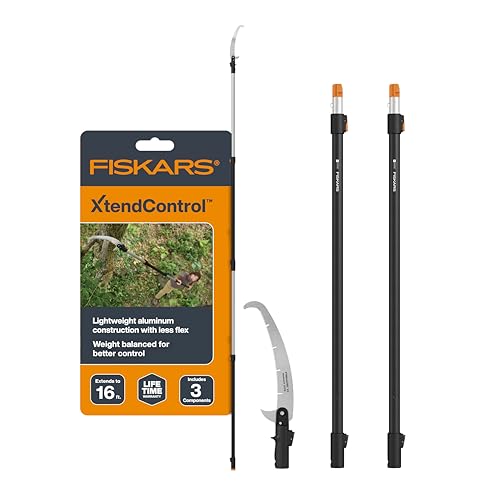
The Fiskars XtendControl 16-Foot Tree Pruner takes a different approach to balance. Instead of one long pole, it uses two interchangeable aluminum extension poles, each extending from 4 to 8 feet, which combine for a maximum 16-foot extension. The design shifts weight closer to the hands, which increases control and reduces fatigue at full reach. Three interchangeable components give three pruning configurations in one package. The 15-inch X3 Double-hooked Saw blade features a triple-grind profile with sawdust reliefs, plus a shaped handle for stand-alone use, so the saw can work on its own for low branches, then attach to the poles for high work. Snap-fit connectors and secondary safety locks keep the components securely in place. The blade material is stainless steel. This is a premium option for tall trees and for gardens where the same tool must switch between low and high work.
Specs
- Type: Manual modular tree pruner with saw
- Reach: Up to 16 feet with two extension poles
- Saw blade: 15-inch X3 double-hooked saw blade
- Blade material: Stainless steel
- Pole material: Aluminum extension poles with snap-fit connectors
- Pole length: Two poles, each 4 to 8 feet
- Tier: Premium
5. Greenworks 24V 8-Inch Cordless Polesaw

The Greenworks 24V 8-Inch Cordless Polesaw is the only powered tool in this roundup. Instead of pulling a rope or sawing by hand, a 24-volt lithium-ion battery drives an 8-inch bar and chain. That makes it a strong choice for thicker limbs and storm cleanup. The kit includes a 2.0Ah battery and charger. The bar and chain use a 0.050 gauge, 33 drive links, and a 3/8-inch low-kickback chain, with an automatic oiler and manual chain tensioning. The aluminum shaft keeps the tool manageable at 7.8 pounds, and the cushioned overmold grip helps with control during powered cuts. The trade-off is cutting style: a polesaw suits limbs thick enough to saw cleanly, while a bypass pruner head is better for small, live twigs. This is a mid-range powered option for homeowners who prune thicker branches often.
Specs
- Type: Battery-powered cordless polesaw
- Battery: 24-volt lithium-ion, 2.0Ah battery and charger included
- Bar length: 8 inches
- Chain: 3/8-inch low-kickback chain, 33 drive links
- Oiler: Automatic oiler with manual chain tensioning
- Shaft material: Aluminum shaft
- Weight: 7.8 pounds
- Tier: Mid-range
How to Choose the Best Tree Pruner
Start with reach, because it decides whether the tool can do the job at all. Measure the height of the highest branch you prune each year, then add your own arm height to the pole length. A 14-foot pole suits most single-story gardens, while a 16-foot pole suits taller shade trees and second-story limbs. Next, match cutting capacity to branch size. Most manual pruner heads in this guide cut branches up to about 1-1/4 inches in diameter. Thicker limbs need a saw, so check the saw blade length as well as the pruner capacity. A 13-inch or 15-inch saw handles limbs that a pruner head cannot, and a hooked or curved blade helps hold the cut line overhead. Pole material and locking system decide how the tool behaves at full extension. Fiberglass resists flex and feels steady, while aluminum is light and easy to maneuver. Look for a clear locking system, whether it is a double lock, a twist lock, or snap-fit connectors with secondary locks. Finally, decide between manual and powered cutting. Manual pruners are quiet, light, and simple, while a battery polesaw cuts thicker limbs with less arm effort but adds battery care and chain maintenance.
Who Should Skip a Pole Tree Pruner
A pole tree pruner is not the right tool for every garden. Skip this category if your trees are small enough to reach with hand pruners or loppers, because a long pole adds weight and awkwardness to work that a short tool does faster. Bypass hand pruners or loppers give better control on shrubs, roses, and low branches, and store in far less space. Skip a manual pole pruner if you only need to cut a few thick limbs each year and already own a chainsaw with safe access to the work. A pole pruner is also the wrong choice for branches near power lines, for dead limbs over a roof, or for any cut where a falling branch could strike a person, a building, or a vehicle. Those jobs call for a professional tree service. Finally, skip a battery polesaw if you do not want to maintain a chain or store a battery.
Frequently Asked Questions
What size tree pruner do I need for a tall tree?
Choose a pole that reaches the highest branch you prune regularly, with your arm height added to the pole length. A 14-foot pole covers most single-story gardens, while a 16-foot pole suits taller shade trees. If the highest branch is well beyond 16 feet, a professional tree service is a safer choice.
Can a tree pruner cut thick branches?
A pruner head alone cuts branches up to about 1-1/4 inches in diameter in most models in this guide. Thicker limbs need the saw blade that comes with the tool, or a powered polesaw with an 8-inch bar. Cut in stages on heavy limbs so the falling wood does not tear the bark.
Is a manual or battery-powered tree pruner better?
A manual pruner is lighter, quieter, and simpler, and it suits routine shaping and small live branches. A battery-powered polesaw cuts thicker limbs with less arm effort and suits storm cleanup and mature trees.
How do I keep a tree pruner blade in good condition?
Wipe the blade clean after each use, remove sap with a cloth, and dry the tool before storage. Keep the blade sharp so it cuts cleanly instead of crushing the stem, and check the pole locks and rope before each session.
Final Verdict
The best tree pruner for most homeowners is the Fiskars 14 Foot Power-Lever Extendable Tree Pruner, because it pairs a useful 14-foot reach with a pruner head and a 15-inch saw in a light, simple manual tool. For taller trees, the Fiskars Chain-Drive model adds reach and leverage, while the XtendControl adds balance at full extension. The Corona TP 6870 suits heavier orchard work, and the Greenworks polesaw suits powered cutting for thicker limbs. Measure your trees and choose the tool that keeps both feet on the ground.
FAQ
What size tree pruner do I need for a tall tree?
Can a tree pruner cut thick branches?
Is a manual or battery-powered tree pruner better?
How do I keep a tree pruner blade in good condition?
More from Amazon
Programs that pair well with the guide above. Offers and eligibility are set by Amazon and may change.
Free shipping on eligible items, Prime Video and more. Eligible new members can start with a free trial.
Start a Prime free trialAudiobooks and podcasts to listen to on the go. Eligible new members can start with a free trial.
Try Audible freeAd-free music streaming. Eligible new subscribers can start with a free trial.
Try Music Unlimited freeA free business account with business pricing and bulk-buying tools for work, shop or home office.
Create a business accountAs an Amazon Associate we earn from qualifying purchases.








Write Your Review
No reviews yet. Be the first to share your experience!