
Key takeaways
- Garden cloches vs frost blankets compared: PET and PVC domes for single plants, floating row covers for whole beds, with sizes, vents and fabric weights.
One clear, cold night can undo weeks of spring growth, and gardeners have two classic ways to answer it: individual cloches that cap a single plant, and floating frost blankets that drape over a row or bed. Both create a sheltered pocket of air around tender growth, but they differ in coverage, daily handling and how much of the garden they can protect.
This guide compares the two approaches, with three cloches and two frost blankets, so you can match the format to the way you actually plant. For a handful of high-value transplants, cloches put protection exactly where it is needed. If your risk is a long row of seedlings or a bed of greens, a blanket covers everything in one pass. Neither side wins outright; the right choice depends on plant count, bed layout and your tolerance for daily venting.
As an Amazon Associate, we earn from qualifying purchases.
Quick answer
Choose cloches when the plants to protect are few and spaced out: each dome covers one plant, vents at the top, and anchors with stakes. Choose a frost blanket when a whole row or bed needs covering in a single sheet. The RooTrimmer 5-pack suits a few prized plants, the VICAMB 40-pack covers many seedlings, and the Agfabric and Gardzen sheets are the picks for rows and wide beds.
RooTrimmer Transparent Garden Cloches, 5-Pack

The RooTrimmer set is the straightforward starting point on the cloche side: five transparent PET plastic domes, each 10 inches across and 6.7 inches high, sized to sit over a single young plant. The clear material lets light reach the leaves while the dome traps a still layer of air around the plant, which is the basic mechanism behind every cloche in this guide.
Each dome has adjustable top vents, so on a bright morning you can open the vent rather than lifting the whole cloche off, then close it again before the evening chill. Steel ground stakes are included to pin the domes down, because a lightweight dome that blows across the yard protects nothing. A pack of five suits a gardener protecting a short list of plants: a few tomato or pepper transplants, a small herb group, or the most tender row in a mixed bed.
Specs
- Form: individual dome cloche
- Material: PET plastic
- Size: 10 in diameter, 6.7 in high
- Pack size: 5
- Venting: adjustable top vents
- Anchoring: steel ground stakes included
nutroeno Plant Protector Cover, 10-Pack

The nutroeno covers double the count to ten PVC cloches, each measuring 10.2 inches by 8.3 inches, which makes this the middle option for gardeners with a full row of individual plants to cap. The slightly taller profile gives seedlings more headroom before they outgrow the cover.
Venting is handled by rotating adjustable air vents in the top, opened or closed with a twist, and the set includes 30 metal stakes for anchoring the covers against wind. One caution from the listing is worth repeating in full: the stakes and labels are small parts, so keep them away from children under 3. The listing’s own copy is inconsistent about how many plant labels are in the box, so treat the label count as unconfirmed and plan on the stakes and covers being the substance of the set.
Specs
- Form: individual cloche
- Material: PVC
- Size: 10.2 in by 8.3 in
- Pack size: 10
- Venting: rotating adjustable air vents
- Anchoring: 30 metal stakes included
VICAMB Garden Cloches, 40-Pack

The VICAMB set is the volume play on the cloche side: 40 domes in one box, each 7.9 inches high and 6.7 inches in diameter, with 80 ground stakes included, two per dome. Instead of reserving domes for a few favourite plants, you can cap every seedling in a bed and still have spares for later succession sowings.
Each dome has a rotary top vent for the same open-on-sunny-mornings routine as the other cloches here. The trade-off for the high count is thinner documentation: listing information is at title level, and the dome material and thickness are not stated, so if material specification matters to you, the RooTrimmer and nutroeno sets above publish more detail.
Specs
- Form: individual cloche
- Material: not stated
- Size: 7.9 in high, 6.7 in diameter
- Pack size: 40
- Venting: rotary top vent
- Anchoring: 80 ground stakes included
Agfabric Floating Row Cover, 6 ft × 50 ft, 0.9 oz
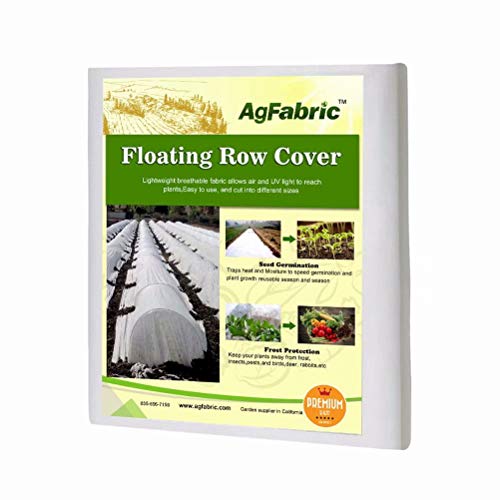
Switching to the blanket side, the Agfabric row cover is a single spun polypropylene sheet, 6 feet wide and 50 feet long, in a 0.9 oz fabric weight, and it is UV-stabilised for repeated outdoor use. Instead of capping plants one at a time, you drape the sheet over a whole row or a narrow bed and secure the edges, so dozens of plants sit under one cover.
A light fabric weight like 0.9 oz is the gentler end of the row-cover range: it rests directly on most crops without crushing them, a style often called a floating cover. The maker claims frost protection down to 28°F and states a light transmission figure of 85 percent; both numbers are the manufacturer’s own claims rather than measured results, so treat them as guidance for comparing fabric weights, not as a guarantee for a specific night. Within this comparison, the Agfabric is the lighter, longer sheet, with less insulation weight per square yard than the Gardzen below.
Specs
- Form: floating row cover sheet
- Material: spun polypropylene, UV-stabilised
- Size: 6 ft by 50 ft
- Fabric weight: 0.9 oz
- Frost protection: maker claims protection down to 28°F
- Light transmission: maker states 85 percent
Gardzen Plant Covers Freeze Protection, 10 ft × 30 ft, 1.5 oz

The Gardzen cover is the heavier, wider blanket of the two: a non-woven fabric sheet 10 feet wide and 30 feet long at 1.5 oz per square yard, sold as a reusable floating row cover. The extra width suits broad beds and grouped containers that a 6-foot sheet would need two passes to cover, and the heavier fabric weight is the option gardeners usually reach for when the forecast is colder rather than merely chilly.
A maker figure of protection down to 28°F circulates for this cover as well; as with the Agfabric, that is a manufacturer claim, not a measured result, and the honest comparison between the two blankets is width, length and fabric weight rather than rival temperature promises. As the heavier sheet, it is the one to weigh down carefully at the edges on windy sites, and to lift on warm days so plants underneath do not overheat.
Specs
- Form: floating row cover sheet, reusable
- Material: non-woven fabric
- Size: 10 ft by 30 ft
- Fabric weight: 1.5 oz per square yard
- Frost protection: maker figure of protection down to 28°F
- Venting: lift or fold back on warm days
How to choose
Start with coverage pattern. Cloches protect plant by plant, so they suit spaced-out plantings, containers and the few transplants you care about most; pack size is the key number, from 5 in the RooTrimmer set to 40 in the VICAMB box. Frost blankets protect area by area, so sheet width and length are the numbers that matter, and one sheet replaces dozens of individual domes on a dense bed.
Next, think about daily handling. Every cloche here has a top vent, and those vents need opening on sunny mornings and closing before cold evenings; a blanket needs its edges checked and the sheet lifted or folded back on warm days. Neither format is fit-and-forget during a changeable spring week.
Fabric weight is the blanket-side decision. The 0.9 oz Agfabric is the lighter sheet, easier on delicate crops and longer at 50 feet; the 1.5 oz Gardzen is the heavier sheet, wider at 10 feet and the more substantial cover of the two. On the cloche side, the equivalent choice is size and material detail: the RooTrimmer publishes full PET material detail, the nutroeno adds height and a mid-size count, and the VICAMB trades material detail for sheer numbers.
Finally, anchoring. Cloches arrive with their stakes included, counted per set above. Blankets arrive as bare sheets, so plan to weigh down or pin the edges, especially on exposed plots.
Who should skip
Skip both formats if your garden rarely sees frost; neither product earns its storage space in a reliably warm climate. Skip cloches if your plants are already tall or wide, since even the tallest dome here is under 9 inches, and skip them if you cannot manage the twice-daily venting routine during sunny spells. Skip frost blankets if your planting is a few isolated specimens in separate corners of the garden, where a sheet has nothing continuous to cover, and skip the lighter 0.9 oz fabric if your site is very windy and you have no way to secure long edges. Gardeners wanting rigid, season-long structures should look at cold frames instead of either format here.
FAQ
Do cloches or frost blankets protect better against frost?
Neither is automatically better; they protect differently. A cloche concentrates its shelter on one plant and can be vented precisely, while a blanket spreads lighter shelter over a whole bed. The blanket makers claim protection down to 28°F, but those are manufacturer claims, so choose by coverage pattern and use the format you will actually put out on cold nights.
Can these covers stay on during the day?
The cloches are designed to: open the top vents on bright mornings so heat does not build up, and close them again in the evening. The Agfabric sheet’s maker states 85 percent light transmission, which is why light row covers are often left floating over crops for days at a time, though lifting any cover on a warm, sunny day is the safer habit.
How many cloches do I need?
One per plant you intend to protect. Count your transplants before choosing a pack: five RooTrimmer domes for a short list of prized plants, ten nutroeno covers for a full row, or the 40-dome VICAMB box when you are capping a whole bed of seedlings and want spares for later sowings.
How do I keep a frost blanket in place?
Drape it loosely so plants are not pressed flat, then secure the edges along both sides and at the ends. On the sheets here, the fabric itself is light, especially the 0.9 oz Agfabric, so edge security is what stops a night breeze from moving the cover off the bed it was meant to protect.
Final verdict
For a handful of valued plants, cloches are the precise tool: the RooTrimmer 5-pack is the best-documented small set, the nutroeno 10-pack adds height and numbers, and the VICAMB 40-pack makes per-plant protection practical across a whole bed of seedlings. For rows and beds, frost blankets cover more ground with less handling per plant: the Agfabric 0.9 oz sheet is the long, light option, and the Gardzen 1.5 oz sheet is the wide, heavy one. Match the format to your planting pattern first, and the specific pick follows from pack size on one side and sheet dimensions on the other.
Product and ASIN Reference
| Product | ASIN |
|---|---|
| RooTrimmer Transparent Garden Cloches, 5-Pack | B0DSPV58N5 |
| nutroeno Plant Protector Cover, 10-Pack | B08YN8RTTJ |
| VICAMB Garden Cloches, 40-Pack | B0G7C8TYQ1 |
| Agfabric Floating Row Cover, 6 ft × 50 ft, 0.9 oz | B01BUNY34O |
| Gardzen Plant Covers Freeze Protection, 10 ft × 30 ft, 1.5 oz | B0D8KTQKVJ |
FAQ
Do cloches or frost blankets protect better against frost?
Can these covers stay on during the day?
How many cloches do I need?
How do I keep a frost blanket in place?
More from Amazon
Programs that pair well with the guide above. Offers and eligibility are set by Amazon and may change.
Free shipping on eligible items, Prime Video and more. Eligible new members can start with a free trial.
Start a Prime free trialAudiobooks and podcasts to listen to on the go. Eligible new members can start with a free trial.
Try Audible freeAd-free music streaming. Eligible new subscribers can start with a free trial.
Try Music Unlimited freeA free business account with business pricing and bulk-buying tools for work, shop or home office.
Create a business accountAs an Amazon Associate we earn from qualifying purchases.




Write Your Review
No reviews yet. Be the first to share your experience!