
Key takeaways
- Compare LiFePO4 portable power stations for frequent backup use, with cycle life, capacity, output and recharge specs taken from Amazon pages.
A station that waits in a closet for one outage a year can be almost anything with a handle. A station you lean on every month is a different purchase entirely, because the battery itself becomes the wearing part. Every discharge and recharge spends a little of the pack, so the decision that matters here is cycle durability: how many cycles the LiFePO4 cells are built to take before capacity fades, and whether capacity and output still suit your loads once that slow fading begins.
This guide serves households on unreliable grid power, home workers who cannot lose a router or laptop midday, and anyone who repeatedly runs a fridge, lights or small appliances through short outages. Each pick below uses a LiFePO4 battery, and each specification quoted comes from the product name and details on its Amazon product page, including cycle figures where the page states them.
Quick Picks
As an Amazon Associate we earn from qualifying purchases.
| Product | Best for | Key spec from title |
|---|---|---|
| BLUETTI Portable Power Station AC180 | Frequent fridge and appliance backup at home | 1152Wh LiFePO4 |
| EF ECOFLOW Portable Power Station DELTA 2 | Many devices plugged in at once, with room to expand | 1024Wh LiFePO4 |
| Anker SOLIX C1000 Portable Power Station | Fast turnaround between back-to-back outages | 1056Wh LiFePO4 |
| Jackery Explorer 1000 v2 Portable Power Station | Lighter carry between rooms, garage and car | 1070Wh LiFePO4 |
How to Choose
Read the Cycle Rating Before Anything Else
Frequent backup use turns cycle life from a footnote into the headline figure. A cycle is one full discharge and recharge, and a household cycling a station twice a week passes one hundred cycles a year without trying. Where an Amazon page states a cycle figure, treat it as the product’s working lifespan in plain form: the BLUETTI AC180 page lists its battery at 3500 or more cycles, while the Jackery Explorer 1000 v2 page states its LFP pack holds over 70 percent of capacity after 4,000 cycles. When a page gives no cycle figure, as with the DELTA 2 and the Anker SOLIX C1000 listings opened for this guide, that absence is itself information worth weighing before you buy.
Size Capacity to the Loads You Repeat
Capacity in watt-hours only means something against your own repeated loads, so do the arithmetic once, honestly. A fridge that draws around 100 watts while running, a router at roughly 10 watts and two lamps can stay inside a 1000Wh-class station for an evening outage, with margin. Add a kettle or a microwave and the same station empties far sooner, not because it is weak but because heating loads are hungry. Buy for the outage pattern you actually have: the four stations here sit between 1024Wh and 1152Wh, close enough that cycle life, output and recharge speed separate them more than raw capacity does.
Match Output and Surge to Motors and Heating Loads
Continuous output decides what runs at the same time; surge headroom decides whether motor loads start at all. Fridge compressors and pumps ask for a brief spike at start-up, and a station rated 1800W with a higher starting figure handles that spike more calmly than one working at its limit. The DELTA 2 and the Anker SOLIX C1000 both list 1800W running output, the AC180 lists 1800W with a 2700W peak through its app lifting mode, and the Jackery lists 1500W with a 3000W surge peak. None of that helps a load the inverter cannot start, so check the starting wattage line on the page, not just the headline output.
Plan the Recharge Between Outages
A backup station that takes all day to refill is a poor fit for a street where the power drops twice in one week. Recharge speed therefore belongs in the first round of comparisons, not the last. The Anker SOLIX C1000 title states a full charge in 58 minutes, the AC180 page states a full charge in one hour at 1440W AC input and a charge to 80 percent in 45 minutes, and the Jackery reaches a full charge in one hour only with its emergency charging mode enabled in the app, defaulting to 1.7 hours otherwise. Solar input matters too: the AC180 accepts up to 500W, rebuilding charge during a long outage.
The 4 Best Options
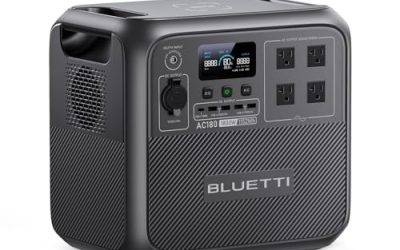
BLUETTI Portable Power Station AC180

Households that cycle a station hard, week after week, should look at the AC180 first. Its Amazon page puts the cycle figure in its own comparison table, listing the battery as LiFePO4 at 3500 or more cycles, and the rest of the sheet suits repeated home duty: 1152Wh of capacity, 1800W of output for a fridge and smaller appliances together, and a 20 ms UPS switchover that keeps a router or computer from dropping when the grid fails. It is the heaviest pick here at 37.4 pounds, so it suits a fixed corner near the loads it serves rather than daily carrying.
Specs
- Capacity: 1152Wh LiFePO4 battery
- AC output: 1800W, with 2700W peak through Power Lifting in the app
- AC outlets: 4, rated 1800W in the product title
- Recharge: full charge in 1 hour at 1440W AC input; 0 to 80 percent in 45 minutes
- Solar input: up to 500W, full solar charge in 2.8 to 3.3 hours
- UPS switchover: 20 ms
- Weight: 37.4 pounds
- Dimensions: 13.39 x 9.72 x 12.48 in
- Included: AC charging cable, car charging cable, solar charging cable, user manual, 5-year warranty
Best for: Frequent home backup where a stated cycle figure and UPS switchover matter most.
Watch out for: The 2700W figure is a peak reached through the app lifting mode, not the standard output, and the weight makes it a stay-in-place unit.
ASIN: B0C1SMJTDT
EF ECOFLOW Portable Power Station DELTA 2

The DELTA 2 answers a different frequent-use problem: too many things needing power at once. Its page lists 15 total power outlets, the most in this group, alongside 1024Wh of LiFePO4 capacity and 1800W running output, so a fridge, router, lamps, laptop and phone chargers can share one station without a tangle of adapters. EcoFlow also lists expandable capacity among its special features, which suits buyers whose backup needs are still growing. At 27 pounds it moves between rooms without a struggle, and its footprint is tall rather than wide, which helps in a crowded utility corner.
Specs
- Capacity: 1024Wh LiFePO4 (LFP) battery
- AC output: 1800W running wattage
- Starting wattage: 2700W
- USB-C output: 100W, per the product title
- Outlets: 15 total power outlets
- Special features listed: expandable capacity, faster AC charging
- Weight: 27 pounds
- Dimensions: 15.7 x 8.3 x 11.3 in
- Model: EFD330
Best for: Backup for many devices at once, with an expansion path if needs grow.
Watch out for: The opened Amazon page does not state a cycle-life figure, so buyers prioritising cycle durability should weigh that gap against its outlet count.
ASIN: B0B9XB57XM
Anker SOLIX C1000 Portable Power Station

Short gaps between outages are where the C1000 earns its place. The product title states a full charge in 58 minutes, the fastest refill claim in this group, and it pairs that speed with 1056Wh of LiFePO4 capacity and 1800W running output, peaking at 2400W. Eleven total outlets cover a work-from-home corner and the kitchen essentials without swapping plugs, and the 5-year warranty listed on the page suits a product bought for years of regular cycling. At 27.6 pounds it is no harder to move than the DELTA 2, so it can live by the desk and travel to wherever an outage bites hardest.
Specs
- Capacity: 1056Wh LiFePO4 battery, per the product title
- AC output: 1800W running wattage
- Starting wattage: 2400W peak
- Recharge: full charge in 58 minutes, per the product title
- Outlets: 11 total power outlets
- Weight: 27.6 pounds
- Dimensions: 14.8 x 8.07 x 11.02 in
- Warranty: 5 years, as listed on the page
- Model: A1761
Best for: Frequent short outages where a fast full recharge between cuts matters.
Watch out for: The opened page does not state a cycle figure, and the fastest charging depends on the settings described on the listing, so read the charging notes before relying on the 58-minute figure.
ASIN: B0C5C89QKZ
Jackery Explorer 1000 v2 Portable Power Station

The Jackery makes the durability argument in the clearest words on any page here: its LFP battery maintains over 70 percent of its original capacity even after 4,000 charge cycles, with a lifespan the page puts beyond ten years. Around that claim sits a lighter package than its rivals, 23.8 pounds with a foldable handle, 1070Wh of capacity and 1500W of output with a 3000W surge peak for starting a fridge. Output is lower than the 1800W models, so it fits households whose repeated loads are modest, and its two USB-C ports, at 100W and 30W, keep laptop charging simple.
Specs
- Capacity: 1070Wh LiFePO4 battery
- AC output: 1500W, with 3000W surge peak
- Cycle life: over 70 percent of original capacity after 4,000 charge cycles, per the page
- Ports: 3 AC ports, 2 USB-C ports (100W max and 30W max), 1 USB-A port (18W max), 1 car port 12V/10A
- Recharge: full charge in 1 hour with emergency charging via the app; 1.7 hours in the default mode
- Weight: around 23.8 lbs / 10.8 kg
- Dimensions: 12.87 x 8.82 x 9.72 in
- Charge temperature listed: 0 to 45 degrees C (32 to 113 degrees F)
- Discharge temperature listed: -10 to 45 degrees C (14 to 113 degrees F)
Best for: Buyers who want the clearest stated cycle-life figure in a lighter, easier-to-carry unit.
Watch out for: Solar charging is compatible only with Jackery solar panels, per the page, and the 1500W output is the lowest here.
ASIN: B0D7PPG25F
Which One Fits Your Situation
Your Street Loses Power Most Weeks
Choose the BLUETTI AC180. Frequent cycling is exactly the duty its page speaks to, with the battery listed at 3500 or more cycles, and the 20 ms UPS switchover keeps connected equipment running through the moment the grid drops. Its 1152Wh is also the largest capacity in this group, which stretches each cycle further before the next recharge is needed.
You Work From Home and Cannot Drop Offline
Choose the Anker SOLIX C1000. A router, laptop and monitor draw little, so its 1056Wh lasts through a working day of outage, and the stated 58-minute full recharge means an overnight cut leaves it ready again by morning. The DELTA 2 is the alternative if your desk setup needs more outlets than its eleven.
Your Backup Load Is a Fridge Plus Basics
Choose the Jackery Explorer 1000 v2 if the fridge is modest and portability matters, since its 3000W surge peak addresses compressor start-up and it is the lightest unit here. Step up to the AC180 or DELTA 2 when a second appliance joins the fridge, because their 1800W running output leaves more headroom for overlapping loads.
Your Needs Keep Growing
Choose the EF ECOFLOW DELTA 2. Expandable capacity is listed among its special features, so the station you buy for this winter’s outages is not stranded when you later add a second room or a larger fridge. Its 15 outlets also postpone the day you start rationing sockets between devices.
Safety Notes for Frequent Backup Use
Charge the station in a dry, ventilated spot, on a hard surface, and keep its vents and fan openings clear while it charges and while it runs; a unit cycling every week moves a lot of air through those vents over its life. Store and charge the battery within the temperature range the manufacturer states for that model — the Jackery page, for example, lists a charging range of 0 to 45 degrees C — and check the stated limits on your own unit’s page or manual rather than assuming every model shares them. Do not charge a battery that is far colder than the manufacturer’s stated charging limit; bring it indoors and let it warm first. Never open the case or attempt to service the battery pack yourself; a sealed LiFePO4 pack is not a user-serviceable part, and frequent use is a reason to inspect cables and plugs for wear, not to open the unit.
Common Mistakes
- Buying on capacity alone and ignoring the cycle figure, then discovering that a frequently cycled pack fades sooner than expected.
- Counting surge wattage as running wattage, so a fridge and a kettle together trip a station that looked big enough on paper.
- Leaving the station at a full charge in a hot garage for months between uses instead of following the storage guidance for the model.
- Running heating appliances — kettles, space heaters, hair dryers — as routine backup loads and draining in an hour what should last an evening.
- Forgetting the recharge plan: a slow-charging station bought for a home with weekly outages spends half its life refilling instead of standing ready.
Frequently Asked Questions
How many cycles should a frequently used backup station handle?
Look for a stated figure in the thousands on the product page. In this group the AC180 page lists 3500 or more cycles and the Jackery page states over 70 percent capacity after 4,000 cycles. At two cycles a week, figures like those translate into many years of service before capacity fade becomes the limiting factor.
Does fast charging wear a LiFePO4 battery out sooner?
The pages here present fast charging as a standard feature, and one model, the Jackery, defaults to a slower 1.7-hour charge that its page says is set to optimise battery health, with the one-hour mode enabled deliberately in the app. For frequent use, treat the fast mode as a tool for urgent turnarounds rather than the everyday default.
Can one of these stations run a full-size fridge overnight?
That depends on the fridge’s draw and what else shares the station. A 1024Wh to 1152Wh unit running only a fridge that cycles on and off stands a reasonable chance of covering a night; add lights, a router and chargers and the margin shrinks. Check your fridge’s wattage, divide the capacity by it, and keep a reserve rather than planning to empty the pack.
Should I leave the station plugged in all the time as a UPS?
One pick here, the AC180, is sold with a stated 20 ms UPS switchover, which is the feature to look for if pass-through backup is the plan. For other models, check whether the page describes UPS behaviour at all before leaving the unit permanently in line with your equipment, and follow the manufacturer’s guidance on long-term plugged-in storage.
FAQ
How many cycles should a frequently used backup station handle?
Does fast charging wear a LiFePO4 battery out sooner?
Can one of these stations run a full-size fridge overnight?
Should I leave the station plugged in all the time as a UPS?
More from Amazon
Programs that pair well with the guide above. Offers and eligibility are set by Amazon and may change.
Free shipping on eligible items, Prime Video and more. Eligible new members can start with a free trial.
Start a Prime free trialAudiobooks and podcasts to listen to on the go. Eligible new members can start with a free trial.
Try Audible freeAd-free music streaming. Eligible new subscribers can start with a free trial.
Try Music Unlimited freeA free business account with business pricing and bulk-buying tools for work, shop or home office.
Create a business accountAs an Amazon Associate we earn from qualifying purchases.



Write Your Review
No reviews yet. Be the first to share your experience!