
Key takeaways
- Compare five water filter pitchers from Brita, ZeroWater, PUR, LifeStraw and Waterdrop by capacity, stated filter life, materials and daily upkeep needs.
A countertop filter pitcher is one of the simplest ways to improve the taste of tap water without plumbing work or a permanent installation. The five pitchers below cover the main designs on the market: large family-size models, compact fridge-door models, a glass option, and filters built around activated carbon, ion exchange, or a membrane. Every filtration figure, certification, and filter-life rating in this guide comes from the product listings themselves, so treat each one as a claim made by the maker rather than an independently verified result.
The picks suit different households. Two hold ten cups for families that refill often, while three hold seven cups for smaller kitchens and tighter fridge shelves. One adds a built-in meter for readers who like to check readings, one uses glass instead of plastic, and one stretches the interval between filter changes. Filter life matters as much as capacity, because a pitcher only performs as its maker describes while its filter is within its rated lifespan.
As an Amazon Associate, we earn from qualifying purchases.
Quick answer
For most kitchens, the Brita Large 10-Cup Elite is the straightforward pick, with an Elite filter the maker rates at about six months. ZeroWater suits readers who want a built-in TDS meter and five-stage filtration, while PUR covers smaller households. LifeStraw Home adds a glass body and membrane filtration, and Waterdrop stretches filter changes with a filter the maker rates at 200 gallons.
How to choose
Start with capacity. A ten-cup pitcher reduces refill trips for families and shared kitchens, while a seven-cup model fits smaller fridges and households that drink less water each day. Check the footprint against your fridge shelf as well, since tall pitchers can clash with low shelves even when the cup count looks modest.
Next, look at the filtration method the listing describes. Activated carbon is the common approach for chlorine taste and odor. Ion-exchange designs, like the five-stage system ZeroWater describes, target dissolved solids. A membrane design, like the one LifeStraw lists, adds a physical barrier stage. Each maker supports its design with its own certification and reduction claims, and those claims differ from brand to brand, so compare the specific contaminants each listing names rather than assuming one system covers everything.
Filter life drives the ongoing routine. Stated lifespans in this group range from about two months to a maker-rated 200 gallons, and a longer rating means fewer changes but also a longer wait before a fresh filter restores the stated performance. Indicator lights and smart reminders help track changes. Finally, consider materials: most pitchers here are BPA-free plastic per their listings, while one uses borosilicate glass with a silicone base for readers who prefer to avoid a plastic body.
Brita Large 10-Cup Elite Water Filter Pitcher
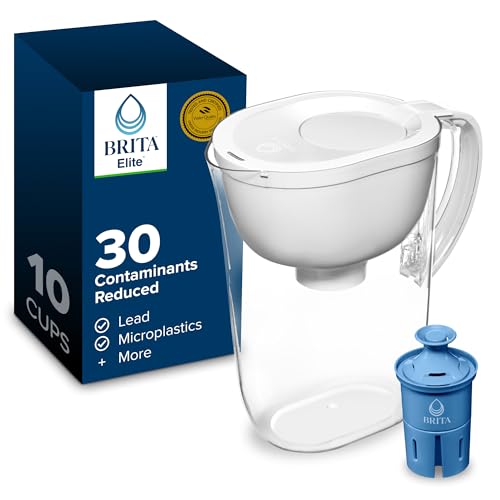
This is the mainstream family pick. Brita lists the pitcher at ten cups with its Elite filter, which the maker rates at roughly six months or 120 gallons before replacement, the longest time-based rating in this group. A SmartLight indicator signals when a change is due, which removes the guesswork of marking a calendar.
The listing states the pitcher is WQA NSF/ANSI certified and that the Elite filter reduces 99 Percent of lead, microplastics, and 30 contaminants, and removes chlorine taste and odor. Those are Brita’s claims for this filter, presented here as the maker states them. The body is listed as BPA-free, and one filter is included in the box.
Specs
- Capacity: 10 cups
- Filter: Elite filter, maker-rated at about 6 months or 120 gallons
- Indicator: SmartLight filter indicator
- Filtration medium: activated carbon, per the listing
- Body: BPA-free, per the listing
- Model: Everyday OB46/OB06
- Dimensions: not stated
ZeroWater 10-Cup Ready-Pour 5-Stage Water Filter Pitcher
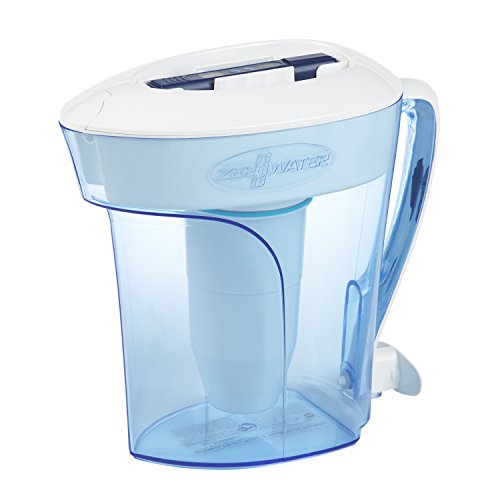
ZeroWater takes a different approach from carbon-only pitchers. The listing describes a five-stage ion-exchange filtration system and frames the result as 0 TDS, meaning the maker presents the filter as reducing total dissolved solids to a zero reading on the included meter. That framing is ZeroWater’s own. The built-in TDS meter lets owners check the reading and judge when the filter is spent.
The listing states the pitcher is IAPMO certified to reduce lead, chromium, and PFOA/PFOS, again as the maker’s claims. The Ready-Pour design holds ten cups, matching the Brita on capacity while aiming at readers who care about dissolved solids rather than taste alone. The body is listed as BPA-free.
Specs
- Capacity: 10 cups, Ready-Pour design
- Filtration: 5-stage ion exchange, per the listing
- Meter: built-in TDS meter included
- Dimensions: 11.63 x 5.93 x 11 inches
- Body: BPA-free, per the listing
- Model: ZP-010
- Weight: not stated
Check the Amazon product page for current availability.
PUR 7-Cup Water Filter Pitcher

The PUR pitcher is the compact, low-fuss option in this group. It holds seven cups, uses what the listing calls 2-in-1 filtration, and seals with a LockFit cap designed to stay in place while pouring. PUR rates its filter at two months or up to 40 gallons, the shortest stated life here, so owners should expect more frequent changes than with the Brita or Waterdrop.
The listing describes the filtration as powerful and faster, and notes that parts are dishwasher safe, which simplifies cleaning. One point of honesty stands out in PUR’s own copy: the listing states plainly that PUR does not filter microbes. Readers who need protection aimed at bacteria or parasites should look at the membrane design below instead of assuming any pitcher covers that ground.
Specs
- Capacity: 7 cups
- Filter life: maker-rated at 2 months or up to 40 gallons
- Filtration: 2-in-1 filtration, per the listing
- Cap: LockFit cap design
- Care: dishwasher-safe parts, per the listing
- Weight: 1.61 lb
- Model: PPT700WAMA
- Dimensions: not stated
LifeStraw Home Water Filter Pitcher, 7-Cup Glass

LifeStraw is the pick for readers who want a glass pitcher and a membrane stage. The body is borosilicate glass with a silicone base, holding seven cups. Per the listing, filtration combines activated carbon with a microfiltration membrane, and LifeStraw presents the pitcher as everyday protection against bacteria, parasites, microplastics, lead, mercury, PFAS, and a variety of chemicals. Those protection claims are the maker’s, attributed here as the listing states them.
The two filter parts run on different schedules: the brand’s table puts the carbon filter at about two months and the membrane at about one year, both as maker figures. That split means one inexpensive-feeling routine of regular carbon changes plus a rare membrane swap. The white finish and glass body also make it the most display-friendly option on a countertop.
Specs
- Capacity: 7 cups
- Body: borosilicate glass with silicone base
- Dimensions: 5.8 x 5.8 x 11.25 inches
- Filtration: activated carbon plus microfiltration membrane, per the listing
- Filter life: carbon filter about 2 months, membrane about 1 year, per the brand’s table
- Model: LSH7GLSWH21
Check the Amazon product page for current availability.
Waterdrop Water Filter Pitcher, 7-Cup Elfin

Waterdrop competes on filter longevity. The listing states the included filter lasts 200 gallons and describes that as a 5X times lifetime compared with standard filters, which is the maker’s own comparison language. For a seven-cup pitcher, that rating stretches the change interval well beyond the PUR’s stated two months. A smart filter indicator tracks when a replacement is due.
Per the listing, the pitcher is NSF 42/372 certified and reduces PFOA/PFOS and chlorine, presented here as Waterdrop’s claims. The Elfin design in blue is sized for fridge and countertop use, and the body is listed as BPA-free. Waterdrop also states plainly that this pitcher does not lower TDS, so readers chasing a zero dissolved-solids reading should choose the ZeroWater instead.
Specs
- Capacity: 7 cups
- Filter life: maker-rated at 200 gallons
- Certifications: NSF 42/372, per the listing
- Indicator: smart filter indicator
- Body: BPA-free, per the listing
- Weight: 840 g
- Replacement filter: WD-PF-01A
- Model: WD-PT-05B
- Dimensions: 9.7 x 3.8 x 10 inches
Check the Amazon product page for current availability.
Who should skip
Skip pitcher filters if you want filtration for the whole home or a high flow rate at the tap; an under-sink or whole-house system fits that goal better. Skip the carbon-only pitchers if your concern is bacteria or parasites, since PUR states plainly that its pitcher does not filter microbes, and only the LifeStraw listing here describes a membrane stage aimed at that category. Skip the ten-cup models if your fridge shelves are low or crowded, and skip any pitcher if you know you will not track filter changes, because every performance claim in these listings assumes a filter within its rated life.
FAQ
Do these pitchers actually remove lead?
Brita states its Elite filter reduces 99 Percent of lead, ZeroWater states its pitcher is IAPMO certified to reduce lead, and LifeStraw lists lead among the substances its pitcher is presented as protecting against. Each figure is a claim from the maker for its own filter, so check the certification details on the listing that matches the pitcher you choose.
How often do the filters need to be changed?
It depends on the brand. PUR rates its filter at two months or up to 40 gallons, Brita rates the Elite filter at about six months or 120 gallons, Waterdrop rates its filter at 200 gallons, and LifeStraw splits its parts at about two months for carbon and about one year for the membrane. All of these are maker ratings, and heavy daily use can shorten real intervals.
Does a zero TDS reading mean the water is safer?
Not necessarily. TDS measures the total dissolved solids in water, which includes ordinary minerals. ZeroWater frames its five-stage filter around a 0 TDS reading, while Waterdrop states plainly that its pitcher does not lower TDS. A low reading describes dissolved content, not a complete safety verdict, so match the pitcher to the specific concern each listing addresses.
Which pitcher suits a small fridge or a single person?
The three seven-cup models fit that role: the PUR, the LifeStraw Home, and the Waterdrop Elfin. The LifeStraw lists its dimensions at 5.8 x 5.8 x 11.25 inches and the Waterdrop at 9.7 x 3.8 x 10 inches, so measure your shelf height before choosing, especially with the taller glass pitcher.
Final verdict
For most households, the Brita Large 10-Cup Elite is the balanced default: the largest capacity here paired with the longest time-based filter rating its maker states. Choose the ZeroWater if dissolved solids and a meter reading guide your decision, the PUR for a compact pitcher with simple upkeep and honest limits, the LifeStraw Home for glass construction and the only membrane design in the group, or the Waterdrop if a maker-rated 200-gallon filter life matters most. Whichever you pick, treat the filtration figures as the makers’ claims and keep up with the stated change schedule.
Product and ASIN Reference
| Product | ASIN |
|---|---|
| Brita Large 10-Cup Elite Water Filter Pitcher, WQA NSF/ANSI Certified, Reduces 99 Percent of Lead, Microplastics, & 30 Contaminants, BPA-Free, Removes Chlorine Taste & Odor, 1 Filter Included, White | B0B3GK9RW6 |
| ZeroWater 10-Cup Ready-Pour 5-Stage Water Filter Pitcher 0 TDS for Improved Tap Water Taste – IAPMO Certified to Reduce Lead, Chromium, and PFOA/PFOS | B0073PZ6O0 |
| PUR 7-Cup Water Filter Pitcher, Cleaner, Great-Tasting Water, Dishwasher Safe, Powerful, Faster Filtration, LockFit Cap Design – White | B09LP3WDGK |
| LifeStraw Home– Water Filter Pitcher, 7-Cup, Glass with Silicone Base, White, for Everyday Protection Against Bacteria, Parasites, Microplastics, Lead, Mercury, PFAS and a Variety of Chemicals | B09R6211QP |
| Waterdrop Water Filter Pitcher with 1 Filter, 5X Times Lifetime, Lasts 200 Gallons, for Fridge, Countertop and Gift, Reduces PFOA/PFOS, Chlorine, 7-Cup Capacity, Elfin, Blue | B081Q6DGGY |
FAQ
Do these pitchers actually remove lead?
How often do the filters need to be changed?
Does a zero TDS reading mean the water is safer?
Which pitcher suits a small fridge or a single person?
More from Amazon
Programs that pair well with the guide above. Offers and eligibility are set by Amazon and may change.
Free shipping on eligible items, Prime Video and more. Eligible new members can start with a free trial.
Start a Prime free trialAudiobooks and podcasts to listen to on the go. Eligible new members can start with a free trial.
Try Audible freeAd-free music streaming. Eligible new subscribers can start with a free trial.
Try Music Unlimited freeA free business account with business pricing and bulk-buying tools for work, shop or home office.
Create a business accountAs an Amazon Associate we earn from qualifying purchases.
Write Your Review
No reviews yet. Be the first to share your experience!