
Key takeaways
- The best ergonomic snow shovels for snow removal beginners are light, forgiving and easy to lift, so a first winter of shoveling stays manageable.
First-time shovelers usually buy the wrong tool in one of two ways: they grab the widest blade in the store and discover it is too heavy once loaded, or they pick the lightest shovel and find it bends under wet snow. The real decision is balance. A beginner needs a shovel that is light enough to lift all morning, sturdy enough to survive a mistake like prying at ice, and shaped so good posture happens naturally instead of requiring a lesson in body mechanics.
This guide is for new homeowners facing their first winter, renters clearing a walk for the first time, and anyone who has never owned a snow shovel before. The four models below were chosen from product names and specifications shown on their Amazon listings, with an eye toward forgiving designs, simple construction, and handles that make the work easier from the very first storm.
Quick Picks
As an Amazon Associate we earn from qualifying purchases.
| Product | Best for | Key spec from title |
|---|---|---|
| Snow Joe Shovelution SJ-SHLV20 | First-timers who want lifting help on every scoop | 20-inch spring-assisted handle shovel |
| Suncast SC3250 | Learning to push and scoop with one tool | 18-inch ergonomic shovel and pusher combo |
| True Temper 1603072 | A simple, sturdy first shovel for a front walk | 18-inch ergonomic poly combo shovel |
| ErgieShovel ERG-SNSH18 | New shovelers who want two grips for better control | 18-inch dual-handle steel shaft shovel |
How to Choose
Start With a Blade You Can Actually Lift
A beginner’s biggest error is overestimating how much snow a scoop holds. An 18-inch blade filled with wet snow can weigh as much as a small child, and that load arrives on your back dozens of times per storm. Start with a blade in the 17 to 20 inch range and take half scoops until you learn what your body handles comfortably. A poly blade keeps the tool itself light, which matters when you are still building the rhythm of scoop, lift, and toss. Depth matters too: a deep scoop blade carries more per pass but punishes a tired arm faster than a shallow pusher-style blade.
Handles That Teach Good Posture
You do not need a lesson in ergonomics if the handle does the teaching. A bent shaft naturally holds the blade flat while your hands ride higher, so you push with your legs and stay taller. A second handle lower on the shaft gives your bottom hand a grip near the load, which shortens the lever arm and makes each scoop feel lighter. Dual D-ring handles work the same way, spreading the effort between both arms. Straight shafts are not wrong, but they ask more of your technique: with a straight handle you must remember to bend your knees, while a bent or assisted handle makes the right posture the easy one.
Weight and Length for Your Height
Total length decides whether you hunch or stand tall. Most adult shovels run 50 to 54 inches, and taller beginners should look toward the long end of that range so the blade reaches the ground without a deep bend. Weight is the other half of the equation: a bare tool around three to four pounds stays manageable, while a heavier steel blade or an awkward balance point will tire your shoulders before the walk is half done. Hold the shovel the way you would use it and check whether the head feels nose-heavy; a tool that balances near the middle grip is far easier to control when you are still learning the motion.
Where Budget Models Cut Corners
Entry-level shovels hide their savings in places a beginner will not notice until midwinter. The wear strip is the first casualty: a blade with no metal edge scrapes poorly and wears round on concrete within a season. The grip is next, since a smooth plastic handle slips inside a wet glove while a proper D-grip locks your hand in place. Shaft joints are the third weak point, because a thin screw-together connection can wobble or seize after a few freeze-and-thaw cycles. Finally, a blade that flexes at the neck will fold under wet snow. Spend a little more on those four details and the shovel will survive your learning curve.
The 4 Best Options
Snow Joe Shovelution SJ-SHLV20

The Shovelution SJ-SHLV20 is the most beginner-friendly manual shovel in this group because its spring-assisted second handle does real work on every lift. The lower handle acts as a fulcrum, so the loaded blade rises with your arms and legs while your back stays closer to upright. Its 20-inch blade moves a good amount of snow per pass, which suits a driveway or a long walk, and the impact-resistant blade holds up when a new shoveler inevitably catches a curb or a step edge.
Specs
- 20-inch impact-resistant blade
- Spring-assisted second handle
- Aluminum handle
- D-ring grip
- Blade and handle designed for lifting and throwing snow
Best for: New homeowners clearing a driveway or long walk who want the handle to share the lifting effort.
Watch out for: The 20-inch blade fills fast with wet snow, so take partial scoops until you learn how heavy a full load feels.
Suncast SC3250

The Suncast SC3250 is a patient teacher of a shovel. It works as both a pusher and a scoop, so a beginner can push light snow off the walk and scoop the deeper piles without switching tools. The bent S-shaped shaft keeps your posture taller than a straight handle, and the ribbed steel core inside the shaft adds strength where a first-time shoveler will stress it most. A galvanized steel wear strip keeps the edge scraping clean on concrete through the season.
Specs
- 18-inch polycarbonate blade
- 12-inch blade height
- 52.5-inch total length
- Ribbed steel core shaft
- Galvanized steel wear strip
- Ergonomic bent handle with D-grip
Best for: Beginners who want one tool that pushes light snow and scoops deeper drifts on a driveway or walk.
Watch out for: The angled rib pattern on the blade sheds snow well, but packed ice still needs a separate scraper rather than force from the blade edge.
True Temper 1603072

True Temper’s 1603072 is the plain, dependable first shovel. Its poly combo blade pushes and scoops, its steel handle has an ergonomic bend that reduces hunching, and its steel wear strip protects the edge on pavement. There is no second handle to learn and no assembly puzzle to solve, which makes it a good match for someone who wants to open the box, walk outside, and start clearing. The 18-inch width is the classic size for a residential walk, and the oversized D-grip fits a gloved hand.
Specs
- 18-inch poly combo blade
- 13.5-inch blade length
- Steel ergonomic handle
- Steel wear strip
- 54-inch overall length
- Oversized poly D-grip
Best for: A first-time buyer who wants a simple, sturdy shovel with no learning curve.
Watch out for: The poly blade flexes under a very heavy wet load, so take half scoops when the snow is dense and slushy.
ErgieShovel ERG-SNSH18
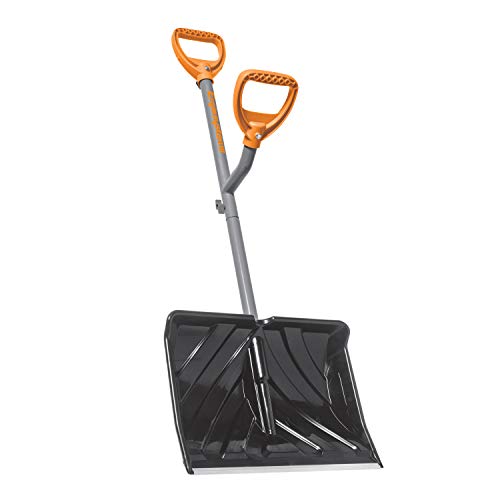
The ErgieShovel ERG-SNSH18 gives a beginner two grips instead of one, which is a genuine advantage when you have not yet learned where your hands belong. The lower D-ring handle sits close to the blade, so the lifting effort spreads across both arms and both shoulders rather than loading one side of your back. Its steel shaft and polycarbonate push-scoop blade are built to take the knocks of a first winter, and the 18-inch width is forgiving on a standard walk or driveway.
Specs
- 18-inch push and scoop combination blade
- 48-inch shaft
- Polycarbonate blade
- Steel shaft
- Dual D-ring handles
- Aluminum wear strip
Best for: New shovelers who want a second grip to steady the load and keep their posture upright.
Watch out for: The dual-handle layout feels different from a normal shovel at first, so give it a full clearing session before judging the grip positions.
Which One Fits Your Situation
Your First Winter in a New House
A new house usually means a driveway and a walk you have never cleared. Pick the Snow Joe Shovelution SJ-SHLV20: the spring-assisted handle helps on every lift, and the 20-inch blade covers ground quickly while you are still learning the pace of a storm, and the impact-resistant blade forgives the odd knock against a curb or step edge.
A Small Walk and a Tight Budget of Effort
If the area is small and you simply want the easiest possible tool, pick the Suncast SC3250. Its bent handle keeps you taller, the combo blade pushes light snow without lifting, and the steel core shaft forgives the odd knock against a step, while the galvanized wear strip keeps the edge scraping clean on concrete all season.
You Want the Simplest Tool Possible
Some beginners want no features to learn and nothing to adjust. Pick the True Temper 1603072: one bent steel handle, one poly blade, and a wear strip that keeps it scraping clean. It is the closest thing to a shovel that just works, with an oversized D-grip that stays comfortable inside a thick winter glove.
Your Back Already Complains
If you already know your back is the weak link, pick the ErgieShovel ERG-SNSH18. The second D-ring grip near the blade shares the load between both arms, which is the most direct way to keep a first season of shoveling from turning into a sore back, and the 18-inch blade stays light enough to control on a standard walk or driveway.
Common Mistakes
- Buying the widest blade available and discovering a full scoop is too heavy to lift repeatedly.
- Shoveling with a straight back and bent knees ignored, then wondering why the lower back aches.
- Taking full scoops of wet snow instead of half scoops, which doubles the load on every lift.
- Prying at ice with the blade edge, which bends poly blades and loosens shaft joints.
- Waiting until the storm ends to start, when deep snow is heaviest and hardest to move.
Frequently Asked Questions
What size snow shovel should a beginner buy?
An 18-inch blade is the safest size for a beginner, because it clears a standard walk in two passes without making each scoop too heavy. A 20-inch blade works well for a driveway if you take partial scoops in wet snow. Pair the blade with a handle around 52 inches long so you can stand tall, and choose a poly blade to keep the bare tool light while you learn.
Is an ergonomic shovel worth it for a first-timer?
Yes, because a bent shaft or a second handle builds good posture into the tool instead of relying on technique you have not learned yet. A beginner with a straight shaft must remember to bend the knees on every scoop, while an ergonomic handle makes the taller stance the natural one. The difference shows up as less back soreness after the first few storms.
How do I avoid hurting my back while shoveling?
Take half scoops, bend your knees, and keep the loaded blade close to your body instead of reaching out to the side. Push light snow rather than lifting it, switch your leading hand regularly, and take a short break every fifteen minutes during a heavy storm. An ergonomic handle helps, but pacing and smaller loads do more for your back than any single feature.
Can one shovel handle both pushing and scooping?
Yes, a combo blade is designed for exactly that: its curved shape pushes light snow like a plow and scoops deeper snow like a spade. The Suncast SC3250 and the True Temper 1603072 both use this design. Push when the snow is light and shallow, switch to scooping when it piles up, and keep a separate ice scraper handy for frozen patches the blade cannot lift.
FAQ
What size snow shovel should a beginner buy?
Is an ergonomic shovel worth it for a first-timer?
How do I avoid hurting my back while shoveling?
Can one shovel handle both pushing and scooping?
More from Amazon
Programs that pair well with the guide above. Offers and eligibility are set by Amazon and may change.
Free shipping on eligible items, Prime Video and more. Eligible new members can start with a free trial.
Start a Prime free trialAudiobooks and podcasts to listen to on the go. Eligible new members can start with a free trial.
Try Audible freeAd-free music streaming. Eligible new subscribers can start with a free trial.
Try Music Unlimited freeA free business account with business pricing and bulk-buying tools for work, shop or home office.
Create a business accountAs an Amazon Associate we earn from qualifying purchases.



Write Your Review
No reviews yet. Be the first to share your experience!