
Key takeaways
- Compare the best freeze alarms for homes, cabins, and vacation properties, from phone-call dialers to WiFi, cellular, and probe temperature monitors.
A freeze alarm is a small monitor that watches the temperature in a home, cabin, or outbuilding and sends an alert when the reading moves outside a range you set. The reason is simple: a furnace can fail or a breaker can trip in an empty property, and the indoor temperature can fall toward freezing long before anyone visits in person. An alarm does not heat the building or fix the furnace. It reports the problem early, by phone call, text, email, or app notification, so you, a neighbor, or a plumber can respond.
The five products below cover the main alert styles sold today: a landline dialer that calls you with a voice message, a WiFi sensor that sends app and email alerts, a cellular monitor built for second homes with no internet service, a long-range wireless sensor system, and a weatherproof probe sensor for pipes and outbuildings. Each was chosen for its maker’s published alert, range, and power specifications.
As an Amazon Associate, we earn from qualifying purchases.
How to Choose a Freeze Alarm
Start with the connection the property already has. A house with an active landline can use a phone-call dialer, which needs no internet at all. A home with reliable WiFi can use a WiFi sensor, usually the simplest setup. A vacation home where the internet is shut off for the season points toward a cellular monitor, which typically requires a service plan. Large properties may favor long-range wireless systems, where the maker states the open-air range between sensor and hub.
Next, decide how you want to be alerted. Voice calls are hard to sleep through and work on any phone. Texts and emails are easy to share with several contacts. App notifications depend on your phone settings, so check whether the maker also offers a backup method, such as an audible beep or a call option. Also look at what else the device reports: many flag power outages, often the first step toward a cold house.
Finally, check the maker’s stated temperature range and power source. The sensor must read well below the alarm point you plan to set, and it must keep working during an outage, so note whether it runs on batteries, AC power with battery backup, or an internal rechargeable cell, and how long the maker says the backup lasts.
1. Control Products FreezeAlarm Intermediate (FA-I-CCA): Phone-Call Dialer

The FreezeAlarm Intermediate from Control Products is the classic landline design. It plugs into a phone jack and an electrical outlet, and when the temperature moves outside the high and low setpoints you program, it calls up to three phone numbers with a voice message describing the problem. According to the maker, it keeps calling in sequence until the alarm is acknowledged, and the voice calls reach any phone, including a basic mobile phone with no apps.
The same unit calls out for a power failure or low backup battery, and you can phone it from anywhere to hear a status report on current temperature, power status, and battery voltage. Programming is voice prompted through a connected telephone, and the maker notes it works alongside answering machines by adjusting the ring count. A temperature sensor on a cord is included.
Specs
- Alert method: Voice phone calls to up to three programmed numbers, with repeat calling until acknowledged
- Temperature range: Maker lists an operating range of minus 49 to 199 degrees Fahrenheit, with adjustable high and low alarm setpoints
- Power source: AC adapter, with an optional 9 volt backup battery (not included) for outages
- Extras: Remote status check by phone, power outage and low battery call-outs, one-year limited warranty per the maker
2. MOCREO WiFi Thermometer NS1: WiFi Alarm With App Alerts
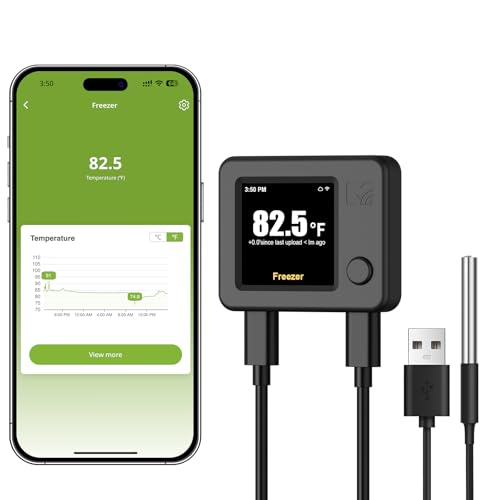
The MOCREO NS1 is a WiFi temperature alarm that skips the hub entirely. The maker states it connects directly to a 2.4 gigahertz home WiFi network and sends alerts through the MOCREO Smart app as push notifications and by email, while the unit itself can sound an 80 decibel beep. That mix suits a primary home, where a failing heater or freezer problem might otherwise go unnoticed for hours. The maker lists no subscription fee for app alerts.
Instead of measuring the air around the device, the NS1 reads through an ultra-thin flat probe on a 4.9 foot cable, which the maker says is about 0.9 millimeters thick so it can pass through a refrigerator or freezer door seal. The same arrangement works in a well house or utility closet. Readings are logged in the app, with export available per the maker.
Specs
- Alert method: App push notifications and email alerts, plus an 80 decibel audible beep at the unit
- Temperature range: Maker lists minus 40 to 221 degrees Fahrenheit, with stated accuracy of plus or minus 0.9 degrees Fahrenheit
- Power source: USB powered (USB Type A to Type C cable included)
- Extras: No hub required, 4.9 foot ultra-thin flat probe cable, data logging with export, no subscription fee per the maker
3. MarCELL Cellular Monitor (MAR-500A): For Vacation Homes

MarCELL, made by Sensored Life, takes the opposite approach to WiFi: it uses a built-in cellular connection on the Verizon 4G LTE network, so the property needs no landline and no internet service at all. That makes it a natural fit for vacation homes, cabins, and RVs that sit empty with the WiFi turned off. When temperature or humidity leaves the range you set, or when power is lost, the maker says MarCELL sends an immediate alert by text, phone call, or email, to up to nine contacts.
Because the connection is cellular, a subscription plan is required, managed through the maker’s online dashboard, where you also set trigger points and review logged data. The unit plugs into a wall outlet and carries an internal rechargeable lithium-ion battery, rated by the maker at roughly 24 to 48 hours during an outage. It also reports humidity, useful in damp basements.
Specs
- Alert method: Text, phone call, or email alerts over a cellular connection, sent to up to nine contacts
- Temperature range: Maker lists an operating range of 10 to 120 degrees Fahrenheit, with stated temperature accuracy of plus or minus 0.5 degrees Celsius
- Power source: Plug-in 5 volt power supply with an internal rechargeable lithium-ion backup battery
- Extras: No WiFi or landline required, humidity and power outage monitoring, cellular subscription plan required, one-year manufacturer warranty per the maker
4. YoLink Wireless Temperature Sensor Kit: Long-Range Wireless

YoLink’s system uses LoRa, a long-range, low-power radio link, between its sensors and the included hub, which connects to your home network. This kit pairs the hub with YoLink’s wireless temperature and humidity sensor, and the maker states the sensor covers minus 22 to 158 degrees Fahrenheit, well below any freeze alarm setpoint. Alerts arrive through the YoLink app, and the maker lists compatibility with Alexa and IFTTT.
The long-range link is the main draw. LoRa is designed to reach detached garages, barns, and basements where ordinary WiFi sensors may drop out, though actual range depends on walls and construction. The sensor is battery powered, so it can sit in a crawl space without an outlet nearby, and the same hub can support additional YoLink sensors later.
Specs
- Alert method: App alerts through the YoLink hub, with Alexa and IFTTT compatibility per the maker
- Temperature range: Maker lists minus 22 to 158 degrees Fahrenheit, with stated accuracy of plus or minus 0.54 degrees Fahrenheit
- Power source: Battery powered sensor (two AAA cells); hub connects to your home network
- Extras: Hub included, LoRa long-range link, humidity sensing, expandable with more YoLink sensors
5. YoLink Weatherproof Probe Sensor (YS8004-UC): Remote Probe Sensor

The second YoLink pick solves a different problem: measuring a specific surface or liquid rather than room air. The YS8004-UC is a weatherproof sensor with a probe on a cable, described by the maker for fluid, air, and surface temperature monitoring. That opens up placements an ordinary room sensor cannot handle, such as against a water pipe in a crawl space or in a pump house. This listing includes the YoLink hub, and the maker states an open-air wireless range of up to 1,000 feet.
Alerts are the most flexible of the group: the maker lists app alerts, text or SMS messages, and email alerts when a reading crosses your set limits. Because the probe is sealed and weatherproof, it can live outdoors or in damp spaces. Real-world range depends on obstructions, and the hub needs internet at the property for remote notifications.
Specs
- Alert method: App alerts, text or SMS alerts, and email alerts through the YoLink hub
- Temperature range: Maker describes an extreme high and low temperature probe sensor; wireless range listed at up to 1,000 feet open air
- Power source: Battery powered sensor; hub included and connects to your home network
- Extras: Weatherproof probe for fluid, air, and surface readings, LoRa long-range link
Side-by-Side Comparison
| Product | Connection | Alert methods | Power source | Standout point |
|---|---|---|---|---|
| Control Products FreezeAlarm Intermediate | Landline phone line | Voice calls to up to 3 numbers | AC adapter, optional 9 volt backup | No internet needed; calls any phone |
| MOCREO WiFi Thermometer NS1 | 2.4 GHz WiFi, no hub | App push, email, 80 dB beep | USB powered | Thin probe fits through door seals |
| MarCELL MAR-500A | Verizon 4G LTE cellular | Text, call, or email to up to 9 contacts | Plug-in with rechargeable backup battery | Works with no WiFi or landline |
| YoLink Temperature and Humidity Sensor Kit | LoRa to included hub | App alerts, Alexa and IFTTT | Battery powered sensor | Long-range link for outbuildings |
| YoLink Weatherproof Probe Sensor YS8004-UC | LoRa to included hub | App, text or SMS, email | Battery powered sensor | Probe reads pipes, fluids, surfaces |
The pattern in the table is simple. The alert path matters more than any single feature: pick the connection your property reliably has in winter, then confirm the power backup story, because an alarm that loses power silently is no help. Only the cellular model here requires a service plan.
FAQ
Do freeze alarms need WiFi?
No. Only some models use WiFi. The Control Products FreezeAlarm dials out over a landline, the MarCELL uses a cellular connection, and the YoLink kits use a long-range radio link to a hub. Choose based on which connection stays active at the property during winter.
Where should I place the sensor?
Follow the maker’s instructions, and in general place the sensor or probe where the temperature matters most: away from direct sunlight, heat vents, and exterior doors. For pipe monitoring, a probe sensor belongs at the pipe run you are most concerned about, such as a crawl space or unheated utility room.
Will a freeze alarm keep my pipes from freezing?
No alarm heats anything or repairs a failed furnace. These are alert devices only. Their job is to notify you when the temperature crosses the limit you set, so someone can act: restore heat, call a plumber or neighbor, or shut off water as a precaution. How much warning you get depends on your setpoint, the building, and how quickly someone responds.
What alarm temperature should I set?
Makers generally let you set your own high and low limits. A low-temperature alert set well above freezing, rather than right at it, leaves time to respond before pipes are at risk, and several products above also alert on power loss, which often comes first. Check the maker’s guidance for your model, and test the alert path after setup.
Final Verdict
For a home with an active landline, the Control Products FreezeAlarm Intermediate remains the most direct option: it calls real phone numbers with a voice message. For a lived-in home with solid WiFi, the MOCREO NS1 is the simplest install, with app and email alerts and a probe that reads exactly where you place it. For a vacation home with no internet, the MarCELL is built for that job, trading a subscription plan for cellular alerts that work when the house is dark. For larger properties, the two YoLink kits cover the long-range cases, one for room air and one with a weatherproof probe for pipes. Whichever style fits, set it up before the cold season, run a test alert, and confirm a real person receives it.
Product and ASIN Reference
| Product | ASIN |
|---|---|
| Control Products FreezeAlarm Intermediate (FA-I-CCA) | B000071NYC |
| MOCREO WiFi Thermometer NS1 | B0D5H991Z7 |
| MarCELL Cellular Temperature, Humidity, and Power Monitor (MAR-500A) | B00QRMFEAQ |
| YoLink Smart Wireless Temperature and Humidity Sensor (Hub Included) | B08JP2TDSC |
| YoLink Weatherproof Temperature Sensor With Probe (YS8004-UC) | B0BJJVD8VQ |
FAQ
Do freeze alarms need WiFi?
Where should I place the sensor?
Will a freeze alarm keep my pipes from freezing?
What alarm temperature should I set?
More from Amazon
Programs that pair well with the guide above. Offers and eligibility are set by Amazon and may change.
Free shipping on eligible items, Prime Video and more. Eligible new members can start with a free trial.
Start a Prime free trialAudiobooks and podcasts to listen to on the go. Eligible new members can start with a free trial.
Try Audible freeAd-free music streaming. Eligible new subscribers can start with a free trial.
Try Music Unlimited freeA free business account with business pricing and bulk-buying tools for work, shop or home office.
Create a business accountAs an Amazon Associate we earn from qualifying purchases.





Write Your Review
No reviews yet. Be the first to share your experience!