
Key takeaways
- Compare five small and backyard greenhouses, from a twin-wall polycarbonate kit to portable tunnels and a mini tiered rack, with sizes and covers compared.
A small greenhouse gives seedlings, herbs, and tender plants a sheltered place to grow while the weather outside is still unsettled. The five greenhouses in this guide cover the main formats a home gardener is likely to consider: a rigid twin-wall polycarbonate kit, two large walk-in tunnels with polyethylene covers, a compact four-tier mini greenhouse for a patio or balcony, and a slim lean-to that sits against a house wall.
The right pick depends mostly on space, budget, and how permanent the structure needs to be. Rigid panel kits cost more and take longer to assemble, but they are built to stay up year after year. Film-covered tunnels go up quickly and give a lot of growing room for the money, while mini and lean-to models suit gardeners who only need to protect a modest collection of pots.
As an Amazon Associate, we earn from qualifying purchases.
How to Choose a Small or Backyard Greenhouse
Start with the footprint and headroom. Measure the spot you have in mind before ordering, and check the maker’s stated dimensions rather than the rounded numbers in a product name. A 6 by 8 foot kit suits a few raised beds or shelving along both walls. Tunnels of 15 to 20 feet suit rows of in-ground planting. Mini tiered racks and lean-tos trade floor space for a small footprint against a wall or on a deck.
Match the cover to your climate and patience. Twin-wall polycarbonate panels are rigid, diffuse light, and hold up for many seasons. Polyethylene (PE) and PVC film covers are lighter and cheaper, but every maker of film-covered models treats the cover as a consumable: sunlight slowly makes film brittle, and most makers sell replacement covers because the original will not last as long as the frame. If you want a set-and-forget structure, rigid panels are the safer long-term choice.
Plan the anchoring before the greenhouse arrives. This point cannot be overstated. Anchor the greenhouse to the ground or to a base exactly as the maker directs. An unanchored lightweight greenhouse acts like a sail, and in a strong gust it can blow over, tear free of its frame, and be destroyed or damage fences, windows, and neighboring property. Rigid kits usually bolt to a steel base or a foundation; tunnels rely on ground stakes, ropes, and buried cover edges. Budget the time and any extra hardware the maker’s instructions call for.
Think about ventilation from day one. A closed greenhouse heats up fast on a sunny morning, even in cool weather, and plants can overheat by midday. Roof vents, roll-up side windows, and doors at both ends all help. Use the vents and doors as the maker directs, opening them on bright days and closing them before cold nights.
Be realistic about winter. A greenhouse extends the growing season at both ends, but it does not heat itself. On a freezing night, the inside of an unheated greenhouse ends up only a few degrees warmer than the air outside. Hardy plants and overwintering pots do fine in many climates; tender plants in a cold region still need a heated space. This guide does not rate greenhouse heaters, so treat any heating plan as a separate purchase decision.
Palram – Canopia Mythos 6 x 8 Greenhouse (HG5008)
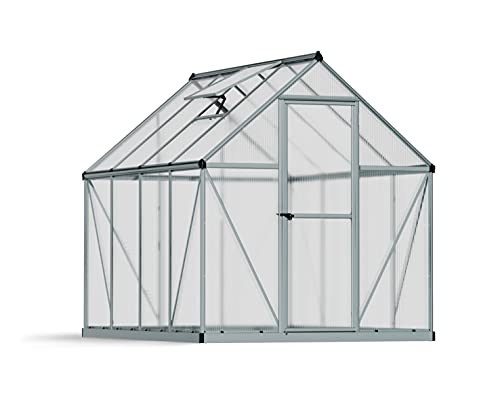
The Mythos is the permanent option in this guide: a hobby greenhouse kit with an aluminum frame, a galvanized steel base, and twin-wall polycarbonate panels. Palram lists the model as HG5008, and the kit includes a lockable door, an adjustable roof vent, and built-in rain gutters. For a gardener who wants one structure that stays in place for years, this is the most house-like of the five.
Palram describes the 4 millimeter twin-wall panels as diffusing sunlight as it enters, which softens the harsh midday light that can scorch leaves under clear glazing. The maker publishes wind-resistance and snow-load figures for the kit in its specification sheet, and those ratings assume the frame is assembled fully and anchored on its base as directed. Assembly is a real project with many panels and clips, so plan on a helper and a full day rather than an afternoon.
Specs
- Footprint: 6 x 8 feet nominal (about 185 x 248 centimeters per the maker)
- Peak height: about 209 centimeters (roughly 6 feet 10 inches)
- Panels: 4 millimeter twin-wall polycarbonate
- Frame: aluminum, with a galvanized steel base included
- Features: lockable door, adjustable roof vent, rain gutters
- Model: HG5008
Quictent 20 x 10 x 6.6 Foot Large Walk-In Greenhouse (GM1306)

Quictent’s large walk-in tunnel is built around floor space. At 20 by 10 feet, it fits rows of vegetables or a mix of beds and shelving, and the 6.6 foot peak leaves room to work standing up. The frame is powder-coated steel, and the reinforced polyethylene cover is rated by the maker at 140 grams per square meter. Quictent describes the cover as transmitting about 85 percent of sunlight.
Two zipper screen doors and eight screen windows give this tunnel the best airflow hardware of the film models here, which matters because a tunnel this size holds a lot of warm air. The maker includes 10 bases and 20 stakes for stability and advises positioning the greenhouse so its front does not face the prevailing wind. Use every stake and rope supplied: a 200 square foot cover catches a great deal of wind, and this style of greenhouse is a seasonal shelter, not a storm structure.
Specs
- Footprint: 20 x 10 feet
- Peak height: 6.6 feet
- Frame: powder-coated steel
- Cover: reinforced polyethylene, 140 grams per square meter per the maker
- Access and vents: 2 zipper screen doors, 8 screen windows
- Anchoring included: 10 bases and 20 stakes per the maker
- Model: GM1306 (SKU GM1306G in green)
Best Choice Products 15 x 7 x 7 Foot Walk-In Greenhouse Tunnel (SKY1917)
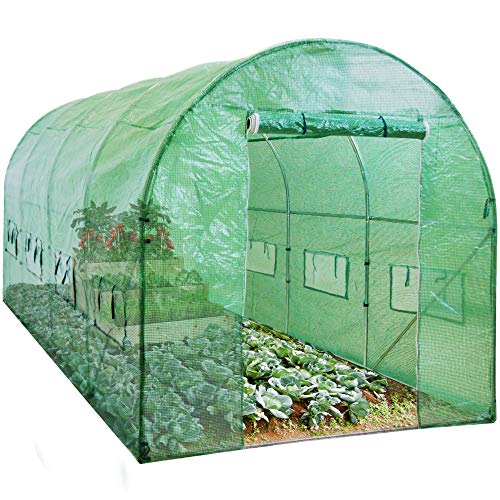
This tunnel from Best Choice Products splits the difference between the mini models and the big Quictent. Fifteen feet of length swallows a serious row of tomatoes or peppers, while the 7 foot width keeps it manageable in an average backyard. The frame is powder-coated steel tubing, and the threaded polyethylene cover is designed to resist tearing better than a plain film sheet.
Eight roll-up windows run along the sides, so ventilation can be adjusted a section at a time rather than all at once, and the zippered door rolls up and ties open for moving trays and carts in and out. As with every film tunnel, the cover is the wear item: the maker treats it as replaceable, and UV exposure will age it over successive seasons even if the frame stays sound.
Specs
- Footprint: 15 x 7 feet (180 x 84 inches)
- Peak height: 7 feet (84 inches)
- Frame: powder-coated steel tubing
- Cover: threaded polyethylene
- Access and vents: zippered roll-up door, 8 roll-up windows
- Model: SKY1917
Ohuhu 4-Tier Mini Greenhouse (Y21-80401-64)
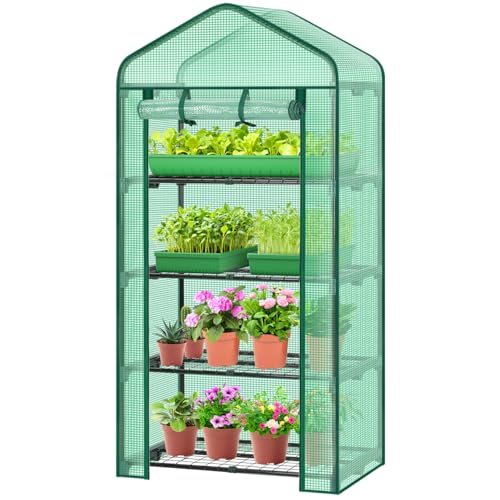
The Ohuhu mini greenhouse is a shelving rack with a cover, made for seed starting and small collections. Four wire shelves stack inside a footprint of about 27 by 19 inches, and Ohuhu rates each shelf for up to 22 pounds. The polyethylene cover zips closed with a roll-up door, and the steel tube frame pushes together without tools, according to the maker.
A mini greenhouse this size works on a balcony, a patio corner, or indoors near a bright window. It is not a windproof structure, though: the light frame and tall, narrow shape can tip, so place it against a wall, weigh or tie it down as the maker directs, and bring it in or secure it before a storm. It also holds humidity well, so open the door regularly on sunny days to keep seedlings from cooking.
Specs
- Footprint: about 27 x 19 inches (2.5 x 1.6 feet)
- Height: about 62 inches (5.2 feet)
- Shelves: 4 tiers, each rated by the maker for up to 22 pounds
- Frame: steel tubing, tool-free assembly per the maker
- Cover: polyethylene with a roll-up zippered door
- Model: Y21-80401-64
Ohuhu Lean-To Greenhouse (Y21-80401-44)

A lean-to uses the wall of a house or garage as its fourth side, which saves space and borrows a little shelter from the building. This Ohuhu model measures 6.6 by 2.5 by 5.6 feet, tall enough for tomato plants in pots along a sunny wall. The transparent PVC cover keeps rain off while the roll-up zippered door gives access along the front.
Because one side is open to the wall, placement matters: choose a wall that gets long hours of sun and make sure the frame sits flush so wind cannot get behind the cover. Secure the frame to the ground and, where the maker allows, to the wall itself. Like the mini greenhouse, this is a lightweight seasonal shelter, and the PVC cover will stiffen and age with UV exposure over time.
Specs
- Footprint: 6.6 x 2.5 feet
- Height: 5.6 feet
- Cover: transparent PVC per the maker
- Access: roll-up zippered door
- Frame: steel tubing
- Model: Y21-80401-44
Comparison: The Five Greenhouses Side by Side
| Product | Type | Footprint | Cover material | Door and vent style |
|---|---|---|---|---|
| Palram – Canopia Mythos 6 x 8 | Rigid kit | 6 x 8 ft | Twin-wall polycarbonate | Lockable door, roof vent |
| Quictent 20 x 10 x 6.6 ft | Large walk-in tunnel | 20 x 10 ft | Reinforced PE film | 2 zipper doors, 8 windows |
| Best Choice Products 15 x 7 x 7 ft | Walk-in tunnel | 15 x 7 ft | Threaded PE film | Zipper door, 8 roll-up windows |
| Ohuhu 4-Tier Mini | Tiered rack | About 27 x 19 in | PE film | Roll-up zipper door |
| Ohuhu Lean-To | Lean-to | 6.6 x 2.5 ft | PVC film | Roll-up zipper door |
The pattern in the table is simple: rigid polycarbonate buys permanence, film buys space or portability for less money, and the two small Ohuhu models buy convenience where floor space is scarce.
FAQ
What size greenhouse should a beginner start with?
Start with the space you will actually fill. A 6 by 8 foot kit or a 15 foot tunnel suits most first vegetable gardens, while the tiered mini greenhouse is enough for seed trays and a few pots. Buying one size up is reasonable if you garden every year, since shelves and beds fill faster than expected, but a half-empty large tunnel is harder to keep warm in spring than a small, full one.
Will a greenhouse keep plants alive through freezing winter weather?
Not by itself. A greenhouse blocks wind and holds a little daytime warmth, but it has no heat source, and on a clear freezing night the inside temperature drops close to the outside temperature. Gardeners in cold climates use greenhouses to extend spring and fall and to overwinter hardy plants. Tender plants through a hard winter need supplemental heat, which this guide does not rate.
How do I stop a portable greenhouse from blowing away?
Anchor it exactly as the maker directs, using every stake, rope, base, or screw the kit includes, and add weight along the cover edges if the instructions allow. Rigid kits should be bolted to their base or a foundation. Site the greenhouse out of the prevailing wind where possible, keep doors closed in gusts (or open both ends, if the maker advises that instead), and take lightweight mini models indoors ahead of severe storms.
How long does a polyethylene cover last?
Makers of film-covered greenhouses treat the cover as a wear part. Sunlight gradually makes polyethylene brittle, so a cover typically serves a few seasons before it needs replacing, depending on sun exposure and climate. Frames usually outlast the cover, and the makers in this guide sell replacement covers. Rigid polycarbonate panels, by contrast, are sold as a long-term glazing and do not need routine replacement.
Final Verdict
For a permanent backyard structure, the Palram – Canopia Mythos 6 x 8 is the strongest choice here, with rigid twin-wall panels, a steel base, and a lockable door. Gardeners who need maximum growing room on a budget should look at the Quictent 20 x 10 tunnel, with the Best Choice Products 15 x 7 tunnel as the mid-size alternative. Where space is tight, the Ohuhu 4-tier mini greenhouse handles seed starting and small pots neatly, and the Ohuhu lean-to makes good use of a sunny wall. Whichever style you pick, anchor it as the maker directs and keep the vents working; those two habits decide how well any of these greenhouses performs.
Product and ASIN Reference
| Product | ASIN |
|---|---|
| Palram – Canopia Mythos 6 x 8 Greenhouse (HG5008) | B004HR1VFA |
| Quictent 20 x 10 x 6.6 Foot Large Walk-In Greenhouse (GM1306) | B00W5B472O |
| Best Choice Products 15 x 7 x 7 Foot Walk-In Greenhouse Tunnel (SKY1917) | B014JPGG1S |
| Ohuhu 4-Tier Mini Greenhouse (Y21-80401-64) | B07F8V9RC9 |
| Ohuhu Lean-To Greenhouse (Y21-80401-44) | B0CLY6QYN5 |
FAQ
What size greenhouse should a beginner start with?
Will a greenhouse keep plants alive through freezing winter weather?
How do I stop a portable greenhouse from blowing away?
How long does a polyethylene cover last?
More from Amazon
Programs that pair well with the guide above. Offers and eligibility are set by Amazon and may change.
Free shipping on eligible items, Prime Video and more. Eligible new members can start with a free trial.
Start a Prime free trialAudiobooks and podcasts to listen to on the go. Eligible new members can start with a free trial.
Try Audible freeAd-free music streaming. Eligible new subscribers can start with a free trial.
Try Music Unlimited freeA free business account with business pricing and bulk-buying tools for work, shop or home office.
Create a business accountAs an Amazon Associate we earn from qualifying purchases.




Write Your Review
No reviews yet. Be the first to share your experience!