
Key takeaways
- Compare ice choppers for frozen driveway edges and plow ridges, with heavy narrow heads for crust and wide blades for the apron, chosen from Amazon listings.
Driveway edges freeze differently from open pavement. Meltwater runs to the border, tires pack it down, and the plow seals it with a ridge that refreezes into the hardest ice on the property. A chopper for this job needs a head that can start a crack in that ridge and an edge that can then work along the border without wandering onto the lawn or chipping the apron corners.
This guide is for homeowners whose cars scrape over a frozen apron lip, households on plow routes with heavy ridge buildup, and anyone whose driveway edge borders pavers or lawn. The four tools below were chosen from their Amazon listing specifications, mixing heavy narrow heads for the ridge with wider blades for the cleanup that follows.
Quick Picks
As an Amazon Associate we earn from qualifying purchases.
| Product | Best for | Key spec from title |
|---|---|---|
| Bigfoot Ice Chopper and Lawn Edger by Emsco | Prying loosened slabs and edging along driveway borders | Steel head, long wood handle, 59 in long, chopper and edger |
| Bully Tools 92200 Heavy Duty Ice Scraper | Thick, bonded ice that needs repeated heavy chopping strokes | 11-gauge all-steel head, long steel handle, 58 in overall |
| CKLT Ice Scraper and Chopper with 11 Inch Blade | Peeling wide ribbons of loosened ice off flat concrete | 65 in adjustable stainless handle, 11 in spring steel blade |
| Colwelt Metal Ice Scraper and Chopper, 58 Inch | Punching through hard crust with a narrow, heavy blade | 58 in all-steel build, narrow thickened blade, ergonomic grip |
Read the table by motion first. The narrow, heavy heads are punchers for bonded ice, and the wide flat blades are peelers for sheets that have started to lift. If two tools look close, the deciding details are handle material and total length, because those decide how long you can work and how much shock reaches your hands during a cold morning session.
How to Choose
A note on how to read the listings behind this guide: many of these tools are sold under both names, chopper and scraper, sometimes in the same title. Ignore the label and read the head. Its width, its steel type and the tool’s overall length tell you how it will actually be worked, downward in short strokes or forward in long pushes. Weight deserves the same attention, because a manual ice tool is lifted or pushed hundreds of times in a session, and the listing weight is the honest predictor of how the last ten minutes will feel.
Decide whether your ice needs breaking or peeling
Look at last winter before you look at listings. If your problem is a hard ridge where the plow passes, or a frozen apron where tires have packed meltwater into a slab, you need a chopper: a heavy, narrow head that is lifted and dropped to fracture the sheet. If your problem is broad, thin ice that has already started to lift at the edges, a wide flat blade worked at a low angle will clear it faster with less effort. Buying the wrong style does not make the tool bad, it just makes every session longer, because you end up forcing a peeler to punch or a puncher to sweep.
Balance head weight against your own stamina
With manual ice tools, weight is both the engine and the cost. An all-steel tool in the 58 inch class breaks stubborn ice because its own mass lands with each stroke, and that same mass is what your shoulders lift hundreds of times in a long session. Lighter adjustable models ask more of your technique and less of your arms. Be honest about who will use the tool and for how long at a stretch. A slightly lighter chopper that gets used after every storm beats a heavier one that stays in the garage because nobody wants to swing it.
Match the edge to concrete, asphalt or pavers
Not every winter surface wants the same blade. Plain concrete sidewalks and asphalt driveways tolerate a steel edge well, and a spring steel or manganese blade adds flex over uneven joints. Decorative and stamped finishes, clay pavers and crumbling older concrete deserve a gentler approach: lower angles, lighter strokes, and a wider blade that spreads the contact. Check the listing for blade material rather than just width, because a thin stamped blade can fold against a frozen ridge where a forged or thickened blade keeps its shape season after season.
Protect your eyes, hands and footing first
The safety list for ice chopping is short and worth following every time. Eye protection guards against the chips that shear off at odd angles, and gloves protect against both cold steel and the blisters that form during a long clearing session. Clear a small standing patch before you start swinging, so your boots grip pavement instead of the sheet you are breaking. Keep the blade path away from your feet, work outward from where you stand, and never chop toward a helper, a pet or a parked car. When the light fades, stop, because hidden ridges and joints are what catch blades.
The 4 Best Options
Bigfoot Ice Chopper and Lawn Edger by Emsco

The Bigfoot is a dual-purpose tool: a steel ice chopper head whose flattened, widened edge wedges under ice sheets, on a long wooden handle that also serves for lawn edging in the warmer months. Wood is a forgiving handle material in cold hands, and the 59 inch length gives real leverage when you pry a loosened slab up and away from the concrete. For frozen driveway edges and the plow ridge, those listed details add up to the most straightforward fit in this group.
Specs
- Head: steel blade tip, flattened and widened edge
- Handle: extra long wooden handle
- Dimensions: 1.25 x 7.75 x 59 inches
- Use: crushing ice on driveways and sidewalks, plus lawn edging
- Model: 1207-1
Best for: Prying loosened slabs and edging along driveway borders
Watch out for: Keep the edge off decorative pavers and stamped concrete, because the steel tip can chip softer surfaces.
ASIN: B074Y9M99X
Bully Tools 92200 Heavy Duty Ice Scraper

The Bully 92200 is the heavy end of the manual ice tool world: an 11-gauge steel head on a long steel handle, 58 inches overall. That mass is the mechanism, because a chopper works by dropping a stiff blade into the ice sheet again and again until it fractures. There is no flex in the handle to absorb the blow, so more of each stroke reaches the ice. For frozen driveway edges and the plow ridge, it is the combination of head design and handle that makes the difference, not any single figure.
Specs
- Head: 11-gauge steel sidewalk and ice scraper head
- Handle: long steel handle
- Overall length: 58 inches
- Construction: all-steel build
- Use: chopping and scraping ice on sidewalks and driveways
- Model: 92200
Best for: Thick, bonded ice that needs repeated heavy chopping strokes
Watch out for: Expect real arm and shoulder work, because the all-steel build that breaks ice also has to be lifted for every stroke.
ASIN: B000PAQEKU
CKLT Ice Scraper and Chopper with 11 Inch Blade
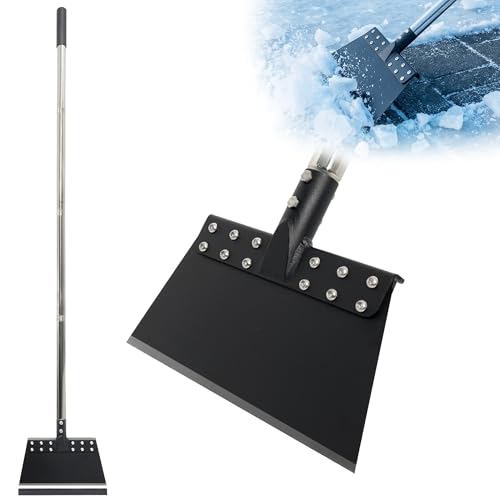
CKLT stretches the format: a 65 inch adjustable stainless handle behind an 11 inch spring steel blade. The wide blade is the story here, because it peels long ribbons of loosened ice in each pass instead of punching narrow slots. Spring steel also flexes slightly against uneven concrete rather than chipping at every joint, and the handle adjusts for taller or shorter users. For frozen driveway edges and the plow ridge, that is the balance this model strikes best, and it is why it earns its place here.
Specs
- Blade: 11 inch wide flat blade, tempered spring steel
- Handle: adjustable stainless steel handle with rubber grip
- Overall length: 65 inches
- Blade coating: sandblasting anti-rust coating listed by the maker
- Use: ice, snow, moss and dirt on driveways and walkways
- Model: LYC
Best for: Peeling wide ribbons of loosened ice off flat concrete
Watch out for: Set the handle length before you start and re-check the lock after hard strikes, since a slipping section changes the stroke.
ASIN: B0DRTWT9QT
Colwelt Metal Ice Scraper and Chopper, 58 Inch

Colwelt concentrates force instead of spreading it: a narrow, thickened steel blade on an all-steel 58 inch frame, so each downward stroke lands on a small footprint and punches through crust that wider blades skate over. The soft grip is a practical touch for a tool that is used in repeated short bursts, and the maker lists an anti-rust finish over the steel. For frozen driveway edges and the plow ridge, those listed details add up to the most straightforward fit in this group.
Specs
- Overall length: 58 inches
- Blade: narrow, thickened hardened steel blade
- Construction: all-steel handle and blade with anti-rust finish
- Grip: soft non-slip ergonomic grip
- Dimensions: 1.8 x 6 x 58 inches
- Model: 0090S
Best for: Punching through hard crust with a narrow, heavy blade
Watch out for: Work in short bursts and let the head weight do the cutting, because forcing a narrow blade sideways can bend your stance.
ASIN: B0G1YDCX38
Timing matters with ice tools as much as with the ice itself. The practical moment to buy is before the first freeze of the season, while you can still check the edge, set any adjustable handle and store the tool by the door instead of behind summer equipment. During the season, work early: ice cleared soon after it forms, before traffic packs it and melt cycles bond it, takes a fraction of the strokes that the same patch demands a week later.
Which One Fits Your Situation
The plow ridge across the apron
Choose the Colwelt Metal Ice Scraper and Chopper, 58 Inch. The narrow, thickened blade concentrates each stroke to punch a starting crack into the ridge, which is the step everything else depends on. Its listed 58 in all-steel build, narrow thickened blade, ergonomic grip is the detail that matters most in this situation, and it keeps the whole job at ground level or on firm footing, where it belongs.
Packed ice along both borders of the drive
Choose the Bully Tools 92200 Heavy Duty Ice Scraper. The all-steel build keeps its force line along the edge without flexing away, even where tires have compacted the ice hardest. Its listed 11-gauge all-steel head, long steel handle, 58 in overall is the detail that matters most in this situation, and it keeps the whole job at ground level or on firm footing, where it belongs.
Edges that meet the lawn or a garden bed
Choose the Bigfoot Ice Chopper and Lawn Edger by Emsco. The same head that wedges ice also edges lawn in summer, and its flattened edge follows a border line with control. Its listed steel head, long wood handle, 59 in long, chopper and edger is the detail that matters most in this situation, and it keeps the whole job at ground level or on firm footing, where it belongs.
The flat apron once the ridge is broken
Choose the CKLT Ice Scraper and Chopper with 11 Inch Blade. The wide blade peels the loosened apron ice in long passes, finishing the area the narrow heads opened up. Its listed 65 in adjustable stainless handle, 11 in spring steel blade is the detail that matters most in this situation, and it keeps the whole job at ground level or on firm footing, where it belongs.
Common Mistakes
- Dropping a steel chopper onto stamped concrete or pavers and chipping the finish the tool was meant to clear.
- Chopping without eye protection, even though ice leaves the surface in sharp, sideways fragments.
- Standing on the ice sheet being broken instead of on a cleared patch with reliable footing.
- Waiting for a week of melt-and-refreeze cycles before clearing, which bonds the layer far harder to the pavement.
- Storing the tool wet with de-icing residue on the blade, then finding a rusted, dull edge next season.
Frequently Asked Questions
How thick does ice need to be before a chopper is worth it?
Once ice is thick or hard enough that a shovel edge skates over it and foot traffic is treacherous, a chopper earns its storage space. It fractures the sheet into pieces a shovel can then move. For a thin glaze, melting or gritting is usually less work than chopping, and heavy chopping on a glaze mostly risks the surface underneath.
Will an ice chopper damage my concrete or pavers?
It can chip stamped concrete, decorative pavers and older spalling concrete if it is dropped carelessly, so match the tool to the surface. On plain concrete and asphalt, a steel edge used in controlled strokes is standard practice. Work at a lower angle on delicate finishes, break only the thickest ridges, and let a thin remaining layer melt rather than chasing it.
When should I chop: before, during or after a storm cycle?
The easiest session is soon after the freeze sets, before traffic packs the layer and before repeated melt-and-refreeze cycles bond it harder. Clearing the bulk early also keeps the next snowfall from building on an ice base. Keep the tool by the door from the first forecast freeze of the season, not buried behind summer gear in the shed.
How do I keep the blade working well season after season?
Rinse road grit and de-icing residue off the blade after big sessions, dry the tool before storing it, and check the edge for rolls or chips in autumn. A few passes with a file restore a working edge on most steel heads. Store the chopper head-down in a corner or hung up, so nobody steps on the edge and the handle stays straight.
Whichever tool you choose, the habit matters more than the hardware: clear early, in short sessions, with protection on, and the ice never gets the week it needs to become a slab. Match the head to your worst patch of ice and the handle to the person swinging it, and a manual chopper stays a simple, reliable answer that needs no fuel, no cord and no warm-up.
FAQ
How thick does ice need to be before a chopper is worth it?
Will an ice chopper damage my concrete or pavers?
When should I chop: before, during or after a storm cycle?
How do I keep the blade working well season after season?
More from Amazon
Programs that pair well with the guide above. Offers and eligibility are set by Amazon and may change.
Free shipping on eligible items, Prime Video and more. Eligible new members can start with a free trial.
Start a Prime free trialAudiobooks and podcasts to listen to on the go. Eligible new members can start with a free trial.
Try Audible freeAd-free music streaming. Eligible new subscribers can start with a free trial.
Try Music Unlimited freeA free business account with business pricing and bulk-buying tools for work, shop or home office.
Create a business accountAs an Amazon Associate we earn from qualifying purchases.





Write Your Review
No reviews yet. Be the first to share your experience!