
Key takeaways
- Five pipe wrenches compared for home and shop plumbing: heavy-duty, aluminum, compact and strap picks with maker specs, sizing advice and safety notes.
A pipe wrench is built for one job: gripping round pipe and threaded fittings firmly enough to tighten or loosen them without the tool slipping. Unlike a smooth-jaw adjustable wrench, a pipe wrench uses serrated teeth and a floating hook jaw that bite harder as torque increases, which is why the same basic pattern has stayed in plumbing kits for well over a century. The catch is that no single size covers every job. Pipe diameter, working space, and surface finish all change which wrench makes sense, so most home and shop toolkits end up holding two or three wrenches in different lengths and styles.
This guide compares five pipe wrenches that cover the main roles a homeowner, landlord, or maintenance worker is likely to need. The lineup includes a 24-inch heavy-duty straight wrench for large pipe, two 14-inch aluminum straight wrenches from different makers, a compact 6-inch wrench for cramped spaces, and a strap wrench that turns polished or plastic pipe without tooth marks. Every specification below is drawn from the maker’s own catalog or listing data, and each model was matched across two independent sources before it was included, so the capacities and weights quoted here reflect published figures rather than estimates.
As an Amazon Associate, we earn from qualifying purchases.
How to Choose the Right Pipe Wrench
Start with the pipe itself. Makers rate each wrench by the maximum nominal pipe diameter its jaws are built to grip, and that capacity, not the handle length alone, decides whether the wrench fits your work. A 14-inch wrench with a maker-rated capacity of 2 inches covers most household supply and drain fittings, while larger mains and older heavy pipe work call for an 18-inch or 24-inch model. Length matters because it sets leverage: a longer handle multiplies the force at the jaws, which helps on corroded or long-seated joints, but it also needs more swing room and adds weight you have to hold in position while you work.
Next, consider jaw style and handle material. Straight wrenches with serrated steel teeth are the default choice for steel and galvanized pipe, but those teeth are designed to bite into the surface, so expect visible marks on soft metals and finished fittings. On chrome, polished, coated, or plastic pipe, the maker guidance is to switch to a strap wrench or smooth jaws that grip by friction instead of teeth. Aluminum handles cut weight substantially; RIDGID rates its aluminum line as nearly 40 percent lighter than comparable cast-iron models, which matters for overhead work or a full day of repeated use, while ductile-iron housings remain the traditional pick for maximum-leverage jobs.
Two habits protect both the plumbing and the person doing the work. First, work in pairs when a joint resists: one wrench turns the fitting while a second wrench backs up the pipe, so torque does not transfer into the rest of the line. Second, never slip a pipe or cheater bar over the handle to gain leverage; handles are designed for hand force, and extending them can bend the housing or cause a sudden slip. Before opening any water line, shut off the supply and drain the line, and if a job involves gas piping, code requirements, or anything you are unsure about, follow local code or bring in a licensed plumber.
RIDGID 31030 Heavy-Duty Straight Pipe Wrench, 24-Inch
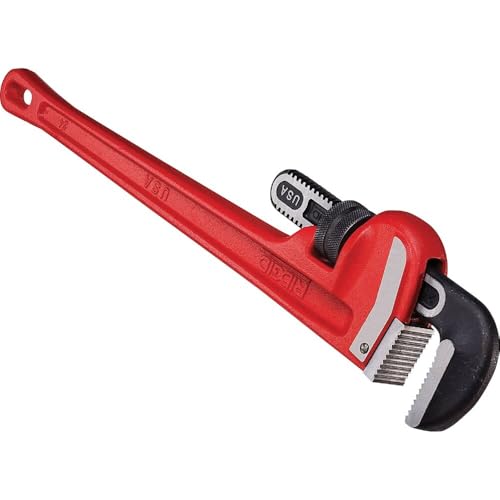
The 31030 is the big wrench in this lineup, built for larger mains, stubborn unions, and the kind of corroded joints that smaller wrenches cannot budge. RIDGID lists it with a 3-inch nominal pipe capacity, a ductile-iron housing, and an I-beam handle, the maker’s traditional heavy-duty construction. The full-floating forged hook jaw is designed to grip quickly and release cleanly, and the hook and heel jaws are replaceable, so worn teeth do not mean replacing the whole tool. At a maker-listed weight of 9-3/4 pounds, this is a two-handed tool that earns its place on bigger residential and light commercial work rather than everyday sink repairs. Choose it when pipe diameter or firmly seated fittings are the limiting factor, and pair it with a second wrench as a backup on the other side of the joint. No wrench frees every seized fitting, and a joint that refuses reasonable hand force is a sign to reassess the joint rather than reach for more leverage.
Specs
- Maker and model: RIDGID 31030
- Type: Heavy-duty straight pipe wrench
- Nominal length: 24 inches
- Maker-rated pipe capacity: 3 inches
- Weight: 9-3/4 pounds, per the maker’s catalog
- Construction: Ductile-iron housing, I-beam handle, forged hook jaw
- Jaws: Replaceable hook and heel jaws, self-cleaning threads
RIDGID 814 Aluminum Straight Pipe Wrench, 14-Inch

For most household and light commercial plumbing, a 14-inch wrench is the size that gets picked up first, and the RIDGID 814 is the aluminum version of the maker’s long-running straight pattern. RIDGID rates it for pipe up to 2 inches and lists a weight of 2-1/2 pounds, well under a comparable iron wrench, which makes a real difference during overhead work or a long run of fittings. The maker states that the jaws and all other parts match those on its heavy-duty wrenches, so the weight saving comes from the handle rather than lighter gripping hardware. The full-floating hook jaw, self-cleaning threads, and replaceable jaw parts follow the same service pattern as the iron line. Pick the 814 if you want one primary wrench for supply lines, traps, and general fitting work, and prefer to carry less weight while doing it.
Specs
- Maker and model: RIDGID 31095, Model 814
- Type: Aluminum straight pipe wrench
- Nominal length: 14 inches
- Maker-rated pipe capacity: 2 inches
- Weight: 2-1/2 pounds, per the maker’s catalog
- Construction: Aluminum handle with steel jaw parts
- Note: The maker rates its aluminum line as nearly 40 percent lighter than comparable cast-iron models
Milwaukee 48-22-7214 Aluminum Pipe Wrench, 14-Inch

Milwaukee’s 48-22-7214 takes a different approach to the same 14-inch aluminum slot. Its maker highlights an overbite jaw, designed to give a larger gripping surface on the pipe and to release more easily from the workpiece, along with dual coil springs that the maker fits for durability and tool life. The jaws are through-hardened for grip, the handle is shaped to sit comfortably in the palm without digging in, and a lanyard hole at the end supports tethered work where site rules call for it. Barcode and retailer records for this model list a 2-inch jaw capacity, in line with the other 14-inch wrenches in this guide. Choose the Milwaukee if you like the idea of a jaw geometry aimed at bite and clean release, or if the rest of your kit already runs on the same maker’s hand tools.
Specs
- Maker and model: Milwaukee 48-22-7214
- Type: Aluminum straight pipe wrench
- Nominal length: 14 inches
- Maker-rated jaw capacity: 2 inches
- Jaw design: Overbite jaw with through-hardened teeth, per the maker
- Features: Dual coil springs, ergonomic handle, lanyard hole
RIDGID Model 6 Heavy-Duty Straight Pipe Wrench, 6-Inch

The smallest wrench in this guide solves a different problem: access. At 6 inches long with a maker-rated capacity of 3/4-inch pipe, the RIDGID Model 6 is built for the tight spots under sinks, inside cabinets, and between closely spaced lines where a standard wrench head will not even fit. It keeps the same heavy-duty pattern as its bigger siblings, with a cast-iron housing, an I-beam handle, a floating hook jaw, and replaceable hook and heel jaws, just scaled down. The trade-off is leverage; a 6-inch handle offers limited force, so this wrench suits small fittings, valve stems, and light assembly rather than seized joints. It works best as a companion to a full-size wrench, not a replacement for one, and its half-pound weight means it disappears into a tool bag until the day a tight fitting makes it the only tool that fits.
Specs
- Maker and model: RIDGID 31000, Model 6
- Type: Heavy-duty straight pipe wrench, compact
- Nominal length: 6 inches
- Maker-rated pipe capacity: 3/4 inch
- Weight: 1/2 pound, per the maker’s catalog
- Construction: Cast-iron housing, I-beam handle
- Jaws: Replaceable hook and heel jaws
RIDGID No. 2 Strap Wrench, 31340

The RIDGID No. 2 strap wrench exists for the pipe a toothed wrench should never touch. Instead of steel teeth, it grips with a woven nylon strap that the maker describes as giving a tight hold, and the maker’s catalog positions the design as the choice for polished pipe; it is also the standard approach for plastic pipe and finished fittings that would scar under serrated jaws. The maker lists a 2-inch pipe capacity, an outside-diameter tube capacity of 3-1/2 inches, a 17-inch strap, and a cast-iron housing with an 11-3/4-inch handle. Because grip comes from strap friction rather than bite, it needs a clean, dry surface and steady tension, and it will not match a toothed wrench for breaking loose corroded steel joints. Keep it for chrome, coated, and plastic work, where protecting the surface matters more than maximum torque.
Specs
- Maker and model: RIDGID 31340, No. 2 Strap Wrench
- Type: Strap wrench for polished and plastic pipe
- Handle length: 11-3/4 inches
- Strap: Woven nylon, 17 inches long and 1-1/8 inches wide
- Maker-rated capacity: 2-inch pipe, 3-1/2-inch outside-diameter tube
- Weight: 1-3/4 pounds, per the maker’s catalog
- Housing: Cast iron
Side-by-Side Comparison
The table below lines the five picks up by type, length, and maker-rated capacity, so the differences are visible at a glance.
| Product | Type | Length | Maker-Rated Capacity |
|---|---|---|---|
| RIDGID 31030 | Heavy-duty straight | 24 inches | 3-inch pipe |
| RIDGID 814 | Aluminum straight | 14 inches | 2-inch pipe |
| Milwaukee 48-22-7214 | Aluminum straight | 14 inches | 2-inch jaw |
| RIDGID Model 6 | Compact straight | 6 inches | 3/4-inch pipe |
| RIDGID No. 2 Strap Wrench | Strap | 11-3/4-inch handle | 2-inch pipe |
Read as a kit rather than as rivals, the five split into clear roles. A practical two-wrench starter set is a 14-inch aluminum straight wrench for general work plus the strap wrench for finished surfaces. Add the 31030 when larger pipe shows up in your home or workload, and add the Model 6 when access, not force, is what keeps stopping the job.
Frequently Asked Questions
What size pipe wrench do most homeowners need?
A 14-inch model with a maker-rated capacity around 2 inches covers the majority of household supply and drain fittings. Add a compact wrench for under-sink work, and step up to a larger model only if your home has bigger mains or older large-diameter pipe.
Will a pipe wrench damage chrome or plastic pipe?
It can. The serrated teeth are made to bite into the surface, so they leave marks on soft or finished materials. Maker guidance for polished, coated, or plastic pipe is to use a strap wrench or smooth jaws, which grip by friction and leave the finish intact.
Can I extend the handle with a pipe for more leverage?
No. Never use a cheater bar or slip a pipe over the handle. Handles are designed for hand force, and extending them can overload the housing or make the wrench slip suddenly. If a joint will not move, step up to a longer wrench and use a second wrench to back up the fitting.
Why do plumbers use two pipe wrenches at the same time?
One wrench turns the fitting while the second holds the pipe steady, so the torque goes into the joint instead of twisting the rest of the line. Backing up the work protects nearby joints and valves, and it is the standard technique for both tightening and removal.
Final Verdict
For a single all-round pick, the RIDGID 814 covers the widest range of everyday plumbing at a weight that is easy to live with, and the Milwaukee 48-22-7214 is a strong alternative in the same size with its overbite jaw design. The RIDGID 31030 is the specialist for large or firmly seated pipe, the Model 6 earns its place purely on access, and the No. 2 strap wrench protects the finished surfaces the other four would mark. Match the wrench to the pipe in front of you, respect the maker ratings, and shut the water off before you start, and this style of tool will handle household plumbing for decades.
Product and ASIN Reference
| Product | ASIN |
|---|---|
| RIDGID 31030 Heavy-Duty Straight Pipe Wrench, 24-Inch | B0000224JA |
| RIDGID 814 Aluminum Straight Pipe Wrench, 14-Inch (31095) | B0000224JE |
| Milwaukee 48-22-7214 Aluminum Pipe Wrench, 14-Inch | B01HOXQVXU |
| RIDGID Model 6 Heavy-Duty Straight Pipe Wrench, 6-Inch (31000) | B0009GF3YS |
| RIDGID No. 2 Strap Wrench (31340) | B0016ZYJWS |
FAQ
What size pipe wrench do most homeowners need?
Will a pipe wrench damage chrome or plastic pipe?
Can I extend the handle with a pipe for more leverage?
Why do plumbers use two pipe wrenches at the same time?
More from Amazon
Programs that pair well with the guide above. Offers and eligibility are set by Amazon and may change.
Free shipping on eligible items, Prime Video and more. Eligible new members can start with a free trial.
Start a Prime free trialAudiobooks and podcasts to listen to on the go. Eligible new members can start with a free trial.
Try Audible freeAd-free music streaming. Eligible new subscribers can start with a free trial.
Try Music Unlimited freeA free business account with business pricing and bulk-buying tools for work, shop or home office.
Create a business accountAs an Amazon Associate we earn from qualifying purchases.

Write Your Review
No reviews yet. Be the first to share your experience!