
Key takeaways
- The best try squares for marking and checking 90-degree work, compared by blade size, stock material, and maker specs, plus how to test one for true.
A try square does one job, and it has to do it exactly: give you a true 90-degree reference for marking lines across stock and checking whether edges, faces, and finished cuts are actually square. Every other layout tool on the bench depends on the lines this one produces, so a square that is even slightly out of true quietly exports its error into every shoulder, tenon, and frame corner that follows it. It is also the tool that tells you whether a board you just planed is ready for joinery or still needs work.
The five squares below cover the main ways this tool is built today, from traditional rosewood and hardwood stocks with plain steel blades to cast aluminum stocks with retractable ledges and scribing features. Sizes run from 8 inches to 12 inches, and each pick was checked against maker listings for its blade material, stock construction, and markings before it earned a place here. Traditional models suit furniture work at the bench, while the feature-led models are aimed at carpenters who mark on site and need the square to stay put on the edge of a board.
As an Amazon Associate, we earn from qualifying purchases.
Quick answer
For most benches, the Swanson TS152 is the safe default: an 8-inch stainless blade in a brass-bound hardwood stock, per Swanson. If you want a longer reach for casework, the Crown Tools 127 stretches to 12 inches with a rosewood stock. The Kapro 353 adds a retractable ledge and angle-scribing holes for layout-heavy work.
1. Swanson TS152 8-Inch Try Square

Swanson’s TS152 follows the classic pattern: a stainless steel blade set into a hardwood stock, with brass hardware binding the stock so the reference face stays stable. Per Swanson, the blade is 8 inches long, which is the size most woodworkers reach for when marking across boards and checking the ends of planed stock. The etched rule along the blade doubles as a short measuring scale for quick layout marks.
Because the blade is stainless, it shrugs off the damp conditions that pit plain carbon steel in an unheated shop, and the brass-bound stock resists the wear that a bare wood reference face picks up after years of sliding along board edges. It is a plain tool with no moving parts, which is exactly the point: nothing to loosen, nothing to recalibrate.
Specs (per Swanson):
- Blade length: 8 inches
- Blade material: stainless steel
- Stock: hardwood with brass-bound hardware
- Style: fixed 90-degree try square
Who it’s for: Woodworkers who want one traditional square for everyday marking and checking, and who prefer a wood stock that registers comfortably against an edge.
Who should skip: Anyone who needs a longer blade for wide panels, or a retractable ledge for marking on narrow edges; look at the Crown and Kapro picks below instead.
2. POWERTEC 80015 Try Square, 8-Inch
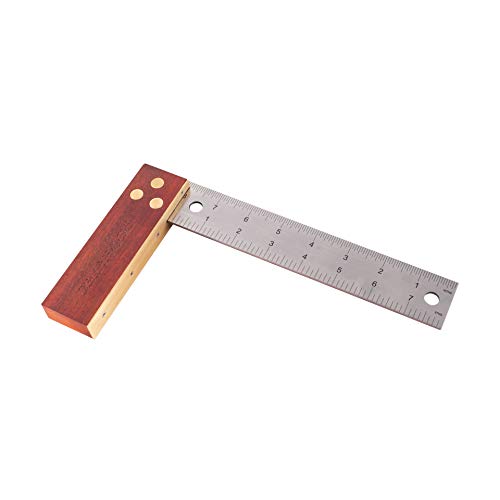
The POWERTEC 80015 pairs an 8-inch stainless steel blade with a brass-bound hardwood handle, and it adds something the plainest traditional squares leave off: a graduated scale. Per POWERTEC, the blade carries laser-etched inch and metric graduations on both sides, so the same square can check a corner and mark a measured offset without swapping tools.
That dual-scale blade makes the 80015 a practical single-square solution for mixed workshops where some plans arrive in inches and others in millimeters. The brass binding on the hardwood stock serves the same protective role as on the Swanson, guarding the reference face against dings that would otherwise print errors into every line.
Specs (per POWERTEC):
- Blade length: 8 inches
- Blade material: stainless steel
- Stock: brass-bound hardwood
- Markings: laser-etched inch and metric scales, both sides
Who it’s for: Hobbyists and DIY woodworkers who mark measurements as often as they check square, and who want one mid-size tool to cover both jobs.
Who should skip: Purists who prefer an unmarked blade for pure reference work, and anyone who wants a blade longer than 8 inches for panel work.
3. Kapro 353 Professional Ledge-It Try & Mitre Square, 8-Inch
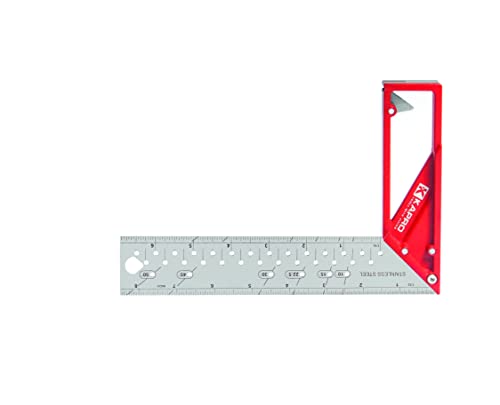
Kapro builds the 353 around a cast aluminum stock and a stainless steel blade, then adds two features aimed at layout speed. Per Kapro, a retractable ledge slides out to support the square on the edge of a board so it stays in place while you mark, and the blade carries etched ruler markings plus holes for scribing common angles, including 45 degrees for mitre work.
The ledge is the detail that matters most in practice: it hooks the stock over the edge of the work, so the square hangs on a vertical board or narrow rail instead of sliding off while your other hand reaches for a pencil. The angle holes turn the same tool into a quick mitre marker for trim and picture-frame work, and the etched graduations are cut into the blade rather than printed on it, per Kapro.
Specs (per Kapro):
- Blade length: 8 inches
- Blade material: stainless steel with etched markings
- Stock: cast aluminum
- Features: retractable ledge support; angle-scribing holes
Who it’s for: Carpenters and cabinet installers who mark on vertical or narrow edges and want the square to hold itself in place, plus anyone who regularly lays out mitres.
Who should skip: Traditionalists who want a wood stock, and anyone who only ever checks 90 degrees and would never use the ledge or angle holes.
4. Crown Tools 127 Try Square, 12-Inch

Crown Tools of Sheffield builds the 127, also sold as the Big Horn 20145, the traditional way: a tempered, blued steel blade fitted to a rosewood stock with a brass face on the reference side. Per Crown, the blade is 12 inches long, the longest in this group, which makes it the natural pick for checking wide boards, casework sides, and glued-up panels. The blade is unmarked, so this is a pure reference and marking tool rather than a measuring one.
The extra length is not just about reach. A longer blade averages out small bumps along an edge, so the line it produces across a wide panel is a fairer test of square than a short blade riding over the same surface. The blued finish on the blade also cuts glare under bench lights, which makes a pencil line against it easier to read.
Specs (per Crown Tools):
- Blade length: 12 inches
- Blade material: tempered blued steel, unmarked
- Stock: rosewood with brass face
- Style: fixed 90-degree try square
Who it’s for: Furniture and casework builders who check wide stock and want a traditional Sheffield-made square with a long, stable reference edge.
Who should skip: Anyone who needs etched graduations on the blade, or who mostly works small parts where a 12-inch blade is clumsy and gets in the way.
5. Swanson Savage SVR149 Try Square, 9-Inch

The SVR149 is Swanson’s modern take: a 9-inch stainless steel blade in an anodized aluminum handle with a rubber-coated insert. Per Swanson, it carries a scribe bar with tapered holes spaced so the two sides combine into fine marking increments, and a retractable kickstand that props the square on the edge of the work so it does not slide off while you reach for a pencil.
The scribe bar is built for repetitive layout: drop a pencil point into a hole and slide the square along the edge to strike a line parallel to it, at the offset the hole sets. Combined with the kickstand, the SVR149 behaves less like a passive reference and more like a small layout station, which is why it suits production-style marking more than fine bench work.
Specs (per Swanson):
- Blade length: 9 inches
- Blade material: stainless steel
- Stock: anodized aluminum with rubber-coated insert
- Features: scribe bar with tapered marking holes; retractable kickstand
Who it’s for: Framing and general carpentry users who scribe lines at set offsets all day and want a square that stays where it is placed.
Who should skip: Anyone who wants a plain, unmarked reference blade, or who prefers the weight and feel of a wood stock at the bench.
How to choose a try square
Check it before you trust it. Whatever square you buy, verify it against a known reference before trusting it for layout. The standard flip test needs only a board with one straight edge: draw a line along the blade, flip the square over against the same edge, and draw a second line beside the first. If the two lines stay parallel, the square is true; if they diverge, it is not, no matter what the packaging claims.
Treat drops as damage. A dropped square can be knocked out of true, especially where the blade meets the stock, so re-check it after any drop onto a hard floor before using it again. A square that fails the flip test after a fall should be retired from layout work.
Match the blade to the work. Eight-inch blades suit most board marking and end checking. A 12-inch blade earns its keep on wide panels and casework, where its length bridges small surface irregularities. Graduated blades help if you mark offsets directly; unmarked blades are the cleaner pure reference.
Pick a stock you will protect. Wood stocks feel best at the bench and are kind to finished surfaces, but their reference faces wear and can swell with humidity. Brass facing, as on the Swanson, POWERTEC, and Crown picks, slows that wear. Aluminum stocks shrug off site abuse and suit ledge and kickstand designs, at the cost of a colder, more industrial feel.
Remember what it is not. A try square is a marking and checking tool, not a cutting guide or a pry tool. Running a saw or knife against it as a fence, or levering with the blade, is how blades get nicked and stocks get sprung. Store it flat in a drawer or hanging on a peg so the blade is not bent or nicked by other tools.
FAQ
How do I check whether a try square is really square?
Use the flip test: hold the stock against a known-straight edge, draw a line along the blade, then flip the square and draw a second line from the same starting point. Parallel lines mean the square is true; lines that meet or spread mean it is out.
What size try square should I buy first?
An 8-inch or 9-inch square covers most board marking and checking. Move up to 12 inches if you regularly check wide panels or casework sides, where a shorter blade cannot reach across the work or bridge its surface.
Does a try square need graduations on the blade?
No. Graduations are a convenience for marking measured offsets, and makers offer both styles. A square with an unmarked blade works just as well as a reference; you simply measure with a separate rule.
How should I store a try square?
Flat in a drawer or hanging from a peg, with the blade protected from knocks. Storing it loose in a toolbox full of steel tools risks nicks in the blade edge and a stock knocked out of true.
Final verdict
Buy the Swanson TS152 if you want one dependable, traditional square for daily bench work. Choose the Crown Tools 127 when your work runs wide and you want the longest reference here. The Kapro 353 and Swanson SVR149 suit layout-heavy carpentry with their ledges and scribing features, and the POWERTEC 80015 is the pick when etched graduations on both sides will save you reaching for a separate rule. Whichever you choose, run the flip test the day it arrives and after any drop, because a square you have not verified is only a rumor of 90 degrees.
Product and ASIN Reference
| Product | ASIN |
|---|---|
| Swanson TS152 8-Inch Try Square | B000VYJ93O |
| POWERTEC 80015 Try Square, 8-Inch | B07N2P41CB |
| Kapro 353 Professional Ledge-It Try & Mitre Square, 8-Inch | B0873YCX1M |
| Crown Tools 127 Try Square, 12-Inch | B001BZZ0O4 |
| Swanson Savage SVR149 Try Square, 9-Inch | B0083SGSMA |
More from Amazon
Programs that pair well with the guide above. Offers and eligibility are set by Amazon and may change.
Free shipping on eligible items, Prime Video and more. Eligible new members can start with a free trial.
Start a Prime free trialAudiobooks and podcasts to listen to on the go. Eligible new members can start with a free trial.
Try Audible freeAd-free music streaming. Eligible new subscribers can start with a free trial.
Try Music Unlimited freeA free business account with business pricing and bulk-buying tools for work, shop or home office.
Create a business accountAs an Amazon Associate we earn from qualifying purchases.



Write Your Review
No reviews yet. Be the first to share your experience!