
Our Short List of 3

- Rod material: Aluminum-zinc alloy
- Length: 44 inches, four segments with stainless steel joints
- Hex head size: 1-1/16 inch
- Thread: 3/4 inch NPT

- Rod material: Magnesium, R-Tech resistored design
- Length: 54 inches, four linked sections of about 12 inches each
- Hex head size: 1-1/16 inch
- Thread: 3/4 inch NPT

- Rod material: Titanium with mixed metal oxide coating (powered, not sacrificial)
- Length: 12 inches
- Hex head size: Threaded plug fitting with power lead (no sacrificial hex head)
- Thread: 3/4 inch NPT
All 4 Picks at a Glance
| Product | Specs | Action |
|---|---|---|
| Ozek Aluminum Zinc Anode Rod, 44 Inch |
| Check price on Amazon |
| Rheem SP8371B R-Tech Resistor Flexible Magnesium Anode Rod |
| Check price on Amazon |
| Corro-Protec Powered Anode Rod (CP-R) |
| Check price on Amazon |
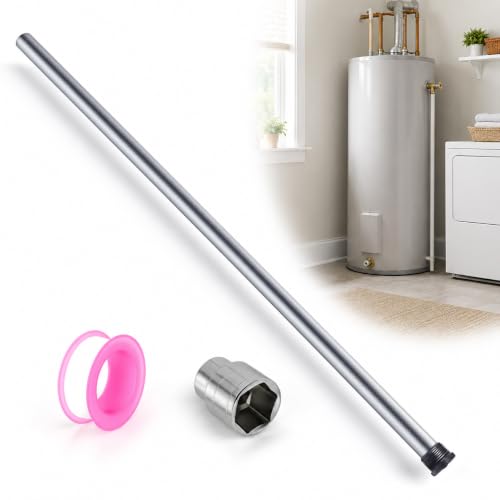 Podoy 32-Inch Magnesium Anode Rod |
| Check price on Amazon |
Key takeaways
- Compare magnesium, aluminum-zinc, flexible, powered, and short water heater anode rods, with lengths, hex sizes, and fit tips for a clean replacement.
Every glass-lined steel water heater tank has an anode rod inside it: a length of sacrificial metal, usually magnesium or an aluminum alloy, threaded into the top of the tank. Because the rod’s metal is more reactive than the tank’s steel, the corrosive action in the water goes after the rod first, and the rod is slowly consumed while the tank wall is left alone. Once the rod is used up, that action turns to the tank itself, which is why heater makers treat the rod as a replaceable wear part.
When an inspection shows a rod that is heavily pitted, thin, or eaten down to its steel core wire, the fix is a like-for-like swap. This guide compares five replacement water heater anode rods covering the main buying situations: a magnesium rod sold as a complete install kit, an aluminum-zinc rod of the type makers describe for sulfur-smelling water, a flexible segmented rod for low ceilings, a powered titanium rod, and a shorter 32-inch rod for smaller tanks.
As an Amazon Associate, we earn from qualifying purchases.
How to Choose
Start with the material. Magnesium is the most common factory fit and the usual default replacement. Aluminum and aluminum-zinc rods are the alternative most often chosen for well water with a sulfur smell, because makers describe the zinc in the alloy as the part that addresses the odor-causing reaction in the tank. Neither material is a cure-all, and the heater maker’s parts list is the final word on approved materials for your model.
Match the thread and hex size. Nearly every residential rod uses a 3/4 inch NPT thread and a 1-1/16 inch hex head, turned with a deep socket and a breaker bar. A few heaters differ, so confirm both figures against the old rod or the parts diagram before ordering. Factory rods are often extremely tight, and the swap goes easier while the tank is still full, since the weight keeps the heater from twisting as you work.
Measure length and ceiling clearance. Rod length should match what came out of the tank; common sizes run from about 32 inches to about 54 inches. A rigid rod needs roughly its own length of clear space above the heater to come out and go back in. Where that clearance is not there, a flexible segmented rod bends through the opening in sections, and powered rods need only about a foot of room.
Consider a powered rod if replacements keep disappearing. A powered anode is a titanium rod connected to a small power supply. Instead of being consumed, it uses a low electric current to do the protective work, so there is no sacrificial metal to wear out. Powered rods are sized by tank capacity, not rod length, and need a nearby outlet.
Plan the job safely. Before any rod comes out, turn off the power at the breaker for an electric heater or set a gas heater’s control to off, close the cold water supply, and relieve pressure by opening a hot water tap and draining a little water, following the heater maker’s instructions. If the old rod will not budge, or you are unsure around gas, power, and hot water, a licensed plumber is the safe route.
Eau 44-Inch Flexible Magnesium Anode Rod
The Eau rod is the straightforward magnesium replacement, sold as a kit with the two things a first-time swap usually sends people back to the store for: a 27 mm chrome socket tool and Teflon tape. The rod is magnesium, 44 inches long, built in four hinged segments each under 12 inches, so it feeds into tanks with limited overhead clearance as well as standard installs.
Eau lists the rod for many common residential brands, including GE, Rheem, Reliance, Richmond, Kenmore, A.O. Smith, and State heaters with the standard hex plug fitting. The diameter is about 0.8 inch, in line with typical factory rods. As a magnesium rod, it is consumed over time and checked on the heater maker’s inspection schedule. For a standard tank, this is the simplest pick of the five.
Specs
- Rod material: Magnesium
- Length: 44 inches, four hinged segments
- Hex head size: 1-1/16 inch (27 mm socket tool included)
- Thread: 3/4 inch NPT
- Extras: Teflon tape included; listed for GE, Rheem, Reliance, Richmond, Kenmore, A.O. Smith, and State
Ozek Aluminum Zinc Anode Rod, 44 Inch
- Rod material: Aluminum-zinc alloy
- Length: 44 inches, four segments with stainless steel joints
- Hex head size: 1-1/16 inch
- Thread: 3/4 inch NPT
Ozek’s aluminum-zinc rod is the pick aimed at water with a rotten-egg smell. The rod is an aluminum alloy with zinc content, and Ozek describes that zinc alloy construction as the feature intended for odor-prone water, as other makers describe their aluminum-zinc rods. The claim belongs to the maker, and results depend on the water and the tank, but this is the category most often recommended for that complaint.
The rod is 44 inches long, built as four segments joined by stainless steel links, so it also suits tanks with narrow access. Ozek lists compatibility with many common brands, including A.O. Smith, Rheem, Reliance, Richmond, Kenmore, State, and GE, and notes the rod does not fit Bradford White heaters, whose anodes are typically part of the hot water outlet. PTFE tape is included.
Rheem SP8371B R-Tech Resistor Flexible Magnesium Anode Rod
- Rod material: Magnesium, R-Tech resistored design
- Length: 54 inches, four linked sections of about 12 inches each
- Hex head size: 1-1/16 inch
- Thread: 3/4 inch NPT
Rheem’s SP8371B is the original-equipment answer to a low ceiling. It is a magnesium rod built as a flexible link, in four sections of about 12 inches each, for a total length of 54 inches and a rod diameter of about 0.9 inch. The linked sections let the rod bend as it is fed through the anode port, exactly the situation in closet and attic installs where a rigid rod cannot be lifted clear.
The SP8371B carries Rheem’s R-Tech resistor design, the resistored construction Rheem fits at the factory in many of its residential tanks, and it is the specified replacement part for those models, on the standard 1-1/16 inch hex head and 3/4 inch NPT thread. Owners of Rheem, Ruud, and Richmond tanks who want the maker’s own part in the flexible format are the audience for this one. Like any magnesium rod, it is a consumable, inspected on the manual’s schedule.
Corro-Protec Powered Anode Rod (CP-R)
- Rod material: Titanium with mixed metal oxide coating (powered, not sacrificial)
- Length: 12 inches
- Hex head size: Threaded plug fitting with power lead (no sacrificial hex head)
- Thread: 3/4 inch NPT
The Corro-Protec is the different approach in this guide. Its rod is titanium with a mixed metal oxide coating, and it is not sacrificial: a small power supply feeds it a low current, and that current does the protective work a magnesium or aluminum rod does by dissolving. Corro-Protec states the rod does not degrade in service, and backs it with a 20-year warranty.
At 12 inches long, the rod needs only about a foot of vertical clearance, solving the tight-space problem a different way than a segmented rod. This CP-R model is sized for tanks of 40 to 89 gallons with a dedicated anode port, threads in on a 3/4 inch NPT fitting, and comes with a power supply on a 12-foot cord for a standard 110-volt outlet. Corro-Protec markets the powered design for homes fighting rotten-egg sulfur smell and for owners who do not want to repeat the replacement cycle; those descriptions are the maker’s. A separate model exists for Bradford White tanks, which install through the hot water outlet.
Podoy 32-Inch Magnesium Anode Rod
- Rod material: Magnesium
- Length: 32 inches
- Hex head size: 1-1/16 inch hex plug
- Thread: 3/4 inch NPT; rod diameter 0.84 inch
Not every tank takes a 44-inch rod. Smaller residential heaters, commonly in the 30 to 40 gallon range, often use a shorter rod, and the Podoy is a solid magnesium rod at 32 inches long with a 0.84 inch diameter. It uses the standard 3/4 inch NPT thread and hex plug fitting, and Podoy lists it for Rheem, Reliance, A.O. Smith, Giant, GE, and Richmond tanks that call for this length.
The shorter rigid format also helps where overhead room is limited but still workable, and where a tank maker specifies a trimmable rod, the listing notes this one can be cut down with a hacksaw to match; check your heater’s documentation before cutting anything. Measure the removed rod first, since a rod longer than the specified size can rest against the tank bottom or fittings.
Comparison
| Product | Material | Length | Format | Best fit |
|---|---|---|---|---|
| Eau 44-Inch Flexible Magnesium | Magnesium | 44 inches | Segmented, kit with socket and tape | Standard swap with tools included |
| Ozek Aluminum Zinc | Aluminum-zinc alloy | 44 inches | Segmented | Sulfur-odor water, per maker description |
| Rheem SP8371B R-Tech | Magnesium | 54 inches | Flexible link, OEM part | Rheem tanks with low ceilings |
| Corro-Protec CP-R | Titanium, powered | 12 inches | Powered rod with supply cord | Owners done with repeat replacements |
| Podoy 32-Inch Magnesium | Magnesium | 32 inches | Rigid, trimmable | Smaller tanks using a short rod |
The pattern across the five is simple. Material decides how the rod behaves in your water, length and format decide whether it fits your tank and your ceiling, and the powered rod trades the wear-and-replace cycle for a cord and an outlet. Thread, hex size, and port style are standardized on most tanks, so confirming them against the old rod settles most of the decision.
FAQ
How often should an anode rod be replaced?
There is no single interval, because consumption depends on water chemistry and usage. Heater makers generally advise inspecting the rod periodically, often when the tank is drained and flushed, and replacing it when it is heavily pitted, noticeably thinned, or eaten down to the core wire. A rod with most of its metal left can go back in.
What socket size fits most anode rods?
Most residential rods use a 1-1/16 inch hex head, which is why kits like the Eau include a 27 mm socket, the metric near-equivalent. A deep socket and a long breaker bar help because factory rods are installed tight. Confirm the size on your old rod first, since a few models differ.
Should I choose magnesium or aluminum-zinc?
Magnesium is the common factory material and the usual default. Aluminum-zinc is the category makers describe for water with a sulfur or rotten-egg smell, thanks to the zinc in the alloy. Neither choice overrides the heater maker’s parts list, so match the material to what your model’s documentation allows and to the problem you are solving.
Can I swap the rod myself, or should I call a plumber?
Many owners do the swap with basic tools: power or gas off, water supply closed, pressure relieved, then the old rod out and the new one in with thread seal tape, following the heater maker’s instructions. The honest limits are a rod that will not break loose, a gas or electrical detail you are unsure about, or a tank in poor condition. In those cases, a licensed plumber is the safe route.
Final Verdict
For most standard tanks, the Eau 44-inch magnesium kit is the easiest recommendation: the typical material, a segmented format for awkward spaces, and the socket and tape in the box. Homes dealing with sulfur smell should look at the Ozek aluminum-zinc rod, with the maker’s odor description kept in proportion. Rheem owners with low ceilings get the maker’s own part in the SP8371B, smaller tanks are served by the Podoy 32-inch rod, and the Corro-Protec CP-R suits anyone who would rather plug in a powered rod than repeat this job on a schedule. Whichever route you take, match the thread, hex, and length to the rod that came out and follow the maker’s safety steps.
Product and ASIN Reference
| Product | ASIN |
|---|---|
| Eau 44-Inch Flexible Magnesium Anode Rod | B07W7QDDB7 |
| Ozek Aluminum Zinc Anode Rod, 44 Inch | B0CR8ZS21K |
| Rheem SP8371B R-Tech Resistor Flexible Magnesium Anode Rod | B008J54DJW |
| Corro-Protec Powered Anode Rod (CP-R) | B01H459TAK |
| Podoy 32-Inch Magnesium Anode Rod | B09DKKSYF7 |
More from Amazon
Programs that pair well with the guide above. Offers and eligibility are set by Amazon and may change.
Free shipping on eligible items, Prime Video and more. Eligible new members can start with a free trial.
Start a Prime free trialAudiobooks and podcasts to listen to on the go. Eligible new members can start with a free trial.
Try Audible freeAd-free music streaming. Eligible new subscribers can start with a free trial.
Try Music Unlimited freeA free business account with business pricing and bulk-buying tools for work, shop or home office.
Create a business accountAs an Amazon Associate we earn from qualifying purchases.

Write Your Review
No reviews yet. Be the first to share your experience!