
Key takeaways
- Five wire strippers compared by type and maker-stated AWG range: self-adjusting, manual, combo, precision, and a round cable slitter, plus safety basics.
Stripping insulation looks like the simplest step in any wiring job, yet it is where a conductor gets damaged most often. A stripping hole one size too small can shave copper strands or nick a solid core, and that weakened spot becomes the point most likely to fail later. The right tool depends on the wire you strip most: heavy solid conductors for outlets and switches, fine stranded leads for electronics, or the thick jacket of a round cable.
This guide compares five distinct types of wire stripper, each verified against documentation published by its maker. Gauge ranges are the ranges the makers state, listed separately for solid and stranded wire where the maker separates them. The lineup covers a self-adjusting stripper, a manual Klein-Kurve model, a stripper and crimper combo, a precision stripper for small gauges, and a rotary slitter for round cable jackets.
As an Amazon Associate, we earn from qualifying purchases.
How to Choose a Wire Stripper
Match the mechanism to the work. Fixed-hole manual strippers give direct control: pick the hole that matches the gauge, squeeze, and pull. Self-adjusting models grip and strip in one squeeze with no gauge selection, speeding up repetitive work across mixed sizes. Rotary slitters do a different job entirely, cutting the outer jacket of round cable rather than insulation on individual conductors.
Check solid and stranded ranges separately. Makers publish two ranges because a stranded conductor of the same gauge has a larger overall diameter than a solid one, so a tool listed for 10 to 18 AWG solid should not be assumed to strip 10 AWG stranded. Insulation thickness also varies between wire types, so a setting that works on one cable may score the conductor on another of the same nominal gauge.
Decide which extra functions you will actually use. Many strippers add a shear-type cutter, screw-shearing holes, looping holes for forming hooks on solid wire, and crimping dies for insulated and non-insulated terminals. Those extras reduce tool swaps on a ladder or at a panel, but a dedicated crimper still gives more consistent crimps for high-volume work.
Do not mistake dipped handles for insulation. The makers of the manual tools here state that their tools are not insulated and that dipped handles offer no shock protection. Treat every stripper in this guide as a tool for de-energized wire only.
Work de-energized, every time. Before stripping any installed wiring, switch off the breaker for that circuit and verify the circuit is de-energized with an appropriate tester before touching a conductor. If a strip nicks a conductor, cut the wire back past the damage and strip a fresh section instead of installing the damaged end. Fixed wiring must follow local electrical code, so when you are unsure about any step, hire a licensed electrician.
IRWIN VISE-GRIP Self-Adjusting Wire Stripper (2078300)

The IRWIN 2078300 is the self-adjusting entry. Per IRWIN, its jaws automatically grip and strip wire from 10 to 24 AWG without selecting a gauge hole, which suits benches and panels where wire sizes change constantly. An adjustable stopper sets a repeatable strip length, and a swivel micro-adjustment knob fine-tunes the bite for gauges smaller than 20 AWG, where an aggressive setting could bite the conductor.
Beyond stripping, IRWIN builds in a cutter and crimping dies for insulated and non-insulated terminals from 10 to 22 AWG, plus 7 to 9 mm ignition terminals. Because the mechanism decides how hard to bite, soft or unusually thick insulation can still need a test strip on scrap first; check the result before committing to a full run of wires.
Specs
- Strips: 10-24 AWG, self-adjusting mechanism (per IRWIN)
- Crimps: 10-22 AWG insulated and non-insulated terminals; 7-9 mm ignition terminals
- Jaw width: 2 in
- Overall length: 8 in
- Handles: ProTouch grips
- Extras: adjustable strip-length stopper, micro-adjustment knob, built-in wire cutter
Klein Tools Klein-Kurve Wire Stripper/Cutter (11055GLW)

The Klein Tools 11055GLW is a manual fixed-hole stripper in the Klein-Kurve pattern, with one distinguishing feature: grips that glow in the dark. Klein Tools states the grips can stay illuminated for up to 30 minutes and recharge in natural or artificial light, a practical touch in dim basements, attics, and panel closets.
Klein Tools rates the 11055GLW to cut, strip, and loop 10 to 18 AWG solid and 12 to 20 AWG stranded wire, which covers the conductor sizes used in most residential branch-circuit work. Precision-ground stripping holes, a strong-gripping serrated nose for bending and pulling wire, and shear holes for 6-32 and 8-32 screws round out the tool. Klein Tools lists the tool as not insulated, with double-dipped handles, an overall length of 7.4 inches, and a weight of 5.4 ounces.
Specs
- Strips and cuts: 10-18 AWG solid, 12-20 AWG stranded (per Klein Tools)
- Screw shearing: 6-32 and 8-32
- Overall length: 7.4 in
- Weight: 5.4 oz
- Handles: glow-in-the-dark grips, double-dipped finish
- Insulated: No (per Klein Tools)
Klein Tools Long-Nose Multi-Purpose Tool (1010)
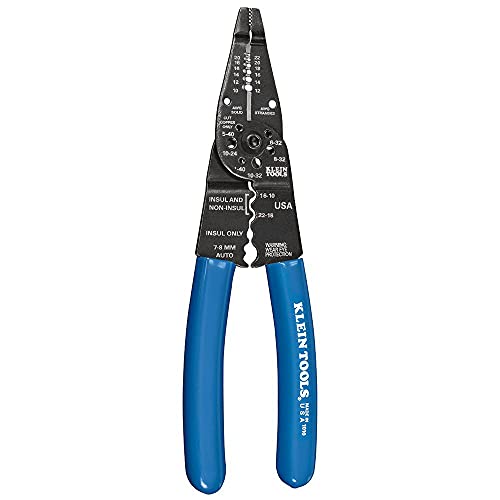
The Klein Tools 1010 folds several functions into one long-nose tool. Klein Tools rates it to strip and cut 10 to 20 AWG solid and 12 to 22 AWG stranded wire, and to crimp 10 to 22 AWG insulated and non-insulated terminals plus 7 to 8 mm ignition terminals. It also shears six bolt sizes: 4-40, 5-40, 6-32, 8-32, 10-32, and 10-24.
The stripping holes and cutter sit in front of the pivot, and the narrow serrated nose pulls, loops, and bends wire in crowded boxes where a bulkier tool cannot reach. At 8.25 inches and 6.9 ounces, it is the longest tool in this guide. The trade-off is that each function shares one frame, so high-volume crimping or all-day stripping is better served by a dedicated tool; as a grab-and-go option for mixed tasks, though, the 1010 covers a lot of ground.
Specs
- Strips and cuts: 10-20 AWG solid, 12-22 AWG stranded (per Klein Tools)
- Crimps: 10-22 AWG insulated and non-insulated terminals; 7-8 mm ignition terminals
- Bolt shearing: 4-40, 5-40, 6-32, 8-32, 10-32, 10-24
- Overall length: 8.25 in
- Weight: 6.9 oz
- Handles: blue plastic-covered cushioned handles
Klein Tools Klein-Kurve Wire Stripper/Cutter (11057)
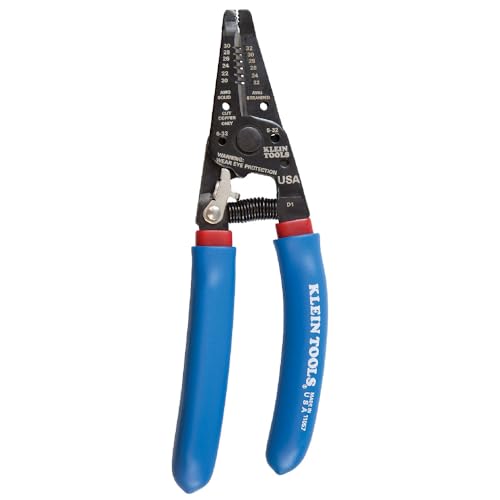
Where the other manual tools here target building wire, the Klein Tools 11057 is built for the small end of the gauge chart. Klein Tools rates it to cut, strip, and loop 20 to 30 AWG solid and 22 to 32 AWG stranded wire, the sizes common in electronics, control wiring, and appliance leads. Using a building-wire stripper on wire this fine usually ends with cut strands, because the smallest hole is still too large; the 11057 exists to solve exactly that problem.
It keeps the Klein-Kurve family traits: precision-ground stripping holes, a serrated nose for gripping and bending, looping holes, and screw shearing for 6-32 and 8-32 screws. A coil spring gives the tool a fast self-opening action, which reduces hand effort across hundreds of repetitive strips, and Klein Tools lists a weight of 5.1 ounces with blue and red double-dipped handles. As with any fixed-hole stripper, matching the hole to the gauge printed on the wire jacket still matters, and a hole one size too small will damage fine conductors.
Specs
- Strips and cuts: 20-30 AWG solid, 22-32 AWG stranded (per Klein Tools)
- Screw shearing: 6-32 and 8-32
- Overall length: 7.5 in
- Weight: 5.1 oz
- Handles: blue and red, double-dipped
- Spring: coil spring for self-opening action
Greenlee AM 25 Round Cable Slitter (1820)

The Greenlee 1820, catalog number PA1820 in the maker’s Paladin Tools line, is not a conductor stripper at all. It is a rotary slitter that removes the outer jacket from round cables from 0.18 to 1.0 inch in diameter, or 4.5 to 25 mm. Tempo Communications, the maker, describes a swivel blade that makes circular, longitudinal, and spiral cuts, with adjustable cutting depth so the blade scores the jacket without reaching the conductors inside.
The maker states the tool slits PVC, Teflon, and THHN insulation and is suited to armored cable, with a laser-trimmed stainless steel blade and a spare blade stored in the handle; the replacement blade is part PA2109. The maker also notes the tool is not for polyethylene, polypropylene, or XLP insulations, and not for use on live circuits. For anyone prepping larger round cables, service entrance cable, or armored cable runs, this style of tool does in seconds what a utility knife does slowly and with far more risk to the conductors underneath.
Specs
- Capacity: round cables 0.18-1.0 in (4.5-25 mm) in diameter (per Tempo Communications)
- Cut types: circular, longitudinal, and spiral, via swivel blade
- Blade: stainless steel; spare blade stored in handle
- Replacement blade: PA2109
- Overall length: 5.3 in
- Weight: 4.7 oz
Comparison: Which Type Fits Your Work?
The five tools divide cleanly by the wire they serve. For mixed wiring where sizes change from strip to strip, the self-adjusting IRWIN 2078300 removes the gauge-selection step. For controlled stripping of standard building wire, the manual Klein 11055GLW covers 10 to 18 AWG solid and adds glow-in-the-dark grips.
If the job mixes stripping with terminal crimping and bolt shearing, the Klein 1010 long-nose combo replaces three separate tools and reaches into tight boxes. Fine electronics and control work belongs to the Klein 11057, the only tool here rated down to 30 AWG solid and 32 AWG stranded. Jacket removal on round and armored cable is a separate task: the Greenlee 1820 slitter, sized by cable diameter rather than conductor gauge.
| Tool | Type | Maker-stated range | Standout extra |
|---|---|---|---|
| IRWIN 2078300 | Self-adjusting | 10-24 AWG | Strip-length stopper |
| Klein 11055GLW | Manual fixed-hole | 10-18 AWG solid, 12-20 AWG stranded | Glow-in-the-dark grips |
| Klein 1010 | Stripper/crimper combo | 10-20 AWG solid, 12-22 AWG stranded | Crimps terminals, shears six bolt sizes |
| Klein 11057 | Precision manual | 20-30 AWG solid, 22-32 AWG stranded | Self-opening coil spring |
| Greenlee 1820 | Rotary cable slitter | Round cable 0.18-1.0 in diameter | Adjustable cutting depth |
FAQ
Can one wire stripper handle both solid and stranded wire?
Yes, but check both ratings first. Makers list separate ranges because diameters differ at the same gauge, and a tool that strips 18 AWG solid may not have the right hole for 18 AWG stranded. The manual Klein tools and the Klein 1010 in this guide publish both ranges; the self-adjusting IRWIN adjusts across its stated range instead.
Are the handles on these strippers insulated against electric shock?
No. Klein Tools states that its manual strippers here are not insulated and that plastic-dipped handles are not intended for protection against shock. Work only on circuits switched off at the breaker and verified de-energized, and leave anything you are unsure about to a licensed electrician.
What should I do if a stripper nicks a conductor?
Cut the wire back past the nick and strip a fresh section. A nick removes copper and creates a weak point that can overheat or break under a terminal screw, so a damaged end should not be installed. Repeated nicking usually means the stripping hole is one size too small for that wire, or the insulation is thicker than the tool setting allows; on the IRWIN, the micro-adjustment knob addresses that case for small gauges.
How do I strip the jacket off a large round or armored cable?
That is a jacket-slitting job, not a conductor-stripping job. A rotary slitter such as the Greenlee 1820 is drawn along or around the cable with its blade depth set to the jacket thickness, which the maker states is adjustable for cables from 0.18 to 1.0 inch in diameter. Utility knives can do it in a pinch but offer no depth control, which is how inner conductors get scored.
Final Verdict
Most readers should start with the tool that matches the wire already in their walls and projects. The Klein Tools 11055GLW is the straightforward pick for standard residential gauges, with grips that are easy to find in the dark. The IRWIN 2078300 suits anyone stripping many sizes in sequence who would rather not change holes between wires. Add the Klein 1010 if terminals and bolt shearing are part of the same jobs, the Klein 11057 if the work is electronics-scale, and the Greenlee 1820 when the task is opening round cable jackets rather than stripping individual conductors. Whichever type you choose, keep the routine the same: breaker off, circuit verified dead, and any nicked conductor cut back and stripped fresh.
Product and ASIN Reference
| Product | ASIN |
|---|---|
| IRWIN VISE-GRIP Self-Adjusting Wire Stripper (2078300) | B000OQ21CA |
| Klein Tools Klein-Kurve Wire Stripper/Cutter (11055GLW) | B09FVTWPQV |
| Klein Tools Long-Nose Multi-Purpose Tool (1010) | B0000302WX |
| Klein Tools Klein-Kurve Wire Stripper/Cutter (11057) | B000XEUPMQ |
| Greenlee AM 25 Round Cable Slitter (1820) | B000X2H7P6 |
FAQ
Comparison: Which Type Fits Your Work?
More from Amazon
Programs that pair well with the guide above. Offers and eligibility are set by Amazon and may change.
Free shipping on eligible items, Prime Video and more. Eligible new members can start with a free trial.
Start a Prime free trialAudiobooks and podcasts to listen to on the go. Eligible new members can start with a free trial.
Try Audible freeAd-free music streaming. Eligible new subscribers can start with a free trial.
Try Music Unlimited freeA free business account with business pricing and bulk-buying tools for work, shop or home office.
Create a business accountAs an Amazon Associate we earn from qualifying purchases.


Write Your Review
No reviews yet. Be the first to share your experience!