
Key takeaways
- Compare the best ice melt spreaders for driveway deicing, from salt-built walk-behind models to drop spreaders that keep granules on the pavement in winter.
A driveway is the surface a household drives on every day, so the real decision is how to keep the tire tracks and the walking path to the door ice-free without wasting granules on the lawn or wearing out a spreader that was built for seed. A driveway is wider than a sidewalk, longer than a porch path, and often sloped, so the tool must hold enough ice melt for the whole surface, roll steadily over frozen ruts, and stop the flow cleanly at the garage door. The wrong spreader leaves slick stripes where tires run and piles where the gate stuck open.
This guide is for homeowners with a single or double driveway, for households on a slope where meltwater refreezes overnight, and for anyone who treats the same driveway after every storm. Each pick below was chosen from the product name and listed specifications on its Amazon page, with hopper size, spread pattern, and salt resistance compared side by side.
Quick Picks
As an Amazon Associate we earn from qualifying purchases
| Product | Best for | Key spec from title |
|---|---|---|
| Chapin 88200A SaltPro Spreader | A standard driveway treated with salt and ice melt | 80 lb all-season SaltPro walk-behind spreader |
| Agri-Fab 85 lb Push Broadcast Spreader | A long driveway that needs fewer refills | 85 lb push broadcast spreader, 10 ft spread width |
| Scotts Turf Builder Classic Drop Spreader | A driveway edged by lawn where precision matters | Drop spreader holds up to 10,000 sq. ft. |
| EarthWay 2150 Commercial Broadcast Spreader | A sloped driveway where tire grip and control matter | 50 lb commercial broadcast spreader, 13-inch pneumatic tires |
How to Choose
Match capacity to the driveway length and slope
A short, flat driveway can be treated with a small hopper in one fill, but a long or sloped driveway needs a larger hopper or a refill point halfway down. A heavy hopper is harder to push uphill on ice, so many homeowners fill a large model only partway and refill at the top of the slope. Measure the driveway from the garage to the street, note the grade, and pick a hopper that finishes the tire tracks without running dry halfway. A refill is a small delay; a bare stripe that refreezes is a fall risk.
Pick a spread pattern that fits the driveway edges
Most driveways are edged by lawn on one or both sides, so a wide broadcast arc will throw granules onto grass with every pass. A model with adjustable baffles, a side deflector, or a drop pattern keeps the material on the pavement, which matters when the driveway is narrow and the lawn is close. A drop spreader lays a controlled band along the tire tracks, while a broadcast model with baffles covers the open center faster. Check the listed spread width on the Amazon page against the width of the driveway.
Look for salt-built parts, not lawn parts
Ice melt is harder on a spreader than seed or fertilizer, so a model built for salt uses a rust-resistant poly hopper, an enclosed gearbox, and a spiked auger that breaks up clumps. Painted steel frames and open gears corrode quickly when wet salt sits in the mechanism, and small plastic wheels can skid on frozen ruts. Pneumatic tires grip better on ice and roll over cracks without bouncing the gate open. After each use, empty the hopper and rinse the spreader so salt residue does not seize the controls.
Check gate control and tire grip before a storm
A driveway spreader needs a gate that opens and closes cleanly, because the flow must stop at the garage door, at the sidewalk crossing, and at the end of each pass. A lever on the handle or a thumb trigger on a handheld model gives that control, and a numbered dial lets the rate match coarse granules. Large pneumatic tires with tread grip frozen pavement better than smooth plastic wheels, especially on a slope. Test the gate and the tires with gloves on before the first freeze, since adjustments in a storm are slow and cold.
The 4 Best Options
Chapin 88200A SaltPro Spreader

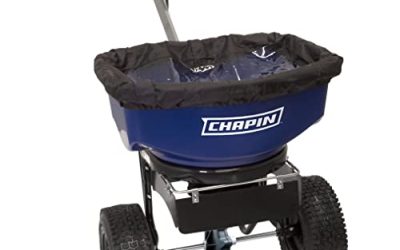
The Chapin 88200A is built for residential salt and ice melt, with an 80-pound blue poly hopper on a coated steel frame and a spiked auger that breaks up clumps before they reach the gate. Adjustable baffles shape the spread pattern around the driveway edges, and 30 gate settings let the flow match coarse granules instead of fine seed. Enclosed gears stay protected from wet salt, and the 12-inch tires roll over frozen ruts without skidding. For a standard driveway treated after every storm, it is a purpose-built tool rather than a lawn spreader pressed into winter work.
Specs
- 80 lb all-season SaltPro walk-behind broadcast spreader
- Blue poly hopper with spiked auger and adjustable baffles
- 30 gate settings for coarse salt and ice melt
- 12-inch tires with coated steel frame and enclosed gears
- Weather-resistant with rain cover included
Best for: A standard driveway treated with salt and ice melt after every storm.
Watch out for: Confirm the gate setting for coarse granules before the first pass, and keep the hopper covered in falling snow so the material stays dry.
Agri-Fab 85 lb Push Broadcast Spreader

The Agri-Fab 85-pound push broadcast spreader suits a long driveway because its large hopper and 10-foot spread width cover the surface in fewer passes and fewer refills. The push design needs no vehicle, and the wide arc moves quickly across the open center of a double driveway. A flow control on the handle lets the user stop the spread at the garage door and restart at the street end without spilling. For a household with a long paved driveway and no tractor, it balances capacity and simplicity.
Specs
- 85 lb push broadcast spreader for fertilizer, ice melt, and seed
- 10 ft spread width for wide driveways
- Push walk-behind design with flow control
- Rustproof poly hopper built for year-round use
Best for: A long driveway that needs fewer refills and faster coverage.
Watch out for: A full 85-pound load is heavy on a slope, so fill it partway for the uphill pass and refill at the top if needed.
Scotts Turf Builder Classic Drop Spreader

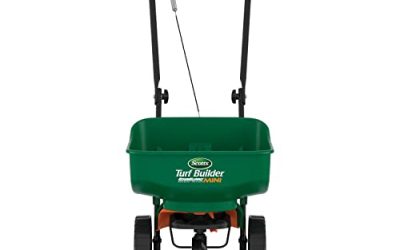
The Scotts Classic Drop Spreader is the precise option for a driveway edged closely by lawn, because a drop pattern releases granules straight down in a controlled band instead of throwing them in a wide arc. That control keeps ice melt on the tire tracks and off the grass, which matters on a narrow driveway where the lawn starts at the pavement edge. The walk-behind design is simple to steer along the driveway, and the hopper holds enough material for a standard driveway in one fill. For a homeowner whose main worry is the lawn edge, the drop pattern is the safest choice.
Specs
- Classic drop spreader holds up to 10,000 sq. ft. of product
- Drop pattern releases material straight down for precise placement
- For seed, fertilizer, and ice melt
- Walk-behind push design with handle gate control
Best for: A driveway edged by lawn where precision matters more than speed.
Watch out for: A drop spreader needs overlapping passes to avoid bare stripes, so plan the lane spacing and keep a steady walking pace.
EarthWay 2150 Commercial Broadcast Spreader

The EarthWay 2150 is a commercial walk-behind broadcast spreader that suits a sloped driveway, because its large 13-inch pneumatic stud tires grip frozen pavement and its heavy-duty gearbox keeps the spinner turning under load. A side-spread control lets the user shut off one side near the lawn edge, and the adjustable drop rate matches coarse ice melt. The 50-pound hopper is sized for a standard driveway without becoming too heavy to push uphill, and the hopper cover keeps falling snow out of the material. It is a sturdy choice for a driveway that freezes hard and often.
Specs
- 50 lb commercial broadcast spreader, heavy-duty walk-behind design
- Large 13-inch pneumatic stud tires for grip on ice
- Adjustable drop rate with side-spread control
- Heavy-duty gearbox with hopper cover and grate
Best for: A sloped driveway where tire grip and edge control matter most.
Watch out for: Check the side-spread control and the gate before the first freeze, and store the spreader dry so the gearbox stays free.
Which One Fits Your Situation
A standard driveway after every storm
Pick the Chapin 88200A, because it is built for salt and ice melt with a spiked auger, adjustable baffles, and 30 gate settings. The 80-pound hopper covers a standard driveway, the enclosed gears resist wet salt, and the 12-inch tires handle frozen ruts. It is the most direct fit for routine driveway deicing.
A long driveway with no tractor
Pick the Agri-Fab 85-pound push spreader, because its large hopper and 10-foot width cover a long driveway in fewer passes. The push design needs no vehicle, and the flow control stops the spread at the garage door. Fill it partway on a slope to keep pushing easy, and refill at the top before the return pass.
A narrow driveway beside lawn
Pick the Scotts Classic Drop Spreader, because its drop pattern lays granules straight down on the tire tracks without throwing them onto the grass. The controlled band suits a narrow driveway where the lawn starts at the pavement edge. Plan overlapping passes so no bare stripes remain, and walk at a steady pace from the garage to the street.
A sloped driveway that refreezes overnight
Pick the EarthWay 2150, because its 13-inch pneumatic stud tires grip frozen pavement and its side-spread control keeps material off the lawn edge. The 50-pound hopper is light enough to push uphill, and the heavy-duty gearbox keeps the spinner turning under load. Treat the tire tracks first, then the walking path to the door.
Common Mistakes
- Spreading ice melt on top of uncleared snow, so the granules never reach the ice bonded to the concrete.
- Running a wide broadcast arc on a narrow driveway, so most of the material lands on the lawn.
- Filling a large hopper to the top on a slope, then struggling to push it uphill on ice.
- Leaving wet salt in the hopper after a storm, which clumps, corrodes the gate, and seizes the gears.
- Treating only the center of the driveway and forgetting the tire tracks, the apron, and the path to the door.
Frequently Asked Questions
When should I spread ice melt on a driveway?
Spread it before a freeze when ice is forecast, or right after clearing snow while the pavement is still cold and damp. A thin layer laid early works better than a heavy layer poured onto thick ice later. If the driveway refreezes overnight, treat the tire tracks and the walking path again in the morning.
Can I use a fertilizer spreader for driveway ice melt?
Yes, if the listing names salt and ice melt among its uses and the gate opens wide enough for coarse granules. A model built for salt, with a poly hopper and enclosed gears, lasts longer than a lawn-only spreader. Clean the hopper after each use so salt residue does not corrode the mechanism.
How do I avoid bare stripes on a driveway?
Overlap each pass slightly so the edge of one lane covers the edge of the last, and keep a steady walking speed. A drop spreader needs closer lanes than a broadcast model, because its band is narrower. Walk the tire tracks first, then fill the center and the path to the door.
How do I store a spreader between storms?
Empty the hopper, rinse off salt residue, and let the spreader dry before storing it under cover. Keep the ice melt bag sealed so the granules stay dry and free-flowing, and check the gate and tires before the next freeze. A clean, dry spreader starts the next storm without clogging.
FAQ
When should I spread ice melt on a driveway?
Can I use a fertilizer spreader for driveway ice melt?
How do I avoid bare stripes on a driveway?
How do I store a spreader between storms?
More from Amazon
Programs that pair well with the guide above. Offers and eligibility are set by Amazon and may change.
Free shipping on eligible items, Prime Video and more. Eligible new members can start with a free trial.
Start a Prime free trialAudiobooks and podcasts to listen to on the go. Eligible new members can start with a free trial.
Try Audible freeAd-free music streaming. Eligible new subscribers can start with a free trial.
Try Music Unlimited freeA free business account with business pricing and bulk-buying tools for work, shop or home office.
Create a business accountAs an Amazon Associate we earn from qualifying purchases.



Write Your Review
No reviews yet. Be the first to share your experience!