
Key takeaways
- Compare five electric wall heaters, from hardwired fan-forced models to plug-in convection panels and an infrared unit, with sizing and thermostat notes.
A wall heater puts heat exactly where a room needs it without giving up floor space to a portable unit. Recessed models disappear into the wall cavity between studs, surface-mounted panels sit almost flat, and both styles suit bedrooms, bathrooms, offices, basements and additions the main heating system reaches poorly. Because most are permanent or semi-permanent fixtures, choosing well matters.
This guide compares five verified electric wall heaters across the main types: two hardwired fan-forced units, two plug-in convection panels, and one infrared wall heater. Two of the five carry programmable or app-based thermostats. Each section lists wattage, voltage and coverage exactly as the maker states them, and the buying guide below covers wiring, sizing and clearances.
As an Amazon Associate, we earn from qualifying purchases.
How to Choose a Wall Heater
Start with the heating method. Fan-forced heaters use a blower to push air across a hot element, so they raise a room’s temperature quickly and suit spaces used on and off through the day. Convection heaters have no fan: air warms as it passes through the unit and rises on its own, which makes them silent but slower. Infrared wall heaters radiate heat toward people and objects in front of them, and they work well for a desk, vanity or reading chair zone.
Next, decide between hardwired and plug-in installation. Hardwired models connect directly to a branch circuit inside a wall can. They need the breaker switched off before any wiring work and a dedicated circuit as their makers direct, and local electrical codes govern the installation, so hire a licensed electrician whenever you are unsure about any step. Plug-in panels mount to the wall with screws and brackets, then connect to a standard outlet, which keeps installation simple, though the maker’s stated clearances still apply.
Voltage follows from that choice. Many plug-in panels and smaller recessed units run on 120 volts. Larger hardwired models run on 240 volts and need a double-pole breaker plus a thermostat rated for line voltage. Match the model to the circuit you have or plan to add, since a heater can only run on the voltage it is built for.
For sizing, many makers suggest roughly 10 watts of heat per square foot for a reasonably insulated room used as primary heat, and less when the heater only supplements another system. Treat each model’s maker-stated coverage figure as the deciding number, and size up rather than down for rooms with high ceilings or large windows.
Thermostats come in three forms. A built-in dial is simple. A built-in digital thermostat holds a set temperature more precisely, and programmable versions follow a weekly schedule. A wall-mounted line-voltage thermostat, sold separately, controls hardwired units that ship without one; check that it is rated for the heater’s voltage and amperage. A basic panel with no thermostat, like the Econo-Heat below, runs whenever it is plugged in unless you add a plug-in thermostat.
Clearance is a safety requirement, not a suggestion. Makers state minimum distances to floors, side walls, curtains, furniture and bedding, and those figures differ by model. Cadet’s manual for the Com-Pak, for example, directs that clothing, curtains and other combustible materials stay at least 3 feet from the front of the heater, and that the intake and exhaust never be blocked. Follow the clearances printed in the manual for the model you buy.
One more type is worth knowing about: slim hardwired convection wall units from makers such as Stiebel Eltron, whose CON Premium line surface-mounts like a low panel, runs silently without a fan and uses electronic controls. The voltage, wattage and clearance checks above apply to them in the same way.
Cadet Com-Pak CSC151TW: Hardwired Fan-Forced Staple
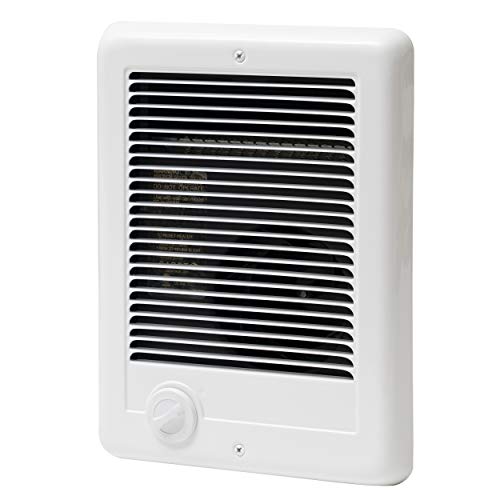
Cadet’s Com-Pak is the classic recessed wall heater, sold as a complete unit with the wall can, heater assembly, grille and a built-in thermostat. It is a fan-forced design that pushes warmed air into the room, and Cadet lists it for rooms up to 175 square feet. At 1,500 watts on 120 volts, it fits the dedicated 15-amp circuit its documentation calls for, making it a practical replacement for older recessed units.
The built-in single-pole thermostat sits on the grille, so no separate wall thermostat is needed. A manual-reset high-temperature shutoff cuts power if internal temperatures climb too high. The unit mounts vertically or horizontally in its wall can, and at 12 by 9 inches at the grille it fits tight walls between a door frame and a corner.
Specs
- Model: CSC151TW (part 67509)
- Wattage: 1,500 watts
- Voltage: 120 volts
- Heat output: 5,120 BTU per hour, as the maker states
- Heating method: fan-forced
- Thermostat: built-in single-pole thermostat
- Maker-listed room size: up to 175 square feet
- Grille dimensions: 12 x 9 inches
- Mounting: recessed wall can, hardwired
- Color: white
Econo-Heat 0603 E-Heater: Slim Plug-In Convection Panel

The Econo-Heat 0603 takes the opposite approach to the Com-Pak: a flat panel, 23 by 23 inches and about a quarter inch thick, that mounts on the surface of the wall and plugs into a standard outlet. It heats by natural convection with no fan, no moving parts and no noise, and the maker rates its 400 watts for rooms up to 120 square feet. The panel surface can be painted to match the wall.
There is no built-in thermostat, so the panel heats whenever it is plugged in; many owners add a plug-in thermostat, sold separately. The Amazon listing for this model is a four-pack, which suits fitting out several small rooms at once. Output is gentle and continuous, so this style of panel is usually chosen as background heat that takes the chill off rather than as a fast warm-up heater.
Specs
- Model: 0603
- Wattage: 400 watts
- Voltage: 120 volts
- Heating method: natural convection, no fan
- Thermostat: none built in; works with a plug-in thermostat, sold separately
- Maker-stated coverage: up to 120 square feet
- Panel dimensions: 23 x 23 inches, about 0.25 inch thick
- Mounting: surface wall mount, plug-in cord
- Listing format: four-pack
- Color: white, paintable
Heat Storm Deluxe HS-1000-WX: Infrared Wall Heater

Heat Storm’s Deluxe HS-1000-WX is an infrared wall heater: it radiates warmth directly toward the people and surfaces in front of it. Heat Storm rates the 1,000-watt unit for about 100 square feet as a primary heat source and up to 500 square feet as a supplemental source alongside another system. It mounts on a wall bracket, plugs into a standard outlet, and the maker fits a safe-touch grille over the front.
A built-in thermostat with a digital display holds a set temperature, and the maker includes a remote control. Because the warmth lands on occupants directly, this style is popular for bathrooms on cold mornings and for desks in drafty offices. As with every heater here, the maker’s stated clearances to furniture and fabrics apply, and the unit should never be covered or blocked.
Specs
- Model: HS-1000-WX
- Wattage: 1,000 watts
- Voltage: 120 volts
- Heat output: about 3,400 BTU per hour, as the maker states
- Heating method: infrared
- Thermostat: built-in thermostat with digital display; remote control included
- Maker-stated coverage: about 100 square feet primary, up to 500 square feet supplemental
- Mounting: wall bracket, plug-in cord
- Color: white
Fahrenheat SmartSeries FSSWH2004: Programmable Hardwired Power

The SmartSeries FSSWH2004, built by Marley Engineered Products under the Fahrenheat name, is the output leader in this guide: 2,000 watts on a 240-volt circuit, which the maker converts to 6,825 BTU per hour. It is a fan-forced recessed unit for larger bedrooms, basements, garages and workshops where a small heater would fall behind.
Its distinguishing feature is the built-in digital programmable thermostat with an LED touch screen: Marley lists 5/2-day programming, so weekday and weekend schedules can differ. That makes it the natural pick for a room on a routine, such as a home office heated only during work hours. Installation is a hardwired job on a 240-volt circuit, with the breaker off and a licensed electrician handling or checking the work if you are not fully confident.
Specs
- Model: FSSWH2004
- Wattage: 2,000 watts
- Voltage: 240 volts
- Heat output: 6,825 BTU per hour, as the maker states
- Heating method: fan-forced
- Thermostat: built-in digital programmable thermostat, LED touch screen, 5/2-day programming
- Mounting: recessed wall can, hardwired
- Color: gray
Amaze-Heater Dual Smart 400W: App-Controlled Convection Panel

The Amaze-Heater Dual Smart pairs a 400-watt convection panel with a plug-in WiFi module thermostat, so the heater can be scheduled and adjusted from an app as well as at the unit. The 24 by 24 inch panel mounts on the wall surface and plugs into a standard outlet. Amaze-Heater lists its heating coverage at 160 square feet, and includes a heat guard that fits over the panel.
Like the Econo-Heat, it heats silently by convection with no fan. The difference is control: the WiFi thermostat module brings programmable scheduling that the basic panel lacks, which suits a bedroom that should be warm by wake-up time or an office warmed before the workday.
Specs
- Model: AH400USDS
- Wattage: 400 watts
- Voltage: 120 volts
- Heat output: 1,364 BTU per hour, as the maker states
- Heating method: convection, no fan
- Thermostat: plug-in WiFi module thermostat with app control and scheduling
- Maker-listed coverage: 160 square feet
- Dimensions: 24 x 24 x 2 inches
- Mounting: surface wall mount, plug-in cord
- Color: white, paintable
Comparison
The five picks divide first by wiring: the Cadet Com-Pak and the Fahrenheat SmartSeries are hardwired, recessed and permanent, while the Econo-Heat, Heat Storm and Amaze-Heater mount on the wall surface and plug in. Output runs from the two 400-watt convection panels up to the Fahrenheat’s 2,000 watts, and control ranges from no thermostat at all on the Econo-Heat to app scheduling on the Amaze-Heater.
| Product | Type | Watts | Voltage | Thermostat |
|---|---|---|---|---|
| Cadet Com-Pak CSC151TW | Fan-forced, recessed | 1,500 | 120 | Built-in dial |
| Econo-Heat 0603 E-Heater | Convection panel | 400 | 120 | None built in |
| Heat Storm Deluxe HS-1000-WX | Infrared | 1,000 | 120 | Built-in digital, remote |
| Fahrenheat SmartSeries FSSWH2004 | Fan-forced, recessed | 2,000 | 240 | Built-in programmable |
| Amaze-Heater Dual Smart 400W | Convection panel | 400 | 120 | WiFi module, app control |
FAQ
Can an electric wall heater be a room’s only heat source?
Yes, when it is sized for the room and the room is insulated. Makers publish coverage figures, and the common maker guidance of roughly 10 watts per square foot is a useful cross-check. Local building codes may set requirements for permanent heat in living spaces, so check them before relying on one unit.
Do hardwired wall heaters need a dedicated circuit?
Makers direct that hardwired wall heaters sit on a dedicated circuit sized for the heater’s amperage. All wiring starts with the breaker off, must follow local electrical codes, and should be done or checked by a licensed electrician whenever you are unsure.
Which wall heater type is quietest?
Convection panels and infrared heaters have no blower, so they run silently. Fan-forced models such as the Com-Pak and the SmartSeries move air with a fan, warm a room faster, and are audible while running. For a light sleeper’s bedroom, a panel is usually the better fit.
How much clearance does a wall heater need?
Clearances are set by each maker, printed in the manual, and vary by model. As one example, Cadet directs that combustible materials such as curtains and clothing stay at least 3 feet from the front of the Com-Pak. Keep the stated distances to the floor, side walls, furniture and bedding, and never block the intake or the outlet.
Final Verdict
For a permanent, no-fuss installation in a bathroom or bedroom, the Cadet Com-Pak CSC151TW is the default choice: complete in one box and thermostat-controlled. For silent background heat, the Econo-Heat 0603 panel is the simplest option, while the Amaze-Heater Dual Smart adds the scheduling and app control the basic panel lacks. The Heat Storm Deluxe HS-1000-WX suits anyone who prefers direct infrared heat in a small room. And for a large or hard-to-heat space on a schedule, the Fahrenheat SmartSeries FSSWH2004 brings the most wattage and the best thermostat here. Whichever you pick, confirm the voltage, the circuit and the maker’s clearances before the unit goes on the wall.
Product and ASIN Reference
| Product | ASIN |
|---|---|
| Cadet Com-Pak Electric Wall Heater, Model CSC151TW | B000HM7U1I |
| Econo-Heat 0603 E-Heater Wall Panel Heater, 4-Pack | B0161YCRF4 |
| Heat Storm Deluxe Infrared Wall Heater, Model HS-1000-WX | B009KY70YQ |
| Fahrenheat SmartSeries Wall Heater, Model FSSWH2004 | B00BPBS1LS |
| Amaze-Heater Dual Smart 400W Wall Panel Heater, Model AH400USDS | B08KNTBBC3 |
FAQ
Can an electric wall heater be a room’s only heat source?
Do hardwired wall heaters need a dedicated circuit?
Which wall heater type is quietest?
How much clearance does a wall heater need?
More from Amazon
Programs that pair well with the guide above. Offers and eligibility are set by Amazon and may change.
Free shipping on eligible items, Prime Video and more. Eligible new members can start with a free trial.
Start a Prime free trialAudiobooks and podcasts to listen to on the go. Eligible new members can start with a free trial.
Try Audible freeAd-free music streaming. Eligible new subscribers can start with a free trial.
Try Music Unlimited freeA free business account with business pricing and bulk-buying tools for work, shop or home office.
Create a business accountAs an Amazon Associate we earn from qualifying purchases.





Write Your Review
No reviews yet. Be the first to share your experience!