
Key takeaways
- Compare five litter boxes: a hooded pan with a charcoal filter, a high-sided open pan, a sifting system, a self-cleaning rake box and a giant pan.
The right litter box depends on the cat in front of you and the room it has to fit into. A large cat that digs hard needs a different pan from a small, shy cat that wants privacy, and multi-cat households clean differently from single-cat apartments. This guide covers the main designs: a hooded pan, a high-sided open pan, a sifting system, a self-cleaning rake box and a giant open pan for big cats and multi-cat homes.
Every pick below is a current product from a known maker, with specs quoted from the makers’ own published figures. Start with size, because it decides more than any feature does: a widely used guideline is a box at least one and a half times the length of your cat, measured from nose to the base of the tail, so the cat can enter, turn and dig without hanging over the edge. After that, choose the cleaning style you will actually keep up with, and follow the maker’s cleaning guidance for that model.
As an Amazon Associate, we earn from qualifying purchases.
How to Choose
Size the box to the cat first. Measure your cat from nose to tail base and compare it with the inside length of the pan, not the outside dimensions on the box. Kittens and older cats need a low entry side; tall cats and enthusiastic diggers do better with higher walls.
Covered or open is the cat’s call. A hood adds privacy, contains scatter from digging and keeps other pets out of the pan. Some cats will not enter an enclosed box, and hoods concentrate smells inside. Open pans with high sides are the middle ground: easy entry, scatter control on three sides, nothing to lift off before scooping.
Sifting systems trade scooping for lifting. A sifting box stacks a perforated tray between two solid pans. You lift the sifter, clumps stay in it, clean litter falls through, and the empty solid pan goes on the bottom. These systems work with clumping litter, and the full sifter has to be lifted level, so they suit owners comfortable handling a full tray of litter.
Self-cleaning boxes trade money and parts for time. Rake-style models use sensors to detect when the cat has left, wait through a short countdown, then sweep waste into a covered compartment. The PetSafe design below runs on disposable trays pre-filled with crystal litter, so running one means keeping spare trays on hand. Rotating-drum models from other makers use ordinary clumping litter instead.
Count boxes for the household, not the room. A common guideline is one box per cat plus one extra, in quiet spots cats can reach at all times. Whatever you buy, wash pans with mild soap and water on the maker’s schedule, replace litter fully at the intervals the maker suggests, and keep the familiar box available when changing styles.
Nature’s Miracle Hooded Flip Top Litter Box

This is the covered pick: a fully hooded pan from Nature’s Miracle with a hood whose front section flips up, so daily scooping does not require removing the whole lid. The hood is held by snap latches, and a replaceable charcoal filter sits in the top of the hood, which the maker positions to absorb odors from the air passing through the lid. The interior has a non-stick surface that the maker states prevents litter build-up from spraying, and the enclosed shape contains scatter.
At 25.3 inches long, it is one of the roomier hooded pans here, with space for a larger cat to turn inside. The entry opening is about 7.2 inches high, low enough for most adult cats. For owners who want a lid that opens in sections rather than lifting away, this is the most straightforward covered design here.
Specs
- Type: Hooded pan with flip-top front section
- Dimensions: 25.3 x 18.8 x 16.5 inches (maker’s published figures)
- Filter: Replaceable charcoal filter built into the hood
- Latches: Snap latches hold the hood to the base
- Surface: Non-stick interior, as the maker states
- Entry: Front opening, about 7.2 inches high
Van Ness Giant High-Sides Cat Litter Pan (CP3HS)

Van Ness takes the opposite approach: no lid at all, an open pan with walls that rise to 9 inches at the back and a front entry dipped to 6.5 inches. That shape suits cats that spray high or kick litter backward, and the lowered front keeps the box accessible to smaller or older cats. The pan is BPA-free plastic with a smooth, high-polish finish that the maker describes as resisting stains and odors.
This is the giant size in the Van Ness high-sides line, a little over 21 inches long, which gives a large cat room to turn without the Petmate pan’s footprint below. There are no filters, lids or moving parts to replace. If your cat refuses hooded boxes but redecorates the floor around an ordinary pan, this is the simplest fix in the guide.
Specs
- Type: Open pan with high sides and lowered front entry
- Dimensions: 21.25 x 17.63 x 9.25 inches (maker’s published figures)
- Model: CP3HS, Giant size
- Entry: Dipped front, 6.5 inches high; rear wall 9 inches
- Material: BPA-free plastic, high-polish finish
- Origin: Made in the USA, per the maker
Arm & Hammer Large Sifting Litter Pan
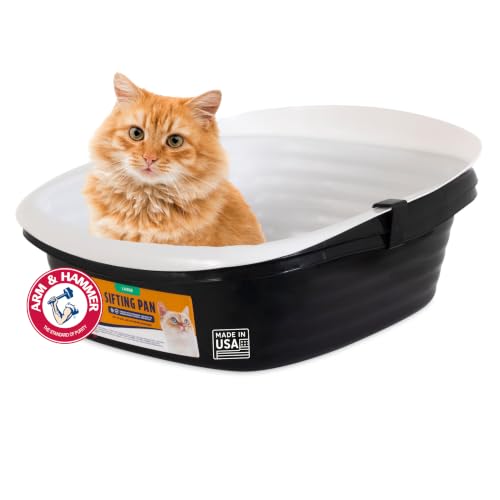
The sifting pick is Petmate’s Arm & Hammer three-pan system, model 42036. Two solid pans and one sifting pan stack together, the sifter in the middle. To clean the box, lift the sifter: clumps and waste stay in it, clean litter falls into the pan below, and the emptied solid pan becomes the new base with the clean litter poured back on top. There is no scoop to store, and the reinforced bottom takes the weight of a full tray being lifted.
The plastic carries Microban antimicrobial product protection, which the maker states is built in to help fight stain- and odor-causing bacteria on the pan surface. At 19 inches long this is the most compact box in the guide, sized for one average cat, not a large breed. It works with clumping litter, and rewards a steady, level lift rather than a fast one.
Specs
- Type: Sifting system, three stacked pans
- Dimensions: 19 x 15 x 8 inches
- Model: 42036
- Contents: Two solid pans and one sifting pan
- Protection: Built-in Microban antimicrobial product protection, as the maker states
- Base: Reinforced bottom for lifting a full tray
PetSafe ScoopFree Self-Cleaning Litter Box

The self-cleaning pick is PetSafe’s ScoopFree, in the version with a front-entry privacy hood. Its mechanism is a rake: sensors detect when your cat has used the box and left, a countdown runs so cleaning never starts with a cat inside, and then the rake sweeps and pushes solid waste into a covered compartment at the end of the tray. The litter is a disposable tray pre-filled with crystal litter; when the tray is spent, you slide the used tray out and a fresh one in, on the maker’s replacement schedule of up to 30 days for a single cat.
The hooded version measures 27.5 inches long with a 6.3-inch entryway, and the hood lifts off if your cat prefers an open box. The box plugs in with no plumbing or permanent installation, and the ongoing commitment is a supply of the maker’s crystal litter trays, the only litter this design uses. For owners who travel or work long hours, this is the hands-off option in the guide, provided your cat accepts crystal litter.
Specs
- Type: Self-cleaning rake box with front-entry hood
- Dimensions: 27.5 x 19 x 15.8 inches (hooded version)
- Mechanism: Sensors detect the cat leaving, then a countdown runs before the rake sweeps waste into a covered compartment
- Litter: Disposable trays pre-filled with crystal litter, replaced on the maker’s schedule
- Entry: Front entryway, 6.3 inches high, hood removable
- Power: Plug-in electric operation
Petmate Giant Litter Pan
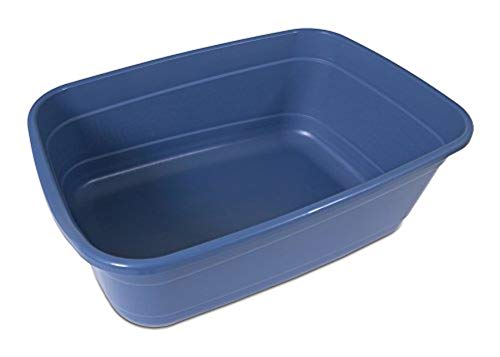
The extra-large pick is Petmate’s Giant pan, an open box built for large cats, multiple cats and shelter-style setups. Retailer listings put it at about 34.7 inches long and 19.8 inches wide, a different class from standard pans. Petmate states the pan holds over 30 pounds of litter, deep enough for serious diggers.
The entry is sloped rather than stepped, which the maker designs for easier access for older cats and kittens. The rim is shaped to give you a grip for moving the loaded pan, and the plastic is made with 95 percent pre-consumer recycled content, per the maker. If your problem is simply that every standard box is too small, this is the direct answer.
Specs
- Type: Extra-large open pan
- Dimensions: About 34.7 x 19.8 x 10 inches (retailer listings)
- Capacity: Holds over 30 lb of litter, as the maker states
- Entry: Sloped front entry for easier access
- Material: Made with 95 percent pre-consumer recycled plastic, per the maker
- Liners: No liners made for this size, per the maker
Comparison
The five boxes split by cleaning style more than by size. The Nature’s Miracle and the ScoopFree both close the cat in, but one is scooped by hand through a flip-up hood while the other rakes itself into disposable trays. The Van Ness and the Petmate are both open pans with high walls; the Van Ness is the everyday size with a dipped entry, the Petmate the oversize answer for big cats. The Arm & Hammer sits between open and automatic: no power and no consumables beyond litter, but a full-tray lift replaces the scoop.
| Product | Type | Approx. length | Cleaning style |
|---|---|---|---|
| Nature’s Miracle Hooded Flip Top | Hooded | 25.3 in | Hand scoop through flip-up hood |
| Van Ness Giant High-Sides CP3HS | Open, high-sided | 21.25 in | Hand scoop |
| Arm & Hammer Large Sifting Pan | Sifting | 19 in | Lift the sifting tray |
| PetSafe ScoopFree | Self-cleaning | 27.5 in | Automatic rake, disposable trays |
| Petmate Giant Litter Pan | Open, extra-large | 34.7 in | Hand scoop |
FAQ
How big should a litter box be for my cat?
Use the cat as the measuring stick: a widely used guideline is a pan at least one and a half times the cat’s length from nose to tail base, so the cat can turn and dig inside. When in doubt, size up. A too-small box is a common reason cats go over the edge or abandon a pan.
Do sifting litter boxes need special litter?
They are made for clumping litter, which forms the clumps the sifter catches while loose litter falls through. Very fine or non-clumping litters can pass through with the waste or fail to separate cleanly. Check the maker’s litter guidance for your model, and rinse the tray on the maker’s schedule so the holes stay clear.
How often should a litter box be cleaned?
For standard pans, scoop daily and replace the full litter bed regularly, washing the pan with mild soap and water; follow the maker of your box for exact intervals. Sifting systems are emptied at each sift and washed periodically. The ScoopFree replaces cleaning with tray swaps, up to 30 days per tray for one cat on the maker’s schedule, sooner with more cats.
Will my cat accept a covered or automatic box?
Some cats will not use a hooded box, and some are wary of a box that moves and makes noise. Introduce any new box beside the old one, let the cat explore it unused, and keep the old box available until the new one is in use. PetSafe’s own guidance for the ScoopFree is to set it up with the power off for the first days, then switch the automatic cycle on once the cat is using it confidently.
Final Verdict
Pick by cleaning style first and size second. The Nature’s Miracle Hooded Flip Top is the covered choice for cats that like privacy and owners who still scoop by hand. The Van Ness Giant High-Sides is the open-pan fix for diggers and sprayers, and the Petmate Giant is the step up when even that is too small. The Arm & Hammer sifting pan removes the scoop from the routine at the cost of a full-tray lift, and the PetSafe ScoopFree removes the most work, in exchange for a supply of crystal litter trays. Whichever you choose, measure your cat before you order, and follow the maker’s cleaning guidance once the box is in place.
Product and ASIN Reference
| Product | ASIN |
|---|---|
| Nature’s Miracle Hooded Flip Top Litter Box | B01KBV4TL8 |
| Van Ness Giant High-Sides Cat Litter Pan (CP3HS) | B0027JF0NO |
| Arm & Hammer Large Sifting Litter Pan | B06XNX32K1 |
| PetSafe ScoopFree Self-Cleaning Litter Box | B07X3XFB6K |
| Petmate Giant Litter Pan | B0135X6ZBG |
FAQ
How big should a litter box be for my cat?
Do sifting litter boxes need special litter?
How often should a litter box be cleaned?
Will my cat accept a covered or automatic box?
More from Amazon
Programs that pair well with the guide above. Offers and eligibility are set by Amazon and may change.
Free shipping on eligible items, Prime Video and more. Eligible new members can start with a free trial.
Start a Prime free trialAudiobooks and podcasts to listen to on the go. Eligible new members can start with a free trial.
Try Audible freeAd-free music streaming. Eligible new subscribers can start with a free trial.
Try Music Unlimited freeA free business account with business pricing and bulk-buying tools for work, shop or home office.
Create a business accountAs an Amazon Associate we earn from qualifying purchases.



Write Your Review
No reviews yet. Be the first to share your experience!