
Key takeaways
- Compare the best sewage pumps for basement bathrooms: cast iron ejector pumps, a pre-assembled basin system, a 2 HP grinder pump and a value pick.
A sewage pump does the one job a gravity drain cannot: when a bathroom, laundry room or kitchen sits below the main sewer or septic line, the pump lifts wastewater, including flushed solids, up and out of the house. These pumps live inside a sealed basin, switch on automatically as the basin fills, and push effluent to the main line. Choosing the wrong one means a pump that cannot pass toilet solids, cannot make the lift, or short-cycles itself to an early failure.
This guide compares five sewage pumps: two heavy cast-iron ejector pumps from established makers, a factory pre-assembled basin system, a 2 HP grinder pump for long or uphill runs, and a lower-cost cast-iron ejector. Lighter thermoplastic ejector pumps are covered in the How to Choose section, because that class could not be confirmed to the same standard as the five picks below.
As an Amazon Associate, we earn from qualifying purchases.
How to Choose a Sewage Pump
Ejector or grinder. A sewage ejector pump passes solids largely intact through a wide discharge, and it is the standard choice for a basement bathroom. A grinder pump cuts solids into a slurry first, which lets it push wastewater through a smaller pipe and against much higher head, at a higher cost. Most single-bathroom installs belong on an ejector.
Solids handling. For a toilet, look for a pump rated to pass 2-inch spherical solids, the figure the makers in this guide publish. Pumps rated only for smaller solids are effluent pumps, not sewage pumps, and do not belong under a toilet.
Head and flow. Head is the vertical lift plus pipe friction the pump works against. Measure the rise from the basin to the main line, then compare it with the maker’s published curve rather than the maximum flow number, which is measured at little or no lift.
Basin size. A basin that is too small makes the pump short-cycle; one matched to the fixture load runs longer, less frequent cycles. Common residential basins run from shallow 24 by 24 inch packages to taller 18 by 30 inch basins, and many local codes set a minimum basin size for a bathroom group, so check yours before ordering. The diameter also has to leave room for the float to swing freely.
Discharge diameter. Ejector pumps typically use a 2-inch discharge; grinder pumps typically use 1-1/4 inch. Match the pump’s discharge to your pipe run, and plan on a check valve and a vent connection sized and placed as the pump maker directs.
Switch style. Wide-angle piggyback floats, tethered floats and integral switches all do the same job differently. Piggyback designs let you replace or bypass the switch without opening the pump.
Construction. Cast iron housings shed motor heat into the surrounding liquid and dominate the heavy-duty end. Thermoplastic ejector pumps are lighter and will not rust, and they suit lighter-duty installs, but verify the solids rating and head curve carefully, because that class varies widely. Follow the maker’s installation guidance, check local plumbing codes before you start, and hire a licensed plumber when you are unsure about any part of the job.
Zoeller Waste-Mate M267 Sewage Pump (267-0001)
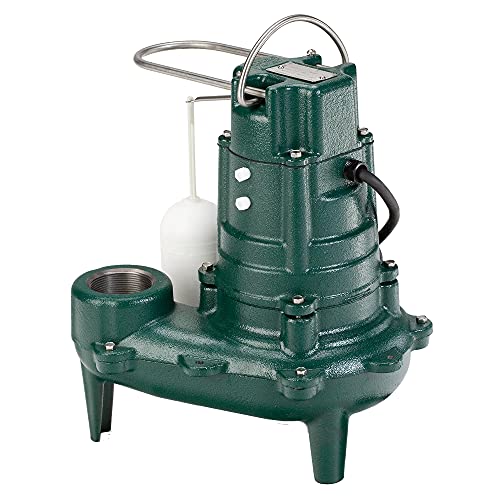
The M267 is the cast-iron ejector that plumbers have specified for decades. Zoeller builds the switch case and housing from ASTM Class 25 cast iron and fits a non-clogging vortex impeller in engineered plastic, so the pump passes 2-inch spherical solids without the impeller sitting in the flow path. The integral float operates a 2-pole mechanical switch, and the unit is hermetically sealed for submerged service.
Zoeller publishes a maximum flow of 125 gallons per minute and a shut-off head of 21.5 feet for this model, which covers the lift in most basement bathrooms with margin to spare. At about 36 pounds it is a dense, compact pump that fits standard residential basins and carries a long parts and service tail behind it.
Specs
- Model: 267-0001 (M267 Waste-Mate)
- Horsepower: 1/2 HP, as Zoeller states
- Voltage: 115 V
- Maximum flow: 125 gallons per minute, as Zoeller publishes
- Shut-off head: 21.5 feet, as Zoeller publishes
- Solids handling: 2-inch spherical solids
- Discharge: 2-inch NPT
- Construction: cast iron housing, thermoplastic vortex impeller
- Switch: integral float-operated 2-pole mechanical switch
Liberty Pumps LE51A Sewage Pump

The LE51A is Liberty’s heavy-duty answer: a cast-iron ejector with stainless steel fasteners and a powder-coat finish, built around an oil-filled, thermally protected motor. Liberty rates it at up to 160 gallons per minute with a maximum lifting height of 25 feet, the strongest published curve among the standalone ejectors here, suiting taller lifts or a bathroom plus laundry sharing one basin.
The wide-angle float switch rides on a piggyback plug, so the pump can be run manually for testing and the switch replaced without disturbing the pump. A quick-connect 10-foot cord is standard, and at roughly 42 pounds it is one of the heavier pumps here.
Specs
- Model: LE51A (LE50 Series)
- Horsepower: 1/2 HP, as Liberty states
- Voltage: 115 V
- Maximum flow: 160 gallons per minute, as Liberty publishes
- Maximum lift: 25 feet, as Liberty publishes
- Solids handling: 2-inch solids
- Discharge: 2-inch
- Construction: cast iron with stainless steel components
- Switch: wide-angle float on a piggyback plug
- Cord: 10-foot quick-connect
Liberty Pumps P382LE41 Pro380 Sewage System

The Pro380 is the pick when you do not want to assemble a system from parts. Liberty ships the P382LE41 factory pre-assembled: an LE41 ejector pump installed in a 24 by 24 inch polyethylene basin with a 41-gallon capacity and a sealed cover, and the floats sit on a stainless rod assembly Liberty calls QuickTree, which lets you inspect or replace floats through a separate access cover without disconnecting plumbing.
The shallow profile suits bedrock or difficult soil where a deep pit is hard to dig, and the larger capacity lengthens pump cycles. The system manual publishes a maximum flow of 122 gallons per minute and a maximum lifting height of 20 feet for the 4/10 HP pump. An anti-flotation collar and molded torque stops are built in. Confirm your local code accepts the basin size for the fixtures you plan to connect.
Specs
- Model: P382LE41 (Pro380 Series)
- Horsepower: 4/10 HP, as Liberty states
- Basin: 24 by 24 inches, 41-gallon capacity, polyethylene
- Maximum flow: 122 gallons per minute, as published for the system
- Maximum lift: 20 feet, as published for the system
- Solids handling: 2-inch solids
- Discharge: 2-inch
- Construction: cast iron pump in a polyethylene basin
- Switch: float assembly on QuickTree rod with separate access cover
- Assembly: factory pre-assembled
Liberty Pumps LSG202A Omnivore Grinder Pump

A grinder pump solves a different problem. Instead of passing solids whole, the LSG202A uses Liberty’s V-Slice cutter system to shred solids into a fine slurry, then pushes that slurry through a 1-1/4 inch discharge. That smaller pipe is easier to run over distance, and the 2 HP motor is built for the high head that long or uphill runs create.
Liberty builds the Omnivore with internal capacitors, so it does not need a separate control panel, and fits a wide-angle piggyback float on a 25-foot quick-disconnect cord. Note the electrical requirement before ordering: this is a 208/230 volt, single-phase pump, so it needs a matching circuit, unlike the 115-volt ejectors above. Grinder pumps are not the default for a simple basement bathroom, but for a long run, a high lift or a pressurized sewer connection, this is the type to buy.
Specs
- Model: LSG202A (LSG200 Series Omnivore)
- Horsepower: 2 HP, as Liberty states
- Voltage: 208/230 V, single phase
- Cutter: V-Slice cutter technology, as Liberty describes it
- Solids handling: grinds solids to a slurry rather than passing them whole
- Discharge: 1-1/4 inch
- Construction: cast iron
- Switch: wide-angle float on a piggyback plug
- Cord: 25-foot quick-disconnect
- Controls: internal capacitors, no separate control panel required
Superior Pump 93501 Sewage Pump

The 93501 brings the same basic specification as the premium ejectors — cast iron construction, 2-inch solids, a 2-inch discharge — at a noticeably lower tier of cost. Superior Pump rates it at up to 4,800 gallons per hour with a maximum lift of 25 feet, and builds it with a thermoplastic vortex impeller, a tethered float switch, and a continuous-duty, thermally protected split capacitor motor with solid copper windings, as the maker describes it.
At about 25 pounds it is lighter than the other cast-iron pumps here, which makes it easier to handle during installation and service. The trade-offs: a tethered float needs basin room to swing, and the maker’s warranty runs one year. For a straightforward basement bathroom on a budget, the published specification covers the job.
Specs
- Model: 93501
- Horsepower: 1/2 HP, as Superior Pump states
- Maximum flow: 4,800 gallons per hour, as Superior Pump publishes
- Maximum lift: 25 feet, as Superior Pump publishes
- Solids handling: 2-inch solids
- Discharge: 2-inch NPT
- Construction: cast iron, thermoplastic vortex impeller
- Switch: tethered float with piggyback plug
- Cord: 10-foot
- Current draw: 7.6 amps, as the maker lists
Comparison
The five picks divide by job. Three pass 2-inch solids through a 2-inch discharge; the grinder shreds solids for a smaller pipe and higher head; the Pro380 trades a little pump size for a complete, factory-built basin package.
| Product | Horsepower | Maximum flow (maker) | Maximum head (maker) | Discharge | Type |
|---|---|---|---|---|---|
| Zoeller Waste-Mate M267 | 1/2 HP | 125 gallons per minute | 21.5 feet | 2 inch | Cast-iron ejector |
| Liberty Pumps LE51A | 1/2 HP | 160 gallons per minute | 25 feet | 2 inch | Cast-iron ejector |
| Liberty Pumps P382LE41 Pro380 | 4/10 HP | 122 gallons per minute | 20 feet | 2 inch | Pre-assembled basin system |
| Liberty Pumps LSG202A Omnivore | 2 HP | High-head grinder curve | Built for high-head runs | 1-1/4 inch | Grinder pump |
| Superior Pump 93501 | 1/2 HP | 4,800 gallons per hour | 25 feet | 2 inch | Cast-iron ejector |
Maximum flow is measured at minimal lift, so the figure that matters is the flow remaining at your actual head on the maker’s curve.
FAQ
What size sewage pump does a basement bathroom need?
Most basement bathrooms run well on a 1/2 HP ejector rated for 2-inch solids, like the Zoeller M267 or the Liberty LE51A. What matters more than the horsepower label is the maker’s curve: confirm the pump still delivers useful flow at your lift height, and pair it with a basin sized for the fixture load and your local code.
Should I choose an ejector pump or a grinder pump?
Choose an ejector for a standard basement bathroom with a short run to the main line; it passes 2-inch solids whole through a 2-inch pipe. Choose a grinder when the run is long, the lift is high, or you are connecting to a pressurized sewer, because ground slurry moves through a smaller 1-1/4 inch pipe against much higher head.
How big should the sewage basin be?
Big enough that the pump runs in longer, less frequent cycles and the float can swing freely. Residential basins commonly range from shallow 24 by 24 inch packages like the Pro380 to taller 18 by 30 inch basins, and many local codes set a minimum size for a bathroom group, so check yours.
Can I install a sewage pump myself?
The work involves plumbing, venting and electrical connections inside a sealed sewage basin, and local plumbing codes govern most of it. Follow the maker’s installation guidance exactly, including check valve and vent placement, and hire a licensed plumber when unsure about any step, particularly the electrical supply and the main-line connection.
Final Verdict
For most basement bathrooms, start with the Zoeller Waste-Mate M267, the proven cast-iron ejector for typical lifts. Pick the Liberty LE51A when you want the strongest published flow and head among the standalone ejectors, or the Superior Pump 93501 when the budget leads and the lift is modest. Choose the Liberty Pro380 P382LE41 when a factory pre-assembled basin system simplifies the job, especially over shallow or difficult digging. Reserve the Liberty LSG202A Omnivore grinder for long, high or pressurized runs where an ejector is the wrong tool. Whichever you choose, match the discharge diameter and basin size to the pump, follow the maker’s installation guidance, and check local plumbing codes before you begin.
Product and ASIN Reference
| Product | ASIN |
|---|---|
| Zoeller Waste-Mate M267 Sewage Pump (267-0001) | B003Y5F7J2 |
| Liberty Pumps LE51A Sewage Pump | B001DEMDUW |
| Liberty Pumps P382LE41 Pro380 Sewage System | B002YRDRP2 |
| Liberty Pumps LSG202A Omnivore Grinder Pump | B00A3GTFKM |
| Superior Pump 93501 Sewage Pump | B0BZ88WD4H |
FAQ
What size sewage pump does a basement bathroom need?
Should I choose an ejector pump or a grinder pump?
How big should the sewage basin be?
Can I install a sewage pump myself?
More from Amazon
Programs that pair well with the guide above. Offers and eligibility are set by Amazon and may change.
Free shipping on eligible items, Prime Video and more. Eligible new members can start with a free trial.
Start a Prime free trialAudiobooks and podcasts to listen to on the go. Eligible new members can start with a free trial.
Try Audible freeAd-free music streaming. Eligible new subscribers can start with a free trial.
Try Music Unlimited freeA free business account with business pricing and bulk-buying tools for work, shop or home office.
Create a business accountAs an Amazon Associate we earn from qualifying purchases.



Write Your Review
No reviews yet. Be the first to share your experience!