
Key takeaways
- Compare the best torque wrenches for lug nuts, engine work and small fasteners, with click, split-beam and digital picks for every drive size.
A torque wrench is a measuring instrument, not just a longer ratchet. It lets you tighten a fastener to the clamping force the vehicle or equipment maker specifies, which matters everywhere from wheel lug nuts and brake caliper brackets to spark plugs, valve covers, and bicycle stems. A fastener left too loose can back out in service, while one pulled too tight can stretch, strip its threads, or warp parts such as brake rotors and aluminum engine covers.
The five wrenches below cover the main types a home mechanic is likely to need: three click wrenches in the three common drive sizes, a split-beam wrench that never needs winding down for storage, and a digital model with an electronic readout and target alerts. Every range and accuracy figure quoted here is the figure the tool’s own maker publishes. The torque value for any given bolt always comes from the vehicle or equipment maker’s specification, never from the wrench maker.
As an Amazon Associate, we earn from qualifying purchases.
How to Choose a Torque Wrench
Match the drive size and range to the job. A 1/4-inch drive wrench graduated in inch-pounds suits small fasteners such as spark plugs, pan bolts, and bicycle hardware. A 3/8-inch drive covers most mid-range engine and chassis work. A 1/2-inch drive is the usual choice for lug nuts, suspension, and steering fasteners.
Plan to work in the middle of the scale. Makers state accuracy over a defined portion of a wrench’s range, not necessarily across all of it. TEKTON states an accuracy of plus or minus 4 percent for its click wrenches, Precision Instruments states within 4 percent of the setting from 20 percent of full scale to full scale, and GEARWRENCH states its figures between 20 and 100 percent of the wrench’s capability. A wrench is a poor pick if your target value sits right at either end of its scale.
Pick a type. Click wrenches are the most affordable and signal with a click you can hear and feel. Split-beam wrenches have no coil spring under tension, so the maker designs them to be left at their setting between jobs. Digital wrenches show the value on a screen and add buzzer, light, and vibration alerts, but they need batteries and cost more.
Handle it like an instrument. Store a click-type wrench at its lowest marked setting, as makers direct, so the internal spring rests without tension. Have the wrench recalibrated at the interval the maker recommends, commonly every 12 months or around 5,000 cycles. Pull smoothly and stop the moment it clicks. Do not use a torque wrench as a breaker bar to loosen fasteners unless the maker rates that model for reverse use, and reach for a breaker bar instead when a fastener needs breaking loose.
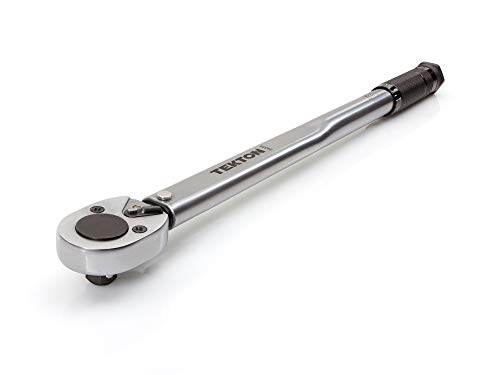
TEKTON 1/2 Inch Drive Micrometer Torque Wrench (24335)
Specs
- Type: Click, micrometer style
- Drive: 1/2 inch
- Range: 10 to 150 ft-lb (13.6 to 203.5 Nm)
- Accuracy: Plus or minus 4 percent, as TEKTON states
- Ratchet: 24-tooth, reversible, chrome vanadium steel
- Length: 18-3/8 inches
- Construction: All steel, no plastic parts
- Includes: Storage case and manual with torque conversion chart
This is the general-purpose pick for wheels and chassis work. Its 10 to 150 ft-lb range covers the lug nut specifications of most cars and many light trucks, along with suspension and brake bracket bolts. The dual-range scale is printed in high contrast so it stays readable in poor light, and the all-steel build has no plastic parts to crack if the wrench is dropped in a driveway.
The ratchet head drives in both directions, but the wrench measures torque in the clockwise direction only, as TEKTON describes it. Following the maker’s manual, store it wound down to its lowest setting of 10 ft-lb. Skip this one if your vehicle’s lug specification runs above 150 ft-lb, or if most of your work is small engine hardware that calls for inch-pound values.
TEKTON 3/8 Inch Drive Micrometer Torque Wrench (24330)

Specs
- Type: Click, micrometer style
- Drive: 3/8 inch
- Range: 10 to 80 ft-lb (13.6 to 108.5 Nm)
- Accuracy: Plus or minus 4 percent, as TEKTON states
- Ratchet: 24-tooth, reversible, chrome vanadium steel
- Length: 14.5 inches
- Construction: All steel
- Includes: Storage case and manual with torque conversion chart
The 3/8-inch size is the one many mechanics reach for most often, because so many engine and chassis specifications land between 10 and 80 ft-lb: intake manifold bolts, caliper bracket bolts, transmission and oil pan fasteners, and similar hardware. At 14.5 inches long, this wrench is noticeably easier to swing in a crowded engine bay than a full-size 1/2-inch model.
Like the other TEKTON click wrenches here, it ships calibrated and ready to use, with a dual-range scale marked in ft-lb and Nm. Wind it back to its lowest setting before putting it in its case. If your work regularly goes past 80 ft-lb, pair it with the 1/2-inch wrench above rather than forcing this one to the top of its scale.
TEKTON 1/4 Inch Drive Micrometer Torque Wrench (24320)

Specs
- Type: Click, micrometer style
- Drive: 1/4 inch
- Range: 20 to 200 in-lb (2.26 to 22.6 Nm)
- Increment: 1 in-lb
- Accuracy: Plus or minus 4 percent, as TEKTON states
- Ratchet: 24-tooth, reversible, chrome vanadium steel
- Length: 10-7/8 inches
- Includes: Storage case and manual with torque conversion chart
Small fasteners are easy to ruin with a big wrench, and this inch-pound model exists for exactly that work: spark plugs, valve covers, oil and transmission pan bolts, motorcycle hardware, and bicycle components. Its 20 to 200 in-lb range reads in fine 1 in-lb increments, and the compact 10-7/8 inch body fits where a longer wrench cannot swing.
One caution matters more here than any feature: inch-pounds are not foot-pounds. Twelve inch-pounds equal one foot-pound, so confusing the two units produces a twelvefold error. TEKTON’s manual also advises pulling slowly at low settings, where the click is subtle. Store it at its lowest setting of 20 in-lb, as the maker directs.
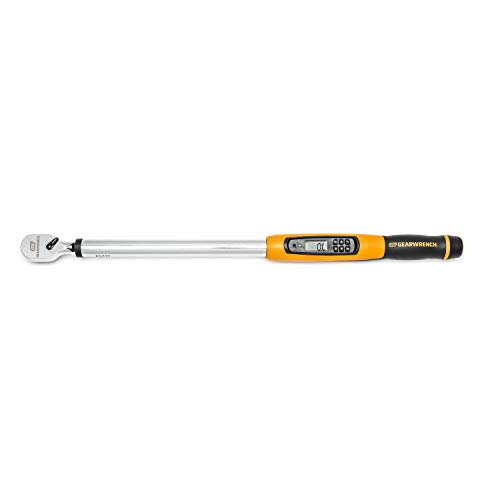
GEARWRENCH 1/2 Inch Drive Electronic Torque Wrench (85077)
Specs
- Type: Electronic, digital display
- Drive: 1/2 inch
- Range: 25 to 250 ft-lb (30 to 340 Nm)
- Accuracy: Plus or minus 2 percent clockwise and plus or minus 3 percent counterclockwise, between 20 and 100 percent of capacity, as GEARWRENCH states
- Ratchet: 72-tooth, 5-degree swing arc
- Units: ft-lb, in-lb, Nm, kgf-m, and kgf-cm
- Alerts: Target Torque Alert with vibrating handle, buzzer, and LED indicator
- Power: 2 AA batteries
- Standard: Meets ASME B107.28M, as the maker states
A digital wrench removes scale-reading from the job entirely. You set the target on the display, and the Target Torque Alert warns you as you approach it, then signals with vibration, sound, and light when you arrive. The 72-tooth ratchet needs only a 5-degree swing, which helps in tight engine bays, and the five selectable units mean metric specifications need no manual conversion.
The 25 to 250 ft-lb range reaches the higher lug and suspension specifications the TEKTON 24335 stops short of. GEARWRENCH guarantees the calibration accuracy for 90 days and covers the wrench with a one-year limited warranty, per the maker’s listing. The trade-offs are batteries to replace and a higher price than any click wrench here, so it suits frequent users better than occasional ones.
Precision Instruments 1/2 Inch Drive Split Beam Torque Wrench (PREC3FR250F)

Specs
- Type: Split beam
- Drive: 1/2 inch
- Range: 40 to 250 ft-lb
- Increments: 5 ft-lb
- Accuracy: Within 4 percent of the setting from 20 percent of full scale to full scale, as Precision Instruments states
- Head: Flex ratchet head
- Direction: Clockwise only
- Origin: Made in the USA, per the maker
The split-beam design replaces the coil spring of a click wrench with a split beam mechanism, and that changes daily life with the tool. Because no spring sits under tension, Precision Instruments designs this wrench to be left at its setting after use instead of wound back down, and the maker notes that users do not need to reset it to the bottom of the scale for storage. That makes it a strong fit for shared shops and anyone who torques the same specification repeatedly, such as fleet wheels.
The flex head angles to reach fasteners a fixed head cannot square up on, and the long body gives the leverage the 40 to 250 ft-lb range demands. Settings change in 5 ft-lb increments, coarser than a micrometer click wrench, and the wrench measures in the clockwise direction only. Skip it if most of your work falls below 40 ft-lb.
Comparison
For wheel and general chassis work on a budget, the TEKTON 24335 is the straightforward choice, and the 24330 and 24320 extend the same approach down to mid-range and inch-pound fasteners. The GEARWRENCH 85077 costs more but adds a digital readout, tighter maker-stated accuracy, and alerts you cannot miss in a noisy shop. The Precision Instruments PREC3FR250F is the pick when the wrench will be used constantly and left set to one value, thanks to a design that skips the wind-down routine entirely.
| Product | Type | Drive | Maker-Stated Range |
|---|---|---|---|
| TEKTON 24335 | Click | 1/2 inch | 10 to 150 ft-lb |
| TEKTON 24330 | Click | 3/8 inch | 10 to 80 ft-lb |
| TEKTON 24320 | Click | 1/4 inch | 20 to 200 in-lb |
| GEARWRENCH 85077 | Electronic | 1/2 inch | 25 to 250 ft-lb |
| Precision Instruments PREC3FR250F | Split beam | 1/2 inch | 40 to 250 ft-lb |
FAQ
What size torque wrench do I need for lug nuts?
Most car and SUV lug nut specifications fall inside a 1/2-inch drive wrench’s range, so check the value in your vehicle maker’s manual and choose a wrench whose scale puts that value comfortably in its middle. The TEKTON 24335 covers 10 to 150 ft-lb, while the GEARWRENCH 85077 and Precision Instruments PREC3FR250F reach 250 ft-lb for heavier trucks.
How often should a torque wrench be recalibrated?
Makers recommend periodic calibration, commonly every 12 months or after roughly 5,000 cycles of use, and sooner if the wrench is dropped. Follow the interval printed in your wrench’s manual, and treat the tool as a measuring instrument: if its history is unknown, a calibration check is the only way to know what it is actually applying.
Can I use a torque wrench to loosen bolts?
Not unless the maker rates that model for reverse torque. A torque wrench is built and calibrated to tighten, and using one as a breaker bar can damage the mechanism and shift its calibration. Break fasteners loose with a breaker bar or a standard ratchet, then switch to the torque wrench for final tightening.
Should I store a click wrench at its lowest setting or at zero?
Store it at its lowest marked setting, not below it. TEKTON’s manuals direct owners to wind the wrench back to the bottom of its scale, 10 ft-lb on the 24335 and 20 in-lb on the 24320, so the spring rests without tension. Split-beam wrenches are the exception: Precision Instruments designs its split-beam models to be stored at whatever setting was last used.
Final Verdict
Most home mechanics should start with the TEKTON 24335 for wheels and chassis work, then add the 24320 when small fasteners enter the picture; the 24330 fills the middle ground for engine work. Choose the GEARWRENCH 85077 if you want a digital readout, approach warnings, and the tightest accuracy figures any maker in this group publishes. Choose the Precision Instruments PREC3FR250F if the wrench will live in a busy shop and stay set to one value. Whichever you buy, take the torque figure from the vehicle or equipment maker’s specification, store and calibrate the wrench the way its maker directs, and it will do its one job reliably.
Product and ASIN Reference
| Product | ASIN |
|---|---|
| TEKTON 1/2 Inch Drive Micrometer Torque Wrench (24335) | B00C5ZL0RU |
| TEKTON 3/8 Inch Drive Micrometer Torque Wrench (24330) | B00FMPKAD0 |
| TEKTON 1/4 Inch Drive Micrometer Torque Wrench (24320) | B00C5ZL2EG |
| GEARWRENCH 1/2 Inch Drive Electronic Torque Wrench (85077) | B01AY0JG0U |
| Precision Instruments 1/2 Inch Drive Split Beam Torque Wrench (PREC3FR250F) | B002XMSFIM |
More from Amazon
Programs that pair well with the guide above. Offers and eligibility are set by Amazon and may change.
Free shipping on eligible items, Prime Video and more. Eligible new members can start with a free trial.
Start a Prime free trialAudiobooks and podcasts to listen to on the go. Eligible new members can start with a free trial.
Try Audible freeAd-free music streaming. Eligible new subscribers can start with a free trial.
Try Music Unlimited freeA free business account with business pricing and bulk-buying tools for work, shop or home office.
Create a business accountAs an Amazon Associate we earn from qualifying purchases.



Write Your Review
No reviews yet. Be the first to share your experience!