
Key takeaways
- Compare the best basin wrenches for faucet nuts, with telescoping and fixed shafts, jaw capacities, and under-sink safety steps for a clean swap.
The nuts that hold a faucet to the sink deck sit in one of the worst spots in the house: behind the basin, above the cabinet floor, and usually flanked by supply lines and a drain tailpiece. A regular wrench cannot swing in that space, and pliers rarely reach it. A basin wrench solves the problem with a long shaft and a spring-loaded, pivoting jaw that climbs up behind the basin, grips the mounting nut, and ratchets it loose or snug from below.
This guide compares five basin wrenches from RIDGID, TEKTON, Superior Tool, ARES, and HAUTMEC, covering telescoping shafts for deep cabinets and fixed shafts for shallower ones. Each pick lists the jaw capacity, shaft length, and materials its maker publishes, so you can match the tool to the nut under your sink before you order. The buying notes also include a short safety routine, because every faucet swap starts with the water turned off.
As an Amazon Associate, we earn from qualifying purchases.
Quick answer
For most faucet swaps, pick a telescoping model with a jaw that covers 3/8 to 1-1/4 inches, such as the RIDGID 31175 Model 1017 or the HAUTMEC PL0025 Pro, and extend the shaft to suit your cabinet depth. For shallow vanities, a fixed 11-inch wrench like the TEKTON WRN92001 or ARES 33004 is simpler and easier to control.
How to choose a basin wrench
Match the jaw capacity to your nuts
Jaw capacity is the range of nut sizes the spring-loaded jaw can grip, and it decides whether the tool fits your faucet at all. Most faucet mounting nuts and supply-line nuts fall between 3/8 inch and 1-1/4 inches, which is why so many basin wrenches are rated for exactly that span. Measure or check the faucet maker’s documentation for your mounting nut size before buying. A jaw rated only to 1 inch, like the TEKTON and Superior Tool picks below, handles many bathroom faucets but can come up short on larger kitchen hardware, while a 1-1/4 inch jaw covers a wider share of residential fittings.
Telescoping or fixed shaft
A telescoping shaft adjusts to the depth of the cabinet, so one tool covers a shallow vanity and a deep farmhouse sink. RIDGID and HAUTMEC both rate their telescoping models from 10 to 17 inches. A fixed shaft, usually 11 inches, has no sliding joint to flex under load and feels more direct on a stubborn nut, but it cannot reach hardware set far behind a deep basin. Choose based on the deepest sink you realistically expect to work on.
Head pivot and handle
The head needs to pivot so the jaw can meet a nut that sits at an angle behind the basin. Makers rate pivot ranges differently: RIDGID holds its head at any angle up to 90 degrees with a tension plug, while TEKTON and ARES rate their heads to 180 degrees. A sliding T-handle at the base of the shaft gives leverage and can be shifted to clear a cabinet wall or a shutoff valve mid-turn.
Before you start: the safety routine
Shut off the water supply at the angle stops or the main valve, and open the faucet to relieve pressure before disconnecting any supply line. Keep a bucket and a towel under the sink to catch the residual water that drains from the lines and the trap area. Wear eye protection against drips and debris while working under a sink, since you will be looking up at the fittings. Finally, have a helper support the faucet body from above, or brace it yourself, so it cannot twist while the nut is broken loose from below.
1. RIDGID 31175 Model 1017 Telescoping Basin Wrench

The Model 1017 is RIDGID’s telescoping basin wrench, catalog number 31175, and it is the reference design in this category. RIDGID rates the spring-loaded jaw for nuts from 3/8 inch to 1-1/4 inches, and the shank telescopes from 10 to 17 inches, so it reaches mounting nuts set deep behind large sinks. A tension plug lets the head hold its position at any angle up to 90 degrees, which keeps the jaw seated on the nut between ratcheting strokes instead of flopping away each time you reset your grip.
Specs
- Maker: RIDGID
- Model: 31175, Model 1017
- Jaw capacity: 3/8 to 1-1/4 inches, per RIDGID
- Shaft: telescoping, 10 to 17 inches
- Head: pivoting, holds position up to 90 degrees with tension plug
- Jaw action: spring-loaded, one-hand ratcheting
- Construction: forged alloy steel jaws, per RIDGID
This is the pick for anyone who expects to swap faucets in more than one bathroom or kitchen over the years. The capacity range covers the standard mounting nuts on most residential faucets, and the adjustable length means it stays useful when the next sink is deeper than the last one.
2. HAUTMEC PL0025 Pro Telescoping Basin Wrench

The PL0025 Pro is HAUTMEC’s telescoping entry, built around a chrome-plated hardened steel shaft that extends from 10 to 17 inches in four locked positions. HAUTMEC rates the spring-loaded, self-adjusting jaws for nuts from 3/8 inch to 1-1/4 inches, the same span as the RIDGID above, and the pivoting head lets the jaw approach nuts that sit at an angle behind the basin. At about 1.5 pounds by the maker’s figures, it is a midweight tool that still maneuvers easily inside a crowded cabinet.
Specs
- Maker: HAUTMEC
- Model: PL0025 Pro
- Jaw capacity: 3/8 to 1-1/4 inches, per HAUTMEC
- Shaft: telescoping, 10 to 17 inches, four positions
- Head: pivoting, spring-loaded self-adjusting jaws
- Construction: hardened steel shaft with chrome plating, per HAUTMEC
- Weight: about 1.5 pounds, per HAUTMEC
Choose this one if you want telescoping reach and the full 1-1/4 inch jaw span at the lighter end of the category. The four set lengths give repeatable positioning, so the shaft length you pick at the start of a turn is the length you still have at the end of it.
3. TEKTON WRN92001 Basin Wrench

The WRN92001 is TEKTON’s fixed-shaft basin wrench, and its simplicity is the point. TEKTON rates the spring-loaded jaw for nuts from 3/8 inch to 1 inch, and the head tilts a full 180 degrees, so the jaw can flip to work on either side of a fitting or fold back along the shaft for storage. The fixed shaft is 11 inches long with a sliding T-handle for leverage, and TEKTON lists the tool at 1.08 pounds, light enough to control with one hand while the other hand steadies the jaw on the nut.
Specs
- Maker: TEKTON
- Model: WRN92001
- Jaw capacity: 3/8 to 1 inch, per TEKTON
- Shaft: fixed, 11 inches
- Head: tilts 180 degrees
- Jaw action: spring-loaded
- Handle: sliding T-handle
- Weight: 1.08 pounds, per TEKTON
This wrench suits bathroom vanities and pedestal sinks where the mounting nuts sit within easy reach and rarely exceed 1 inch. If your faucet hardware runs larger, step up to one of the 1-1/4 inch models above instead of forcing a jaw past its rated capacity.
4. ARES 33004 Basin Wrench
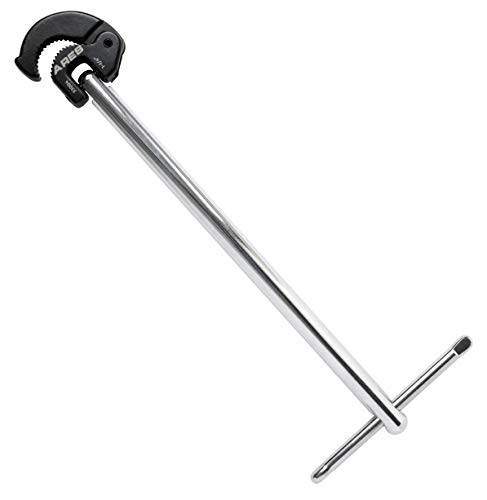
The ARES 33004 pairs a fixed 11-inch shaft with a wider jaw than the other fixed-shaft pick here. ARES rates the spring-loaded jaw from 3/8 inch to 1-1/4 inches, and the head pivots up to 180 degrees to hold its angle in tight spots. The shaft and jaw are chrome vanadium steel by the maker’s description, with a forged steel jaw, and a sliding T-handle provides the turning leverage. ARES lists the weight at about 1.11 pounds, so it stays easy to position overhead inside a cabinet.
Specs
- Maker: ARES
- Model: 33004
- Jaw capacity: 3/8 to 1-1/4 inches, per ARES
- Shaft: fixed, 11 inches
- Head: pivots up to 180 degrees
- Jaw action: spring-loaded, self-adjusting
- Construction: chrome vanadium steel shaft, forged steel jaw, per ARES
- Handle: sliding T-handle
- Weight: about 1.11 pounds, per ARES
Pick the 33004 when a fixed shaft is long enough for your sink but you still want the wider jaw span for kitchen faucet nuts. It covers the same nut range as the telescoping models without a sliding joint in the shaft.
5. Superior Tool 03811 Basin Wrench

The 03811 is Superior Tool’s slimline basin wrench, built on an 11-inch shaft that slips into narrow cabinets where bulkier telescoping bodies feel clumsy. Superior Tool rates the jaw for nuts up to 1 inch, and the head is infinitely adjustable, so it can be set at whatever angle the fitting demands rather than at fixed stops. Retailer listings describe stainless steel construction and a sliding T-handle about 4-1/2 inches long for turning leverage in close quarters.
Specs
- Maker: Superior Tool
- Model: 03811
- Jaw capacity: up to 1 inch, per Superior Tool
- Shaft: fixed, 11 inches, slimline profile
- Head: infinitely adjustable pivot
- Jaw action: spring-loaded
- Handle: sliding T-handle
- Construction: stainless steel, per retailer listings
This is the wrench for shallow, crowded vanities where the mounting nuts are small and the working room is the real constraint. Its 1-inch ceiling makes it a poor match for larger kitchen hardware, so check your nut size first, as with the TEKTON above.
How the five compare
The five wrenches divide cleanly into two camps. The RIDGID 31175 and HAUTMEC PL0025 telescope from 10 to 17 inches and grip nuts to 1-1/4 inches, which makes them the flexible choices for mixed work across deep and shallow sinks. The TEKTON WRN92001, ARES 33004, and Superior Tool 03811 use fixed 11-inch shafts that feel more direct under load and store in less space. Within the fixed group, the ARES stands out with a 1-1/4 inch jaw, while the TEKTON and Superior Tool trade capacity for lighter weight and a slimmer profile, topping out at 1 inch. Head design differs too: the RIDGID holds its angle with a tension plug up to 90 degrees, the TEKTON and ARES heads swing 180 degrees, and the Superior Tool head adjusts to any angle. None of these tools replaces a full faucet installer kit with tab sockets, but for the mounting nuts themselves, one of the five will match nearly any residential sink.
Frequently asked questions
What size basin wrench do I need for a kitchen faucet?
Most kitchen faucet mounting nuts fall within the 3/8 to 1-1/4 inch range that the RIDGID, HAUTMEC, and ARES models cover. Check the faucet maker’s documentation for your model, since some large single-hole faucets use wider retaining nuts. If your nut measures over 1 inch, skip the TEKTON and Superior Tool picks, which are rated to 1 inch.
Can a basin wrench remove a faucet by itself?
It handles the mounting nuts under the sink, which is the step that stops most faucet swaps. You still need to shut off the water supply and open the faucet to relieve pressure before disconnecting any supply line, and the supply lines themselves usually unthread by hand or with a small adjustable wrench once the stops are closed. Support the faucet body from above while the last nut comes off so the faucet does not twist or drop.
Why does the jaw only grip in one direction?
Basin wrench jaws are spring-loaded with angled teeth that bite when the shaft turns one way and ratchet back when it reverses, which is what allows one-hand operation in a space where you cannot swing a full turn. To switch from loosening to tightening, flip the head over so the jaw faces the other way, following the maker’s instructions for your model.
How do I keep the wrench from slipping on an old, corroded nut?
Seat the jaw fully on the nut flats before you pull, keep the shaft aligned so the head stays at its set angle, and apply steady pressure through the T-handle instead of jerking it. A bucket and towel under the sink, plus eye protection against drips and debris, make the job easier to manage while you work. If the nut will not move with firm, steady force, stop and reassess rather than leaning harder on a tool past its rated capacity.
Final verdict
For a single basin wrench that covers the widest range of home faucet work, the RIDGID 31175 Model 1017 is the safest choice: its telescoping shaft and 1-1/4 inch jaw handle deep cabinets and standard mounting nuts alike. The HAUTMEC PL0025 Pro matches that reach and capacity at a lighter weight. If your work is mostly bathroom vanities with smaller nuts, the TEKTON WRN92001, ARES 33004, or Superior Tool 03811 will do the job with a simpler fixed shaft. Match the jaw capacity to your faucet first, and the rest of the decision is about cabinet depth.
Product and ASIN Reference
| Product | ASIN |
|---|---|
| RIDGID 31175 Model 1017 Telescoping Basin Wrench | B0009W6THM |
| HAUTMEC PL0025 Pro Telescoping Basin Wrench | B072QD5D3F |
| TEKTON WRN92001 Basin Wrench | B01D4ZF0HA |
| ARES 33004 Basin Wrench | B0849XLBQ7 |
| Superior Tool 03811 Basin Wrench | B0000CBJD4 |
FAQ
What size basin wrench do I need for a kitchen faucet?
Can a basin wrench remove a faucet by itself?
Why does the jaw only grip in one direction?
How do I keep the wrench from slipping on an old, corroded nut?
More from Amazon
Programs that pair well with the guide above. Offers and eligibility are set by Amazon and may change.
Free shipping on eligible items, Prime Video and more. Eligible new members can start with a free trial.
Start a Prime free trialAudiobooks and podcasts to listen to on the go. Eligible new members can start with a free trial.
Try Audible freeAd-free music streaming. Eligible new subscribers can start with a free trial.
Try Music Unlimited freeA free business account with business pricing and bulk-buying tools for work, shop or home office.
Create a business accountAs an Amazon Associate we earn from qualifying purchases.






Write Your Review
No reviews yet. Be the first to share your experience!