
Key takeaways
- Corded snow blowers for homes with outdoor outlets: match outlet position, cord length and clearing width so every zone clears without crossing the cord.
Outdoor outlets are what make a corded snow blower a sensible purchase instead of a compromise. Where they sit — beside the garage door, on the porch, on a side wall — decides which areas clear in one relaxed cord run and which become a wrestling match with a cable that is always slightly too short. The buying decision therefore starts with a walk around the house, not with motor sizes: map the outlets first, then choose the machine whose width and weight suit the zones those outlets can actually serve.
This guide is for households that already have outdoor outlets, or can see exactly where one would go, and want clearing power without fuel storage or battery routines. The three picks are taken from the names and specifications on their Amazon listings: two full-width single-stage blowers and one light powered shovel for the zones a big machine handles badly. Outlet layout, cord planning and clearing pattern tie them together.
Quick Picks
As an Amazon Associate we earn from qualifying purchases
| Product | Best for | Key spec from title |
|---|---|---|
| Snow Joe SJ627E 22-Inch Electric Snow Blower | A garage-front outlet serving the whole driveway | 22 in, 15-amp, throw up to 25 ft |
| Earthwise SN70016 16-Inch Corded Snow Shovel | Porch and side outlets covering walks and steps | 16 in, 12-amp, 15.95 lb |
| Snow Joe SJ625E 21-Inch Electric Snow Blower | A second zone cleared from a side-wall outlet | 21 in, 15-amp, steel auger with rubber blades |
How to Choose
Map every outdoor outlet before you shop
Walk the outside of the house and note each outlet’s position, height and condition: garage front, porch, side wall, back patio. For each one, pace out the area it could serve and check that a cord run from it reaches the far corner of that zone with slack left over. Many homes discover their outlets cluster on one face of the house, leaving the far side unserved. That map, not the catalogue, decides whether one machine and one cord suffice or whether a second, lighter tool for the awkward zone makes more sense.
Plan a clearing pattern that never crosses the cord
A corded machine should always work away from its outlet in rows, throwing snow forward or to one side, with the cord trailing behind over ground already cleared. The pattern to avoid is any route that loops back across the cable or leaves the cord lying in uncleared snow ahead of the auger. Sketch the row direction for each outlet zone before the first storm: start nearest the outlet, work outward, and finish at the far edge so the walk back crosses only clean pavement. This habit matters more than any single specification.
Match cord gauge to the longest run each outlet demands
Each zone has its own worst-case distance, and the cord has to suit the longest one, not the average. Longer runs need a heavier gauge to deliver the machine’s 12 or 15 amps without the cord heating up or the motor losing strength at the far end. Measure from the outlet to the farthest corner, add turning slack, and buy for that figure. A cord that is adequate for the porch zone may be undersized for the driveway zone even on the same house, so treat the two runs as separate purchases if the distances differ greatly.
Decide between one long cord and one outlet per zone
Two strategies work. A single long cord from one well-placed outlet keeps the kit simple and the storage easy, but every zone inherits that outlet’s geometry, including any awkward angles. Using several outlets, one per zone, shortens each run and keeps cords lighter and easier to handle, at the cost of moving the machine and replugging between zones. Homes with a garage-front outlet usually clear the drive from it and switch to a porch outlet for the front walk, which is why a light second tool appears in this guide.
The 3 Best Options
Snow Joe SJ627E 22-Inch Electric Snow Blower

The SJ627E is the anchor machine for a garage-front outlet: a 22-inch clearing path, 13-inch depth and a 15-amp motor with a steel auger, rated on its listing at up to 25 tons per hour with a throw of up to 25 feet. From an outlet beside the garage door, that width turns most driveways into a short set of outward rows, and the dual LED lights cover the dark early starts that storms tend to demand. At 34.8 pounds it lives by the garage door, which is precisely where its outlet is, so the weight rarely becomes a carrying problem.
Specs
- Model: SJ627E
- Clearing path: 22 x 13 in
- Motor: 15-amp
- Capacity: Up to 25 tons/hr
- Throw distance: Up to 25 ft
- Auger: Steel
- Lights: Dual LED
- Certification: ETL (spec field)
- Weight: 34.8 lb
Best for: Driveways served by a garage-front outlet, cleared in outward rows with the cord trailing behind.
Watch out for: Its weight and size suit one home zone; hauling it around the house to a side outlet for a second zone gets old quickly.
ASIN: B075NMXLSS
Earthwise SN70016 16-Inch Corded Snow Shovel
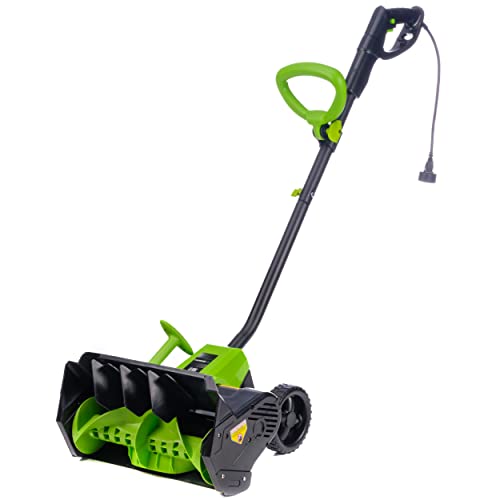
The SN70016 is the zone-two specialist, built for the outlets that serve walks, porches and side paths rather than the main driveway. It clears 16 inches wide and 8 inches deep, moves 430 pounds of snow per minute on its listing figures, and throws up to 30 feet, the longest throw listed here, which helps a narrow walk shed snow well past its edges. At 15.95 pounds on 6-inch wheels it is easy to carry from a porch outlet to the path it serves, and its 12-amp draw is the lightest load in this guide.
Specs
- Model: SN70016
- Type: Corded snow shovel
- Clearing width: 16 in
- Clearing depth: 8 in
- Motor: 12-amp, 120V
- Capacity: 430 lb/min
- Throw distance: Up to 30 ft
- Weight: 15.95 lb
- Wheels: 6 in
Best for: Front walks, porches and side paths cleared from their own nearby outlet.
Watch out for: Snow deeper than its 8-inch clearing depth needs two shallower passes, and the narrow width makes it a slow choice for a full driveway.
ASIN: B073V482GY
Snow Joe SJ625E 21-Inch Electric Snow Blower

The SJ625E suits the household whose second real zone — a side drive, a parking pad, a long path to a detached garage — has its own side-wall outlet and deserves a full machine rather than the shovel. Its 15-amp motor drives a steel auger with two rubber blades across a 21-inch path and 12-inch depth, rated at up to 800 pounds per minute with a throw of up to 20 feet. The rubber blades clear close to paved surfaces, and a 3W LED light covers dim side yards. Kept near its own zone, it avoids dragging the main blower around the house.
Specs
- Model: SJ625E
- Clearing path: 21 x 12 in
- Motor: 15-amp
- Capacity: Up to 800 lb/min
- Throw distance: Up to 20 ft
- Auger: Steel auger with 2 rubber blades
- Light: 3W LED
- Certification: ETL-approved (listing text)
Best for: A second paved zone with its own outlet, where close clearing on smooth pavement matters.
Watch out for: The 20-foot throw is the shortest here, so aim rows toward the nearest edge instead of throwing across wide paved areas.
ASIN: B00W8YAVRS
Which One Fits Your Situation
Your only good outlet is on the front of the garage
Make the SJ627E the single machine and clear everything in outward rows from that outlet. Its 22-inch width finishes the driveway quickly, and the front walk can be done on the same run if the cord reaches with slack. This is the simplest layout, and the one where cord length deserves the most careful measuring before you buy.
A porch outlet serves the front walk and steps
Give that zone the Earthwise SN70016. It is light enough to store by the door it serves, narrow enough for walks and landings, and its long throw clears snow well away from edges people walk on. The driveway keeps its own machine and outlet, and neither tool has to travel around the house.
Outlets on two sides of the house, two paved zones
Split the work: the SJ627E on the driveway outlet and the SJ625E stored near the side zone it clears. Each machine works a short run from its own outlet, cords stay shorter and lighter, and the rubber-bladed SJ625E keeps the side pad or path scraped close. Replugging disappears because nothing moves between zones mid-job.
One outlet, positioned at the back of the garage
Treat this as a range problem first. Measure honestly to the driveway’s far corner; if the run leaves no turning slack, the SN70016’s lighter 12-amp draw and easy carrying make partial clearing from the door outward more practical than muscling a full-size blower at the end of a taut cord. An exterior outlet nearer the drive is the real fix.
Common Mistakes
- Buying the blower first and discovering afterwards that the only outdoor outlet cannot serve the driveway with any slack in the cord.
- Running one undersized cord across every zone because it happens to reach, even though the longest run needs a heavier gauge.
- Clearing in a loop that brings the machine back across its own cord, or letting the cord rest in uncleared snow ahead of the auger.
- Leaving the plug connection lying in slush at the base of the wall, where meltwater pools, instead of keeping it raised and covered.
- Assuming a porch outlet and a garage outlet are interchangeable, then finding the porch circuit shares power with indoor loads that trip it mid-clearing.
Safety First
- Test each outdoor outlet’s GFCI protection before the season; press the test and reset buttons so a fault found in November is not discovered during a January storm.
- Keep the plug connection off wet ground, and use an in-use weatherproof outlet cover so the connection stays dry while the machine is plugged in and running.
- Use a cord of the correct gauge for its length and the machine’s amp rating; a cord that feels warm during use is undersized and should be replaced with a heavier one.
- Unplug the machine fully before checking the auger, clearing the chute or inspecting the cord, every time, even for a quick look.
- Keep the cord routed behind the machine over cleared ground, and stop immediately if it is nicked or cut, replacing it rather than continuing.
Frequently Asked Questions
How far from an outlet can a corded snow blower work?
As far as a properly rated outdoor cord reaches with slack for turning at the end of each row, and no farther. In practice the limit is set by cord length and gauge together: longer runs need heavier gauge to carry a 15-amp load safely. Measure your farthest corner, add slack, and let that number, not optimism, size the cord.
Can I run the blower from an indoor outlet through a window?
It is a poor substitute. A cord pinched in a window frame gets damaged insulation, the opening lets weather in, and indoor outlets may lack the GFCI protection outdoor clearing calls for. These machines are planned around outdoor outlets for a reason. If none serves your driveway, having one fitted near the garage is the durable answer rather than a season of workarounds.
Do different zones of my house need different cords?
Often, yes. The cord must suit the longest run and the machine plugged into it: a short porch run for the 12-amp Earthwise and a long driveway run for a 15-amp Snow Joe are different jobs. Rather than one compromise cord stretched everywhere, many households keep a shorter cord by the porch outlet and the heavier one in the garage.
What if my outdoor outlet has no GFCI protection?
Treat that as a pre-season fix, not a detail. Outdoor outlets serving equipment used on wet ground should have ground-fault protection, and a non-protected or failed outlet should be replaced or fitted with protection before the blower comes out. Test the protection at the start of the season and after any tripped event, and stop using an outlet that will not reset properly.
FAQ
How far from an outlet can a corded snow blower work?
Can I run the blower from an indoor outlet through a window?
Do different zones of my house need different cords?
What if my outdoor outlet has no GFCI protection?
More from Amazon
Programs that pair well with the guide above. Offers and eligibility are set by Amazon and may change.
Free shipping on eligible items, Prime Video and more. Eligible new members can start with a free trial.
Start a Prime free trialAudiobooks and podcasts to listen to on the go. Eligible new members can start with a free trial.
Try Audible freeAd-free music streaming. Eligible new subscribers can start with a free trial.
Try Music Unlimited freeA free business account with business pricing and bulk-buying tools for work, shop or home office.
Create a business accountAs an Amazon Associate we earn from qualifying purchases.

Write Your Review
No reviews yet. Be the first to share your experience!